Home Blog Page 364

Arab shirt shops create sustainable T-shirts

0

Jordan-tee-shirtsFour small businesses, starting as street vendors, offer up made-in-Jordan artwork with heart. 

I’m a gift-giving locavore, preferring artifacts sourced or created wherever I happen to call home. Jordan offers amazing experiences ranging from ancient sites to eco-tours, but if you want a simple souvenir with youth appeal the kingdom falls flat.

I stumbled across four Amman shops offering up artful clothing and jewelry that, despite contemporary styling, scream “made-in-the-Middle-East”.  Not highbrow, but locally designed and produced by owners who are also committed to supporting regional charities.

Giant Squid Kraken Sea Monster Caught on Video

2

The journal Nature reports that a team of ocean researchers have captured the world’s first video of a giant squid (Architeuthis dux) in its natural environment. The video was captured 700 meters (2300 feet) beneath the Pacific near the Ogasawara archipelago,  about 1000 kilometers south of Tokyo Japan. The mission was funded by Japan’s NHK broadcasting commission and the US-based Discovery Channel, both of which will air programs about the giant squid encounter later this month.

Widder’s camera relied on a dim light in the red, near-infrared range. And you can see the results for yourself here:

[youtube]http://www.youtube.com/watch?v=uLRY1cNxL1I[/youtube]

Sailors have known about giant squid for centuries. But ancient whalers and fishermen didn’t carry video equipment and so their fish stories were filed with tales of dragons, mermaids and other sea monsters. The Nordic tales of a sea monster named Kraken may have been based upon rare sightings of the giant squid.

It doesn’t help our believability that these tales were often exaggerated. The Kraken was said to reside in the deep ocean and attract many fish to itself. It was said to only briefly rise to the surface. So far this sounds very much like a giant squid, but the Kraken was also said to be so large that it was sometimes mistaken for an island. Its mouth was described to gape as large as the entrance to a fjord.

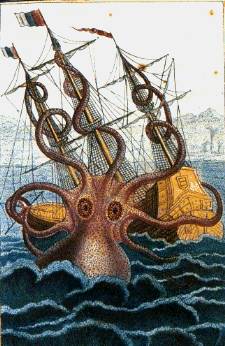
Well, fish stories are known for their exaggerations. The giant squid is estimated to grow as large as 15 meters (50 feet) in length, not quite the size of a fjord but something sure to frighten the daylights out of sailor. In his poem, The Kraken (1830), Alfred Tennyson writes:colossal octopus by pierre denys de montfort kraken giant squid
Below the thunders of the upper deep;

Far far beneath in the abysmal sea,

His ancient, dreamless, uninvaded sleep

The Kraken sleepeth: faintest sunlights flee

About his shadowy sides; above him swell

Huge sponges of millennial growth and height;

And far away into the sickly light…

In 20,000 Leagues Under the Sea, Jules Verne writes:

“I stared in my turn and couldn’t keep back a movement of revulsion. Before my eyes there quivered a horrible monster worthy of a place among the most farfetched teratological legends. It was a squid of colossal dimensions, fully eight meters long. It was traveling backward with tremendous speed in the same direction as the Nautilus. It gazed with enormous, staring eyes that were tinted sea green.

Its eight arms (or more accurately, feet) were rooted in its head, which has earned these animals the name cephalopod; its arms stretched a distance twice the length of its body and were writhing like the serpentine hair of the Furies. You could plainly see its 250 suckers, arranged over the inner sides of its tentacles and shaped like semispheric capsules. Sometimes these suckers fastened onto the lounge window by creating vacuums against it. The monster’s mouth–a beak made of horn and shaped like that of a parrot–opened and closed vertically. Its tongue, also of horn substance and armed with several rows of sharp teeth, would flicker out from between these genuine shears. What a freak of nature!”

Like the monster which attacked Captain Nemo’s submarine and the mythical Kraken, the giant squid spends much of its life in the silent darkness of the deep ocean. This is one reason so few have seen it alive. Occasionally a dead one would wash ashore but because this creature is adapted to cold high pressure water of the deep ocean, it quickly decayed on the surface as Tennyson’s poem ends:

Then once by man and angels to be seen,
In roaring he shall rise and on the surface die

Other clues to the giant squid’s existence are the scars its suckered tentacles leave on sperm whales. These squids are thought to be the only predator large enough to take on a beast of this size.

The first photograph of a giant squid in its native environment was taken by Tsunemi Kubodera of the National Science Museum in Tokyo and Kyoichi Mori of the Ogasawara Whale Watching Association in this same region of the Pacific ocean in the autumn of 2004.

The video taken by this more recent expedition relied on a camera system invented by Edith Widder, founder of the Ocean Research and Conservation Association in Fort Pierce, Florida. Widder believes that the key to this mission’s success was the focus on the squid’s keen sense of sight. Giant squids are accustomed to the darkness of the deep ocean, their eyes, the size of dinner plates, are sensitive to the dim light of bioluminescent prey, so bright camera lights would disturb it and possibly frighten it away.

Masdar Launches Plan to Desalinate Water Renewably

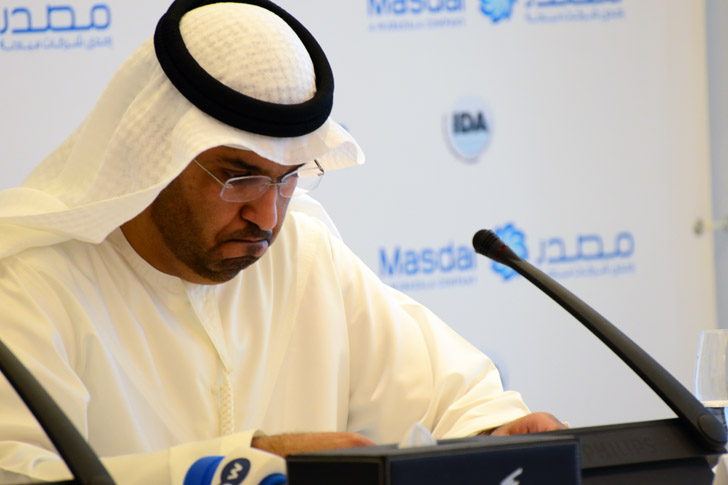
Masdar, renewable energy, desalination, water scarcity, abu dhabi, united arab emiratesMasdar held a packed press conference late last week to announce its launch of three renewably-powered desalination pilot projects. On the last day of the World Future Energy Summit in Abu Dhabi, Masdar CEO Dr. Sultan Al Jaber said that existing desalination technology will continue to “play its role,” but added that the company will also explore ways to “harness natural resources, like solar, wind, geothermal.”

Shams 1: The World’s Largest Concentrated Solar Plant Nears Completion

Masdar, clean tech, carbon capture, CCUS, Shams 1, World's largest CSP solar plant, World Future Energy Summit, Masdar Clean Energy

Abu Dhabi wants to ensure that by 2020, seven percent of the nation’s energy mix will be comprised of renewables, and Shams 1 – the world’s largest single unit concentrating solar power (CSP) plant – is about to put the emirate one step closer to this goal. A 100 MW CSP plant located 120 km southwest of the capital, Shams 1 uses parabolic trough technology to convert the sun’s energy into electricity.

The mirror troughs track the sun as it makes its way across the sky, focusing sunlight onto tubes of synthetic oil that is piped through the entire system. Heat energy from this oil is eventually transferred to water, which boils and releases steam that in turn powers a conventional steam turbine. Shams 1 also has a natural gas-fired booster that literally boosts temperatures by 140 degrees Celsius, increasing its efficiency by roughly 20 percent.

Billionaire Arab Prince Buys Planet’s Largest Private Jet

5

Prince Alwaleed bin Talal al-Saud private jet airbus 747
Look! Up in the sky! Is it an office complex? A concert hall?  A Turkish bath? Or a parking garage? No, it’s the new ride of an Arab prince – a King-sized jet – one that could hold 800 people. Will you step aboard this airborne greenhouse gas factory?

Stuffed inside the fuselage of Prince Alwaleed bin Talal al-Saud’s new Airbus A380 is all that and more; civil aviation’s largest aircraft transformed in an obscene manifestation of wealth and environmental frivolity. It begs the question, just because you can do it – should you? Call the guys at Guinness World Records back to the Middle East: the Saudi billionaire’s newest toy will be the planet’s biggest private jet.

Jordan’s Enviro-Agencies Unite!

0

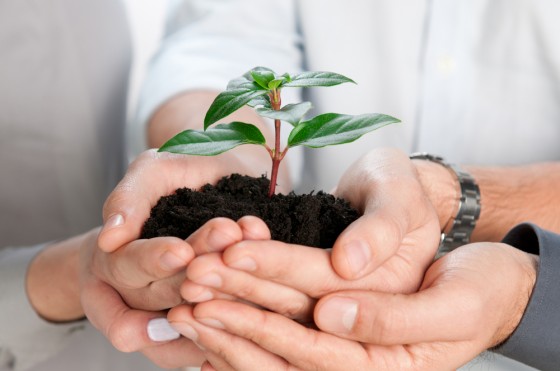
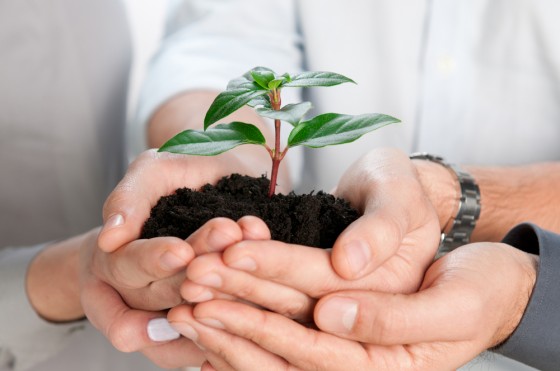
united environmentalists plant seeds and seedlings togetherJordan’s Ministry of Social Development just approved the first coalition of the kingdom’s environmental protection societies.

An underlying message of the Arab uprisings is that there’s strength in numbers and power in unity. The voice of Jordan’s disparate nature and environmental entities is about to change, when they join up as the kingdom’s new Environmental Societies Union (ESU).

Members will participate in setting national environment policy, work to raise public awareness, and seek to institutionalize the kingdom’s environmental work.

They include:

Spokesperson Omar Shoshan said, “The ESU seeks to unite organizations working in environment-related fields when rallying support for an environmental cause.” The union can amplify support for shared interest initiatives.

The nascent coalition has already proved influential  Last December, they held a press conference to oppose government plans to merge the Ministry of Environment with the Ministry of Municipal Affairs. That plan was intended to reduce state expenditure.

“The campaign bore fruit as the government rescinded the decision to merge the two ministries earlier this month,” said Shoshan.

Specific missions and plans are under development: the coalition will be officially launched later this year, Shoshan told The Jordan Times.

Climate Change Contributing to Mali-Algeria Conflict

2

climate change mali algeria drought libya politics environmentAccording to experts, climate change and rising food insecurity are major contributors to the recent destabilization of Mali and southern Algeria

Over the last couple of years, there has been a growing link between climate change and political issues in the Middle East. During the Arab Spring there was a real recognition that rising food prices caused by droughts in Russia and the US brought ordinary people to the streets in protests like never before. In Syria, poor water policies were held up as a major contribution to the drought which forced 500,000 Syrians to flee their homes. Now, experts state that global warming is also playing a role in the destabilization of Mali and southern Algeria which has hit the news.

TEDxAmman – Mohammed Asfour’s Green Message

1

Mohammed Asfour at tedx jordanThe chairman of the Jordan Green Building Council Mohammad Asfour tells us why nature inspires him to deliver a practical message of action

If you have been keeping an eye on the green scene in Jordan, then there’s no chance that you could have missed Mohammed Asfour. As well as the chairman of the Jordan Green Building Council, Asfour is a talented photographer with a great eye for nature and the skill to be able to capture its beauty. At the latest TEDxAmman talks hosted in Jordan, Asfour delivered a personal presentation about his early foray in environmental action and how the country could take action on climate change.

Join Jerusalem’s Critical Mass Biking Event this Friday

0

critical mass cycling in Jerusalem
For the two years I lived in Jerusalem, I tried to bike with my crappy communist throwback – a mini gearless green metallic wonder that I bought for the flat streets of Tel Aviv. The bike looked too pitiful to steal and that’s why it suited my tastes. Transplanted to Jerusalem, the labyrinth of hilly neighborhoods, lack of bike lanes, raised curbs and pedestrian walkways made out of several stories-worth of stairs became a nightmare for me and my sorry bike. I chose to walk bus or take taxis instead. We parted ways by my neglect. Eventually the bike was crushed by a car trying to park on a sidewalk – also too typical for Israeli cities.

While my glutes got a work-out, I dreaded biking into the city center from Rehavia where I lived. Yet, despite the discomfort on your bum muscles, cycling can be a great way to enjoy Jerusalem, especially if your bike is  a mountain or city bike with multiple gears to help you get up steep hills, possibly in the snow. One past Green Prophet writer Michael Green, now living in the UK, was a big fan of cycling in Jerusalem, and wrote about cycling in the historic city here – The Cycling Nightlife of Jerusalem.

Jordan and Masdar Ink Clean Energy Deal

2

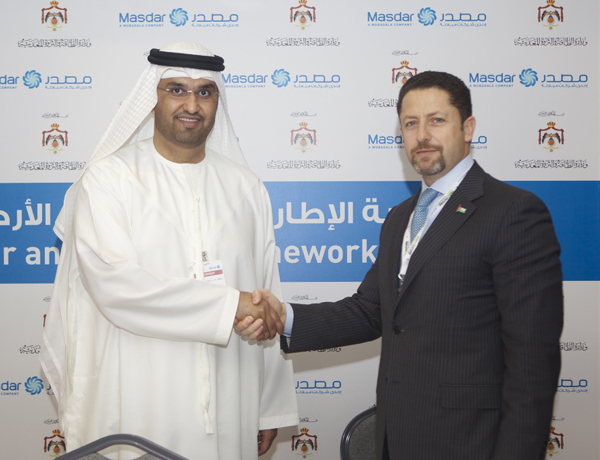
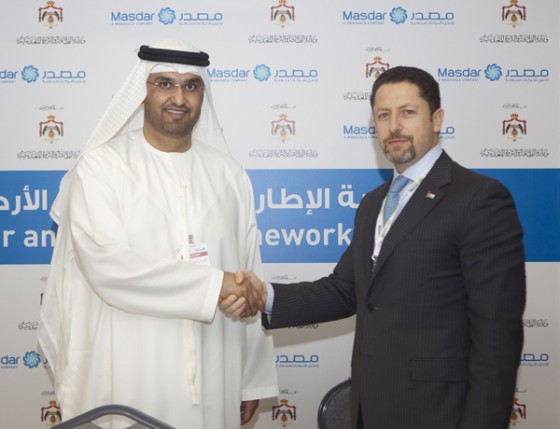
Alaa Batayneh with Masdar CEO Sultan Ahmed Al Jaber jordan minister of energy Masdar Jordan Public Private Partnership.jpegThere’s a lot of mingling afoot at conventions, and news of resulting hook-ups (including those we made there) at last week’s Abu Dhabi World Future Energy Summit are starting to hit the press.

Masdar, Abu Dhabi’s renewable energy company and host of Abu Dhabi Sustainability Week (ADSW) has signed a framework agreement with Jordan to help develop the kingdom’s renewable energy potential. The deal defines a collaborative plan to foster Jordan’s transition from fossil fuels to a more diversified and secure energy mix, according to a statement from Masdar.

Press announcements state that the agreement will facilitate competitive tenders for Masdar [projects] in Jordan. It also establishes a public-private partnership in which Masdar will advise the nation on commercial viability and, eventually, delivery of clean energy projects.

Masdar said Jordan was one of the Middle East’s “most promising clean energy markets”, in part because of its new renewable energy feed-in tariff, which creates incentives for local renewable energy projects.

Alaa Batayneh, Jordan’s Minister of Energy and Mineral Resources, said: “Jordan’s steadfast desire to navigate a path toward energy security and sustainability is of great national importance. The renewable energy industry is set to provide a significant boost to our economy as well provide a pathway to meet future energy demands.
”

“We recognize Masdar as a regional leader in the adoption and delivery of clean energy, and this agreement will support Jordan as we build a new energy industry, benefiting both our economy and society,”
 Batayneh told The Jordan Times.

Jordan’s Queen Rania delivered a keynote speech at the opening of the event on Tuesday, underscoring Jordan’s growing commitment to renewable energy development.

Image of Jordan Minister Alaa Batayneh with Masdar CEO Sultan Ahmed Al Jaber from Masdar 

Intermittent Fasting for Fat Loss and Optimal Health an Old Prophecy?

15
hamburgers not gluten free buns
How can you say no to a burger? Many paleo diets are gluten free. You just have to find yourself a bun, sans gluten

Eat like a Paleo man? A pair of new medical books claim that a continual routine of restricted eating results in fat loss, increased longevity and improved overall health.

The Prophet Mohammed, may peace be upon him as Muslims are careful to say when they mention his name, was a proponent of regular fasting. Dr. Michael Mosley refers to this fact during a BBC interview promoting his book, The Fast Diet: Lose Weight, Stay Healthy, and Live Longer with the Simple Secret of Intermittent Fasting.  Mosley suggests the best path to optimum health is to eat normally for five days a week, and fast for two.

Sort of “fasting lite”: he recommends cutting back to ¼ of your normal food intake (about 600 daily calories for men and 500 for women) while drinking plenty of water and plain tea. He lost 19 pounds in two months by following his own advice. Of course, this diet must be paired with exercise.

Sunny Solar Outlook For Middle East and North Africa

1

masdar-shams-1-solar-energyThe Middle East and North Africa (MENA) are expected to bring 3.5GW of solar capacity online by 2015: Saudi Arabia and Turkey lead the way.

A new report published by Green Tech Media (GTM) Research pins the surge from today’s near-negligible production on rapidly rising energy demand spurred by MENA economic expansion, population growth, and urbanization. It helps that the region is supersaturated with sunlight.

Factor in rising opposition to nuclear development and growing public awareness of the environmental sins of fossil fuels, and solar’s sunny reception makes perfect sense. Plus renewables, specifically concentrated solar (CSP) and photovoltaics (PV), would provide a secure domestic substitute for state-subsidized oil-generated electricity.

Quinoa and its dirty secret to local societies

0

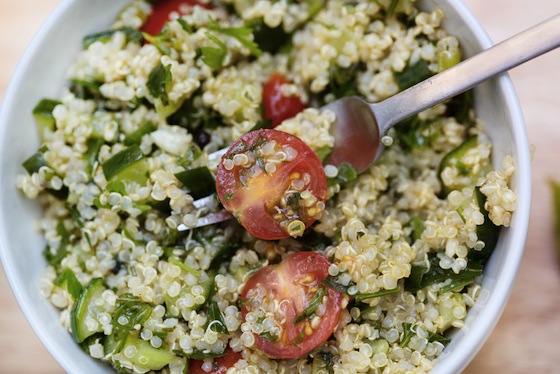
quinoa sustainable

Quinoa is a healthy superfood filling up kitchen cupboards of ethical and vegetarian eaters, but quinoa comes at a high price for those in Peru and Bolivia,

If you’re a vegan or vegetarian or someone who is just trying to eat a little more consciously, you know that shopping can be something of a nightmare.

Taking into consideration food miles, sustainability, water footprints, animal-friendly production as well as making sure the food is organic and healthy is a minefield. So when something as tasty and low fat (I remember ‘superfood’ was being bandied about) as quinoa comes along it’s something of a blessing.


Quinoa is super high in protein

The fact it is high in protein is also perfect for those cutting out meat. However, new research has shown that affluent westerner’s love for quinoa is pushing up prices and denying Peruvians and Bolivians the crop which was once was a staple of the poor.

Since 2006, the price of quinoa has tripled and in Lima, Peru, the once unheard of grain now costs more than chicken. Overseas demand for the grain continues to grow which is all putting pressure on land in Peru and Bolivia that once produced a diverse range of crops to simply harvest quinoa.

Writing in the Guardian, investigative journalist Joanna Blythman states: “The quinoa trade is yet another troubling example of a damaging north-south exchange, with well-intentioned health and ethics-led consumers here unwittingly driving poverty there. It’s beginning to look like a cautionary tale of how a focus on exporting premium foods can damage the producer country’s food security. ”

Another example that Blythman highlights is that Peruvian asparagus which is grown in the arid Ica region has depleted water resources on which the locals depend.

She also adds that soya production is now one of the two main causes of deforestation in South America along with cattle ranching. It is worth pointing out however that according to a UN report in 2006, 97% of soya production was used for animal feed and not to fill vegetarian’s fridges. Even so, the food insecurity caused by the rising popularity of Quinoa is troubling and highlights the need for a more localised approach to food production and consumption. Especially when we are importing from countries with high poverty rates.

For more on sustainable food see:

Eat Like A Sustainable Iranian

Globally, Obesity is Now More Deadlier than Hunger

7 Evergreen Books On Sustainable Food For Your New Year

Mushroom Farmers Start To Sprout Up In Iraq

Image of Tabbouleh Quinoa with Tomatoes via Shutterstock.com

“Irresponsible” World Bank Says Red-Dead Canal Feasible

6

red dead canal conduit

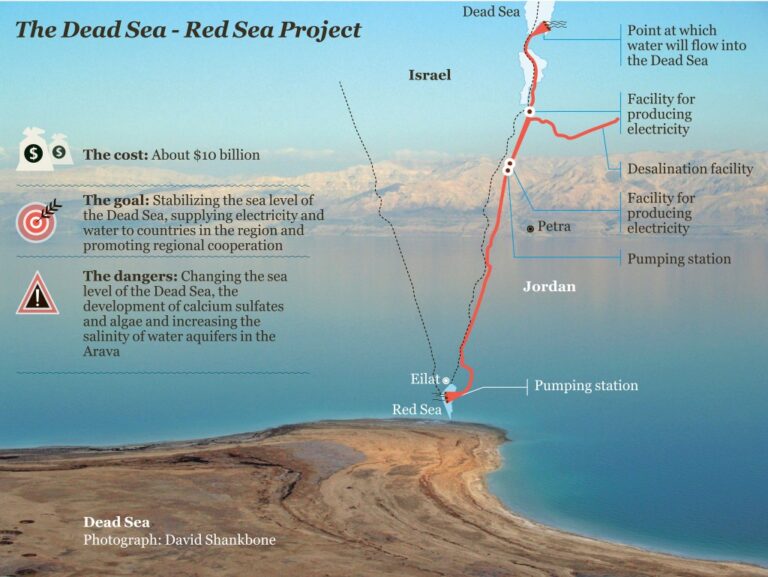
It was about a decade in the making: without much fanfare the World Bank has released a report stating that the Dead Sea – Red Sea Canal project (also called the Red Dead Conduit) will work. The basic idea is to take salty water from the Red Sea, pump it up to a channel, desalinate it and then run the excess saline water to the Dead Sea via the channel where it can replenish the super-salty water at the lowest  place on earth. Fresh drinking water will go to Jordanians as well as energy created by hydro-electric processes.

The Dead Sea is shrinking due to human overuse of water that should normally run to the Dead Sea, as well as mineral cultivation in the South end of the sea by the Dead Sea Works owned by Israel Corp (ILCO:Tel Aviv). While the World Bank report (which can be downloaded here in English, Hebrew and Arabic) says that the canal is feasible and contingent on about $10 billion in investments, it does point out some environmental considerations.

It is these very considerations, green organizations like Friends of the Earth Middle East state, which should stop the Red-Dead plan from ever materializing. In a statement issued after the publishing of the report, Friends of the Middle East write that the World Bank study is “irresponsible” and that their conclusions do not match the findings in the report.  In short: The ‘Red Dead Canal’ project idea has wasted a decade for the Dead Sea, says the NGO which is based in Israel, Jordan and the Palestinian Authority.

Fecal Transplant “Crapsule” Kills Super Bugs Better Than Antibiotics

2

fecal transplant diarrhea in woman

New Nature study research shows that fatal first world, hospital-born diarrhea caused by Clostridium difficile can be treated with donor feces. 

It’s exactly what it sounds like. Transferring feces of a (healthy, tested) donor to the gut of a patient suffering from life-threatening diarrhea.

These are cases where the body’s natural, beneficial bacteria are wiped out from many rounds of antibiotics, giving room for the virulent Clostridium difficile bacteria to take over. It causes never-ending, foul-smelling diarrhea, fever, severe cramps, dehydration and possibly bowel perforation and sepsis.

Fecal transfer is done by introducing the stool sample it into the body either via enema or nasal tube. Disgusting? Very. Effective? Yes. Replacing healthy gut bacteria with donated feces cures.