Green Prophet’s brought you the story behind this year’s winner of the Jameel Prize – 3, an international award for contemporary design inspired by ancient Islamic tradition. But there are nine other finalists who warrant a closer look. Meet fiber artist Faig Ahmed – guaranteed his amazing rugs will trip you up!
 The Azerbaijan-based mixed-media artist redefines the visual boundaries of iconic middle eastern carpets by distorting the conventional structure of their generally symmetrical patterns. The striking results invite us to look back to the originals with new appreciation of traditional forms. His work is reminiscent of Irish photographer David Thomas Smith who “Google maps” major cities into virtual Persian carpets.
Most of Ahmed’s work revolves around the construction and deconstruction of the intricately patterned rugs and carpets native to Azerbaijan, Iran, and Turkey. He rearranges aspects of traditional composition, sometimes pulling fragments into three dimensions.
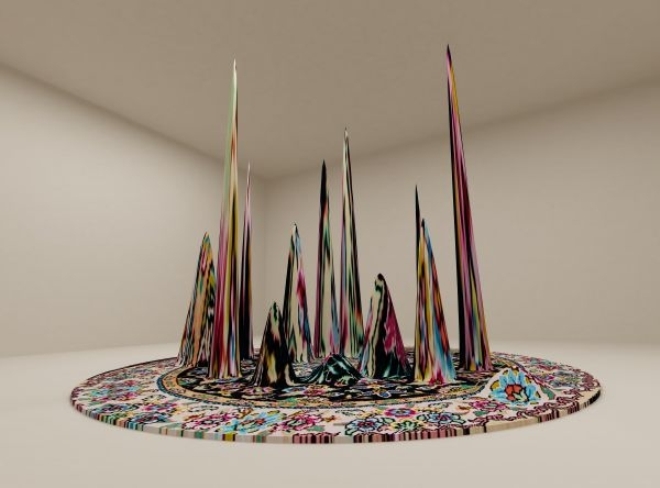
“To be honest, things I do are not always right and beautiful. I do it without thinking, it’s my instantaneous expression. I just make bold experiments, putting them into the art scene, trusting myself and my viewers,” he told website DZineTrip.
This experimentation leads to style mash-ups like tagging a classical pattern with graffiti (painstakingly woven into the piece – no spray paint was hurt in the making of this carpet!).
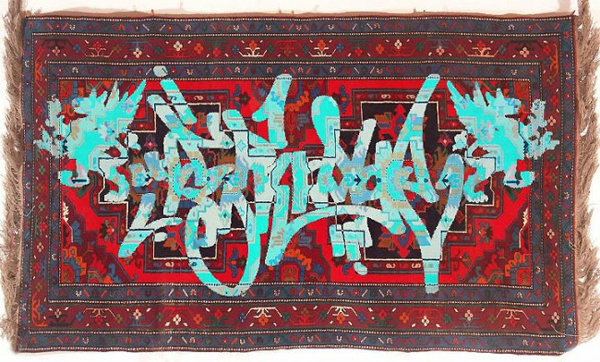
The artist views the carpet as a symbol of invincible Middle East tradition, an enduring icon; a painstakingly crafted artwork that functions – often for centuries – as a pragmatic household artifact. A slight change in form dramatically alters its structure, and in the process, pulls it into the 21st Century.

In his artist’s statement, Ahmed says “I’ve been always fond of investigating and researching every detail of anything that had interested me and sometimes this research reaches inconceivable depths mixing up with my imagination. I’m harried by a question others have left in childhood – ‘what is inside?’ That’s why I’m changing visually static objects making them spatial, giving them a new depth and revealing the essence of the object – which, just a moment ago, was mediocre.”
That’s quite a mouthful – so let’s stick with the images.
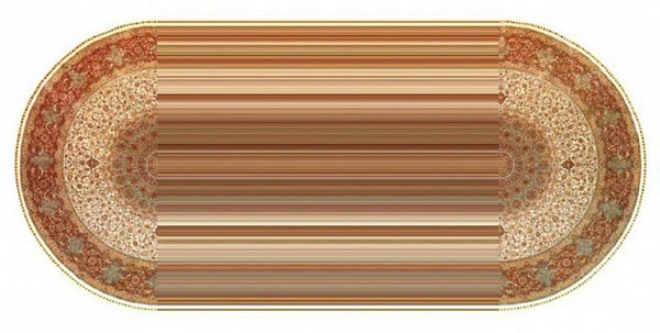
The carpet pictured below was one featured in the Jameel Prize 3 Exhibition held at London’s Victoria & Albert last April. The classical pattern devolves into pixels as the expert handcrafting and brilliantly colored fibers remain consistent. It’s simultaneously jarring and gorgeous.
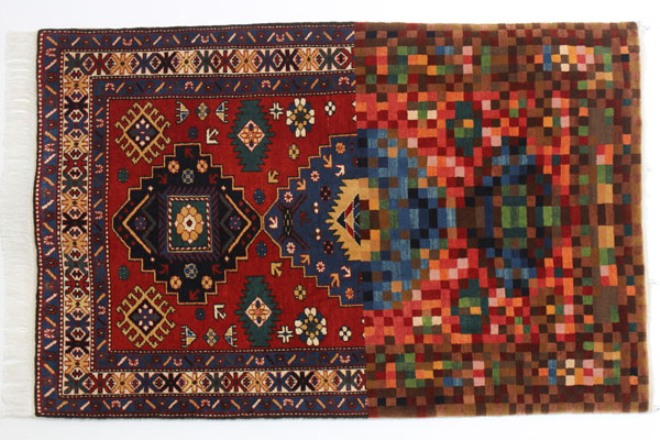 Ahmed uses ancient, handmade techniques (employing local artisans) to create designs inspired by digital corruption and image manipulation. His rug patterns swirl and melt and bloat – sometimes dripping off walls or literally unraveling.
Check out his website (link here) for more of his wild reinterpretations. His carpets have been featured in the Wall Street Journal, Beautiful Decay, The Grumpy Owl and Stylus. Based in Azerbaijan capital Baku, there is no information as to when or if his rugs will be commercially available.
Images from Faig Ahmed’s website