Home Blog Page 260

Archeologists unearth 5000-year-old micro-brewery in Tel Aviv!

3

beer-tel-aviv-archeology-egyptian-6

Hey Brooklyn and your micro-breweries – turns out you’ve got nothing on Tel Aviv!

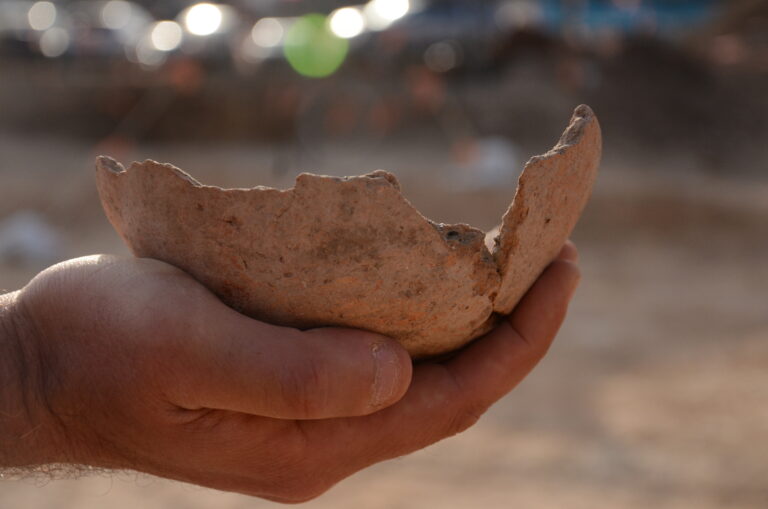
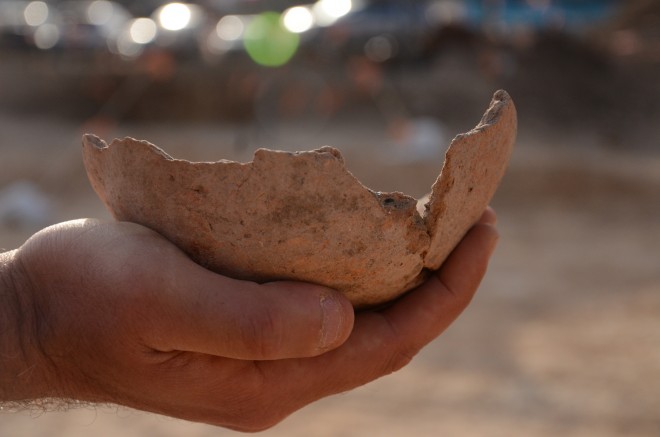
Evidence of an Egyptian brew-house dating to 5000 years ago is being dug up in Tel Aviv. Archeologists there have found pieces of ancient pottery vessels used to make beer. See above and below for how they did it back then.

Apparently Egyptians were drinking the beverage, young and old:

“Now we know that they also appreciated what the Tel Aviv region had to offer and that they too knew how to enjoy a glass of beer, just as Tel Avivians do today,” says Diego Barkan, excavation director on behalf of the Israel Antiquities Authority.

beer-tel-aviv-archeology-egyptian

He adds: “Already thousands of years ago Tel Aviv was the city that never sleeps!”

RELATED: Make Tej, an ancient Ethiopian honey beer!

The evidence indicates that there were Egyptians at the site, living and brewing beer. Not a beverage typically associated with the Middle East. So think again.

The site was located on Ha-Masger Street next to the Ma‘ariv Bridge in downtown Tel Aviv and is part of a salvage operation done before any new construction is done in Israeli cities and towns.

beer-tel-aviv-archeology-egyptian-1

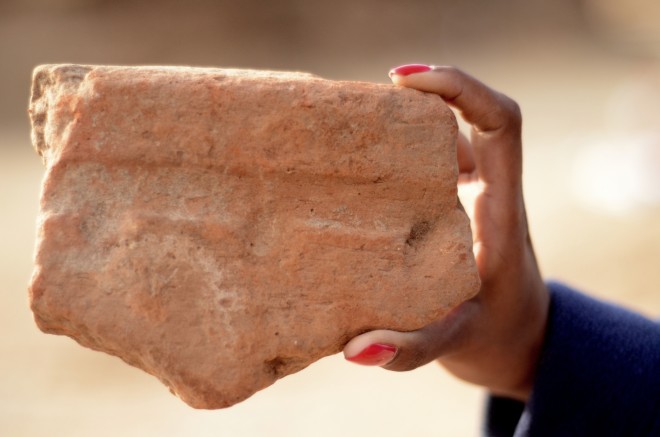
Barkan relates: “We found seventeen pits in the excavations, which were used to store agricultural produce in the Early Bronze Age I (3500-3000-BCE). Among the hundreds of pottery shards that characterize the local culture, a number of fragments of large ceramic basins were discovered that were made in an Egyptian tradition and were used to prepare beer.

tel aviv city of beer, archeology dig from Egypt

“These vessels were manufactured with straw temper or some other organic material in order to strengthen them, a method not customary in the local pottery industry.

RELATED: Lost Tribes Brew restores ancient beers

It is interesting to note that although Muslims shun alcohol (read here why Muslims do not drink) beer was the “national drink of Egypt” in ancient times. It was considered a basic commodity like bread and it was consumed by the entire population, regardless of age, gender or status.

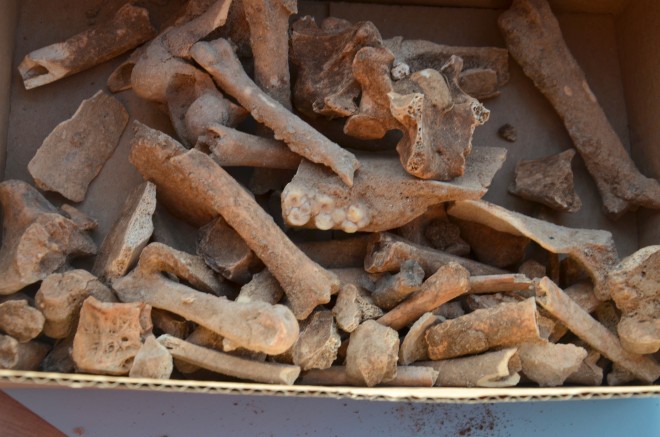
Bones (below) were also found suggesting that beer and barbecues were the combination of choice.

beer-tel-aviv-archeology-egyptian-7

The ancient beer made from a mixture of barley and water that was partially baked and then left to ferment in the sun. Various fruit concentrates were added to this mixture in order to flavor the beer, the experts say. “The mixture was filtered in special vessels and was ready for use.

Strange timing for release of the news. Later this week starts the Jewish holiday of Passover, a time when Jews are forbidden to eat leavened wheat or products made from yeast and leaven – like beer.

5 minutes will sell you on a Middle East visit!

Visit JordanTravel to the Middle East has never been a better deal than now – in terms of economics (deep-discounted hotels and holiday packages), weather (blizzards have all blown by and crushing heat is still months away), and – in most of the region’s top touristic venues – political stability.  All my view based on four years of living in Amman. But how to convince the media-saturated and uninitiated? A five-minute film may do the trick.

The Urban Death Project will turn your dead body into beetroot

1

urban-death-projectFinding greener ways to bury our dead is nothing new. In both Judaism and Islam, people are buried in the most simple and green manner.

Along with these “basic”  burial rites, a variety of eco-funerals are now available to let your death be ever-green. Perhaps, the most novel, and really earth friendly way of disposing of human remains is being proposed by an organization called the Urban Death Project, in which a person’s body will be turned into natural compost to be used for fertilizing gardens and food crops.

Headed by Seattle based Katrina Spade, who also heads an environmental NGO, the Echo Green Organization, the Urban Death Project involves “interning” human remains into a large three story “core”, within which bodies and high-carbon  materials are placed.

katrina-spade-urban-death-project we-carry-our-dead--trans-crop-u4607 urban-death-project-katrina-spade

Over the span of a few months, with the help of aerobic decomposition and microbial activity, the bodies decompose fully, leaving a rich compost that can be used to fertilize crops and gardens.

While many people may object to this method of burial, from a natural and green standpoint, the actual burial process is not that much different than the coffin-less burials practiced by the Muslim and Jewish religious groups.

The burial and composting facility will  have a section where a dignified religious funeral can take place, including interning the shroud wrapped body into a bed filled with wood shavings and other organic material.

This entire process excludes the need for using poisonous embalming fluids and non environmental friendly caskets.

1024px-Compost-dirt

The Urban Death Project is being presented as a non-profit organization in which people will be asked to give donations towards a more ecological manner in which to bury human remains.

Regarding the creation of compost materials, human and animal waste products from raw sewage and farms is already being practised to create compost material.

An example of turning human “crap” into valuable compost is currently being done outside of Dubai. Taking this in mind, if human excrement can be turned into compost material, why not human remains themselves?

It’s simply taking the natural “composting process” one step further by finding a more green solution to the disposal of our mortal remains after death.

Ikea rolls out 10,000 flat-pack refugee shelters

1

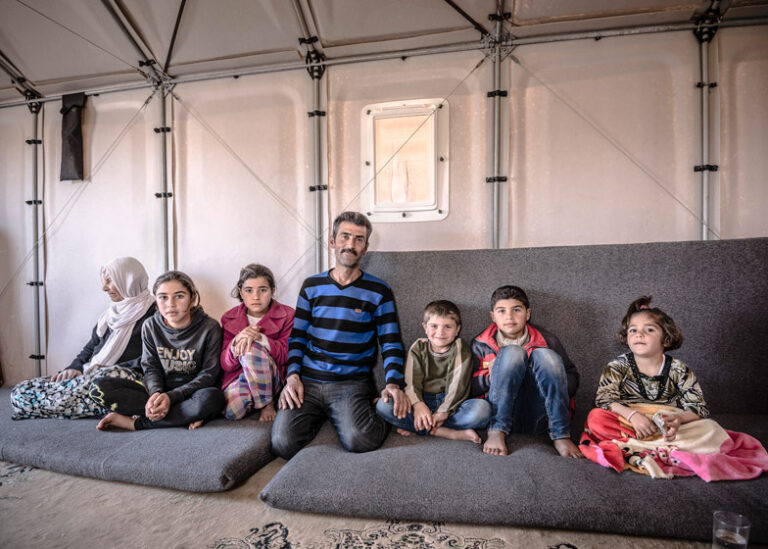
Better-Shelter-IkeaIKEA and UNHCR (the United Nations High Commission for Refugees) emerged from two years of research with a prototype shelter suitable for refugee families anywhere.  It features an innovative roof that reflects 70% of the sun’s rays during the day yet retains heat during the night, and it’s fitted with solar panels that power an interior light fixture and a USB outlet both built into the structure. They’ve begun producing 10,000 of these temporary homes, and as you’d expect from the Swedish home goods giant, they arrive via flat-pack shipping.

Heat hackers breach computer systems by “breathing” data whispers

1

air-gap-security-research

How can the environment around computers be used to hack data? Computer scientists have now determined that it’s possible to send data or “steal” data by using heat transfer between computers – those typically used as servers in high profile institutions like banks and police. Their exercise in hacking heat points out vulnerabilities in today’s computer systems so security experts can build walls around them.

The researchers from Ben Gurion University developed what they are calling BitWhisper to breach into computer systems that use air gapped cooling. This breach lets the computers talk to one another through heat. Wow or what?

According to the researchers, “The scenario is prevalent in many organizations where there are two computers on a single desk, one connected to the internal network and the other one connected to the Internet. BitWhisper can be used to steal small  chunks of data (e.g. passwords) and for command and control.

Stealing with a breath of warm air

“These properties enable the attacker to hack information from inside an air-gapped network, as well as transmit commands to it,” the BGU researchers explain. “Only eight signals per hour are sufficient to steal sensitive information such as passwords or secret keys. No additional hardware or software is required. Furthermore, the attacker can use BitWhisper to directly control malware actions inside the network and receive feedback.”

The research, conducted by Mordechai Guri, a Ph.D. student is part of an ongoing focus on air-gap security. Computers and networks are air-gapped when they need to be kept highly secure and isolated from unsecured networks, such as the public Internet or an unsecured local area network.

Typically, air-gapped computers are used in financial transactions, mission critical tasks or military applications.

The new development of BitWhisper bridges the air-gap between the two computers, approximately 15 inches (40 cm) apart that are infected with malware by using their heat emissions and built-in thermal sensors to communicate.

It establishes a covert, bi-directional channel by emitting heat from one PC to the other in a controlled manner. By regulating the heat patterns, binary data is turned into thermal signals. In turn, the adjacent PC uses its built-in thermal sensors to measure the environmental changes.

These changes are then sampled, processed, and converted into data. Scary. Hackers stealing through heat. Let’s put minds like this on cracking bee colony collapse disorder and we’ll have started a revolution in bio hacking.

Worth their weight in gold: biggest losers in Dubai win coins for weight lost

14

weight1503

The Middle East is seeing the worst rising weights of obesity in the world: but a new Biggest Loser contest in Dubai, is showing that locals there, and children, are taking on the challenge for losing weight. If the prize is gold coins for every pound you’d drop, you’d want to lose too! Consider this is a region where people drive cars made from gold. So gold is a great prize and incentive.

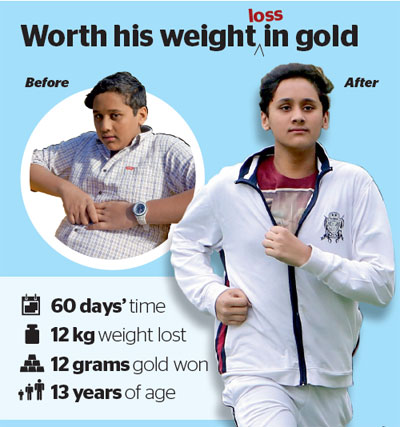
According to Yahoo a 54-year-old woman emerged as the “biggest loser” while a 13-year-old boy became the winner among child contestants. Winners received bags of gold for the efforts.

The woman Sharada Serigara won by losing a whole 32.2kg from 96kg during the two month ordeal. The child, Somesh Chakrabortty, a grade nine student lost 12kg from a starting point of 97kg. Sharada won 32 grams of gold, the boy 12 grams.

We do hope that those running the contest have a sustainable plan so the biggest “losers’ of weight will be able to keep it off.

Below are some tips for keeping it off.


Via: Green Juice Delivery Company

An alternative to standing desks: is it on The Level?

0

alternative standing desk

Is sitting the new smoking?

Nature designed human bodies to be in constant movement throughout the day, but when modern office jobs plant us in seated positions, only our fingertips get a workout.  Now there is compelling evidence that prolonged sitting kills, even if you exercise regularly. In fact, the paradigm that moderate physical exertion, such as going for a run, promotes good health may be completely wrong. New research is instead showing that sedentary behavior is our primary health problem and anything that stops us from sitting will increase our fitness. Take a stand against sitting with a beautifully designed tool that brings new meaning to the term “internet surfing”.

Pee Power is making energy from urine in Africa

4

Pee power project electricity

It’s already well known that manure or poop can be recycled for making products like paper
as well as creating biogas power from methane gas.  Turning urine or pee into electricity is another matter. This readily available “resource”, whether it be from animal or human origin, is now being experimented with to actually generate electricity by using our pee’s  basic ingredients to create enough hydrogen to provide electricity for both homes and businesses.

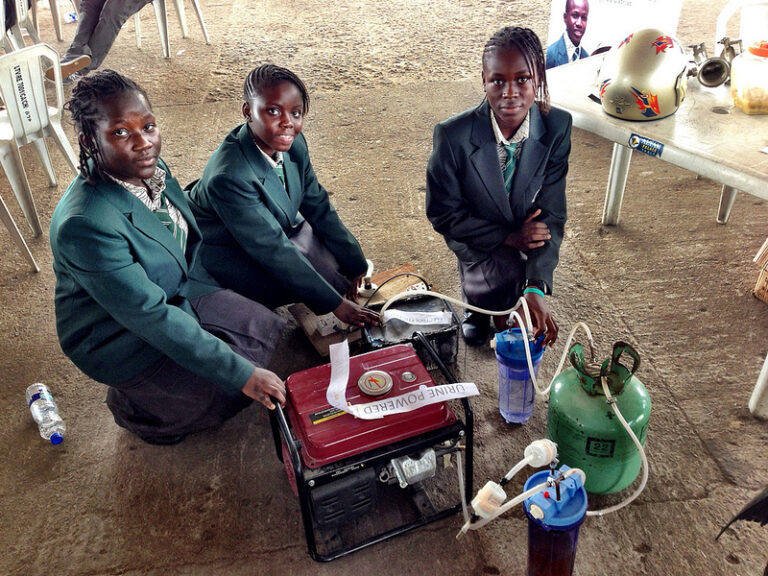
Four teenagers in Lagos Nigeria, working on a school project, created a practical way to separate hydrogen from urine, and then use it to power a generator to create electricity (see photo above). The “pee power” project was entered by the girls in an annual nationwide competition  in Lagos, Maker Faire Africa, and it created enough electrical power to run the generator for six hours from one liter of pee.

The pee-power process occurs like  this:

1. Urine is put into an electrolytic cell, which separates out the hydrogen.

2. The hydrogen is then filtered in a water filter for purification,  and then is sent to a gas cylinder, similar to the kind used for outdoor barbecue grills.

3. The gas cylinder pushes the filtered hydrogen into another cylinder that contains liquid borax, to remove moisture from the gas.

4. In the final step, the hydrogen is sent into a power generator, which creates in electricity.

Although still a long way off from being implemented on a mass scale, this basic way of creating electricity from a substance  normally disposed of  can be a practical way to create electricity in places where normal electrical power has been cut off due to devastation by floods or other natural disasters, including severe storms. It can also be used to create electricity in poor rural agricultural areas that are common in Africa and Asia; including many parts of the Middle East.

The Pee Power idea is starting to take hold. Students and faculty at  Bristol-based University of the West of England are being asked to use a special urinal that sends all the urine collected there to be used to produce hydrogen for powering an electric generator that creates additional electricity for the campus.

If this pee-power prototype project is successful, the idea of using urine produced hydrogen to power hydrogen powered cars is also being considered. Pee as you drive instead of stopping at rest stops? A curious idea.  Not bad ideas for a waste product that normally winds up in the sewers.

Read more on recycling and creating  bio-fuel from excrement:

5 Brilliant Projects That turn Poop into Power

Israel’s 4MW Biogas Plant to Clean Up After 14,000 Cows

What Recycled Paper Products From Poo Look Like

Photo of pee-power project generator by Maker Faire Africa 

Thermo-piezoelectric tires by Goodyear produces energy for your electric car

5

Goodyear BH03 concept tire

Like Israel’s Softwheel for wheelchairs and bikes, Goodyear is asking: Can new ways of engineering tires extend the cruising ranges of electric cars to make them more saleable in the aftermath of the the demise of Shai Agassi’s Better Place electric car venture?

Despite some success in selling electric cars like Nissan’s Leaf model and General Motor’s Chevrolet Volt (more a hybrid),  the cruising range of most electric cars is still one of the main issues that cloud a possible electric car success story. Yes, even with Tesla on the market.

Electric car manufacturers are exploring ways of extending the present cruising range of EV cars between battery pack recharges that in most cases are no more than 160 km (100 miles). At least a partial solution may be found in special “concept tires” being developed by the Goodyear Tire and Rubber Co. which will actually help recharge the EV car’s battery pack while the car is  in motion.

The tires were  exhibited recently as the BH03 Concept Tire at the Geneva International Motor Show. They feature special heat conductors that convert heat generated by road movement into electricity that can then be conveyed to the car’s battery pack. Another feature is a  thermo-piezoelectric layer built into the tire wall  to collect energy from the sun when the car is parked.

This tire is not yet in production, partually due to its very high developmental costs. If it is made available it could help increase the cruising range of electric cars by virtually supplying electrical energy to the battery while driving on the road or sitting in a parking lot.

Better Place may be gone, but electric cars as Elon Musk is proving, are now becoming reality. They just need novel ways to get their drivers further down the road.

Read more on electric cars:

Can Israeli Cars Run on Alternatives by 2025?
What Tesla Can Learn from Better Place’s Post-Mortem
Renault Gives Up on Israel’s Swappable Electric Car Batteries
The Best Electric Cars of 2012, According to the American Buzz

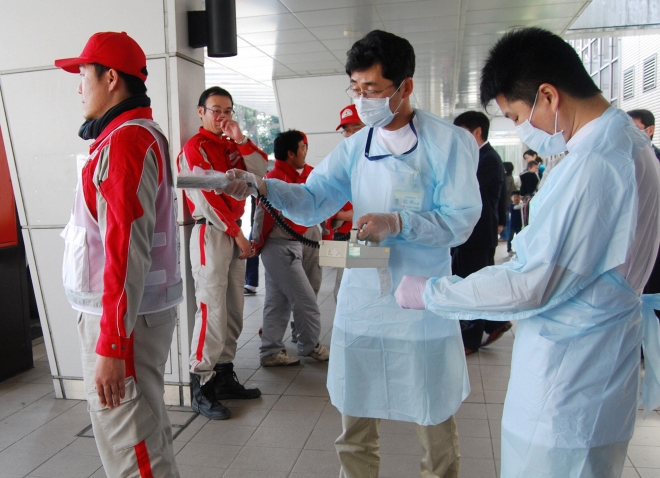
Japan’s Fukushima nuclear meltdown – 4 years later

8

Japan Earthquake Nucl_Hers

Iran’s aggressive nuclear energy program seems to be constantly in the news these days; while other regional countries, including Jordan,  have nuclear power ambitions of their own. As the fourth anniversary of the March 11, 2011 Fukushima nuclear reactor meltdown is commemorated by Japan last week, the world may still not  have learned the entire lesson of that tragic event. Many environmental activists are referring to the Fukushima reactor meltdown as much worse than Chernobyl.

Fukushima is now considered the world’s worst nuclear power plant disaster,  and at least 250,000 Japanese are still displaced from their homes and businesses by the effects of both the giant earthquake-caused tsunami and nuclear reactor meltdown that killed more than 16,000 people and resulted in 2,500 more still missing.

Extremely high levels of radiation in locations near the destroyed Fukushima facility have prevented many Japanese from returning to their former homes; possibly forever. Entire communities are now no more than ghost towns, where wild animals like wild boars and monkeys roam free.

Not only the Japanese were affected, but also foreign rescue personnel who were sent there to aid and rescue the victims of this  double tsunami and nuclear meltdown tragedy. This includes more than 500 American naval personnel who became ill from a variety of diseases  and medical conditions which may have been caused by over-exposure to nuclear radiation.

Statistical information on radiation caused diseases, like cancer, and birth defects caused by the exposure of the Japanese population to high amounts of radiation have not yet been revealed as well.

Despite being the only country whose civilian population has experienced the effects of nuclear weapons first hand, Japan still depends on nuclear energy to supply much of its total electricity needs. The Fukushima tragedy may have changed this, however, with government officials now looking for other means to supply the country’s  energy needs.

Statistically, the facts and figures of the need for nuclear reactors, are evident. Japan still has 48 nuclear reactors in operation, generating more than 42,500 MW of electricity. France, Europe’s  largest nuclear reactor user, has 58 in operation, generating more then 63,000 MW. With 99, the USA has the largest number of nuclear reactors in operation, generating more than  98,700 MW of electricity.

The Middle East is still depending largely on oil and natural gas to supply its energy needs. At present only Iran has a functional nuclear reactor, producing around 915 MW of electricity. Seven more reactors are planned however. Other Middle Eastern countries planning to construct nuclear power reactors include Jordan with 2, Egypt with 2, Saudi Arabia with 16 and the UAE with 10 (3  are under construction).

These figures do not include “scientific reactors” in countries like Iran and Israel. With the tragic memories of the Fukushima reactor meltdowns still relatively fresh on peoples minds, we might all ask ourselves if the potential dangers of these power sources are really worthwhile?

Read more on Fukushima nuclear reactor meltdowns and the effect of nuclear energy on world environment:

Plans for Turkey’s First Nuclear Power Plant Revealed

Dr. Helen Caldicott: Fukushima nuclear meltdown much worse than Chernobyl

“Worst Case Scenario” Realized as Three Fukushima Nuclear Reactors Melt Down

‘Arabian Ark’ is saving UAE wildlife from extinction

Arabian OnyxOryx, giraffes and cheetahs – species once facing regional extinction – are making a robust reappearance on a desert island off the coast of Abu Dhabi. Sheikh Zayed Bin Sultan al-Nahayan, founder of the United Arab Emirates (UAE), created the remote nature reserve in 1971.  Forty years after Sir Bani Yas island received its first ‘imported’ animals, over 13,000 protected creatures now call the “Arabian Ark” home.

Today is a once-in-a-century Pi Day!

3

pi day 2015Today is Pi Day.  Celebrated around the world every March 14th (3/14), the day focuses on the mathematical symbol that represents the constant ratio of a circle’s circumference to its diameter, approximated as 3.14159. This year’s Pi Day is a once-in-a-lifetime event; it will be 100 years until we experience 3/14/15 9:26:53 again – that’s pi to ten places!

Caveman found living in Jordan mountains!

9

modern caveman

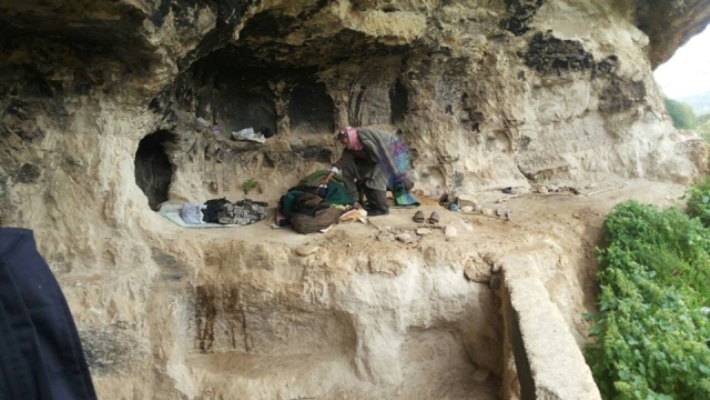
For the past two decades a 70-year old man lived in a cave in northern Jordan, alone with no water or power or reliable access to food, exposed to the elements and wild animals. An unidentified caller contacted radio station Amen FM to alert them to the modern caveman. Last Thursday the kingdom’s Public Security Department (PSD) found him and brought the septuagenarian to safety.

Abu Dhabi falconers think drones are for the birds

0

training falcons with dronesFalcons have been trained for hunting and sport for thousands of years across the Middle East. Now falconers in the United Arab Emirates are turning to drone technology as a new tool to teach their birds to fly increasingly higher and hunt more efficiently. Can technology teach old birds new tricks?

Falcons hunt by scanning the ground below them using a cone-like field of vision; imagine a spotlight scanning the earth – the bird’s-eye-view is limited to what’s moving within that beam. The area within the cone expands when the bird soars higher above ground, but falcons don’t always fly high while scanning terrain, so falconers train them to fly higher, which increases the potential hunting area.

For centuries, falcon trainers have used kites and balloons. They tie a lure to a line, which is attached to the kite or balloon. The falcon chases the device as it flies upwards, then snatches the bait and returns it to its trainer for a reward. Over time, the bird learns to fly higher and hunt prey over a larger area. Replacing kites with small unmanned aerial vehicles, or quadcopters, puts a modern twist on an ancient technique.

The machines act as tiny helicopters, operated by remote control.  They can travel in pre-determined paths, further and higher than ground-tethered balloons and kites.

Watch a video of drone training a falcon below. (The bird makes his appearance at around 0:40.)

https://www.youtube.com/watch?v=YT5Ak63rR1U

A drone is also being used – today – to carry a falcon to the top of the world’s tallest building, the Burj Khalifa in Dubai. It will carry the bird inside a special cage to the top of the 2,722 feet high tower.

The cage will open, and Victor the falcon will soar free, filming his journey using a special camera strapped to his chest. Live images of the world-record-breaking flight (this is Dubai, after all) will be shown on an enormous screen set along the shore between the Dubai Mall and Burj Khalifa.

Drones are deployed in many new ways, but our favorites remain those with environmental benefits, whether raising awareness to abominable practices of Big Food, helping to clear plastic from our oceans,  or replacing delivery vehicles that run on fossil fuels.


Investors get primer on Impact Investing in Israel

2

impact-investing-israel

What’s the social value of a new app that connects me to the best pizza in town? Or a gadget that can help me talk to a fellow gamer in China? Maybe the answer is zero, but maybe not. There is a new investment trend in town and it’s called Impact Investing. While the East and West Coasts of America are already familiar with the term Impact Investing, the Middle East is not. But you know some Impact companies already: Tom’s Shoes. Ben and Jerry’s ice cream.

Doing good for people and planet are known themes in the eco world. But investors haven’t caught up. They may have followed on the clean tech bandwagon, and got burnt from solar, but since that’s fallen out of fashion, what’s next?

Aligning language with practice is a new organization in Israel called Impact Investing Israel with a mission to motivate investors and startups to connect to that place, grounded in reality, where society impacts made by companies can be tangible, measurable and real. You can find Impact Summits from Chicago to New York to San Francisco and now Israel is getting its first.

What can Impact Investment mean? A new startup that 3D prints artificial limbs? A device to help people grow food more sustainably? An app that saves people’s lives from malaria?

The idea of Impact investing seems to have been a natural knock-on effect of what’s been happening in the world of sustainability over the last 15 years where die-hards follow the Triple Bottom Line: People, Planet, Profits. Impact loosely follows the spirit, and is guided by organizations like the B Corp in the US which helps develop criteria for Impact investors to know – what kind of company will have a measurable impact on society?How can we judge and predict a startups’ future Impact?

Over in Israel, investors and entrepreneurs will explore the theme and opportunities at the country’s first Impact Investing Conference taking place on Monday, March the 16th.

I’ve been covering the startup scene in Israel for nearly 15 years. There are so many Israeli companies in biotech and cleantech that could easily be branded as Impact companies, a good idea now that the word clean tech is out since solar energy investments, and investments in biofuel, even promising electric car ventures went belly up. Impact is less specific and gives more room to breath. This is my assessment but I am sure I have lots to learn.

Getting to Know Impact

ronny faivelovitzRonny Faivelovitz, the founder of Impact Investing Israel tells me that the event is a primer, a way for the Israeli investment community to “get to know Impact Investing. There is a lot of talk and buzz about investing in this field,” she says, “but not everyone knows about how to do it right.

“The conference is about aligning this information,” Faivelowitz stresses. Coming from the sustainability world and now charged with the goal of impacting Impact, “I want to give all the information knowledge and techniques to Israeli investors and startups so they can assign to global standards. We will show case studies and ways to learn from experience.”

In the past Faivelowitz best describes her work with startups in the areas of “clean tech, water solutions, social businesses.”

She saw that Israel has a lot to offer and that Israeli companies have great ideas that can make an impact on society.  And no, Impact isn’t just about Africa and feeding the poor, she stresses: “Companies need to know how to build a business plan and an Impact plan. That’s what an Impact Investor will want. They can’t just want to change the world, but need a sound ROI strategy in a global language standard,” she tells Green Prophet.

As for who’s on target for Impact, the event will showcase 11 Israeli startups that have demonstrated a measurable effect or potential for greatly influencing the health of society. But this is more of an event for investors: “The main subject we are dealing with is not from the side of startups,” Faivelowitz urges.

“We want to talk with VCs, private investors, philanthropists. We want to show them how and hold their hand as they take their first steps out in the field.”

Countering notions that Impact companies take longer for the Big Exit or IPO, Faivelowitz shrugs this off. “It’s not that all companies take more time. Each one is different. Most startups from the outset will not make an exit.”

What she does want to do is encourage traction in this investment area, because it’s worth it: “Investors should take it on as a professional field and strategic move. Research has shown that if you invest in these companies they will be more sustainable, and there is less of an investment risk over all because they are built according to regulation. And most can be profitable,” Faivelowitz says.

Consider this: “If you are building a company by definition as Impact it can actually help you with the next funding round because there are a lot of big institutes now already courting publicly their investments in Impact companies,” she concludes.

The event next Monday expects to bring out 300 people, mainly investors.

Who’s got it right? There is an Israeli company called Keepod that provides makes a small computer on disk on key, or a flash drive, for $7.

When you buy one the company also sends one to someone else in Africa. Like the Tom’s Shoes model. It all goes back to eco in the end. But I am going with the flow and believe Impact will be a much more sustainable direction than the eco brand or green, at least in terms of semantics. If not practice.

Among the speakers at the Impact Investing Conference will be:

  • Sir Ronald Cohen, Social Impact Investment Taskforce
  • Abigail Noble, World Economic Forum
  • Eitan Stiva, Vital Capital
  • Chemi Peres, Pitango
  • Danny Almagor, Small Giants
  • Robert Rubinstein, TBLI

According to the Impact Investing Israel group Israel has more “high tech start-ups and a larger capital industry per capita than any other country in the world. Now, an increasing number of Israeli innovators and social entrepreneurs are focusing their attention on solving some of the world’s greatest social and environmental challenges, from addressing issues of food security through agricultural technologies to providing sustainable energy and health solutions.”

Let’s wait and see what sort of Impact investments will be coming out of Israel.