
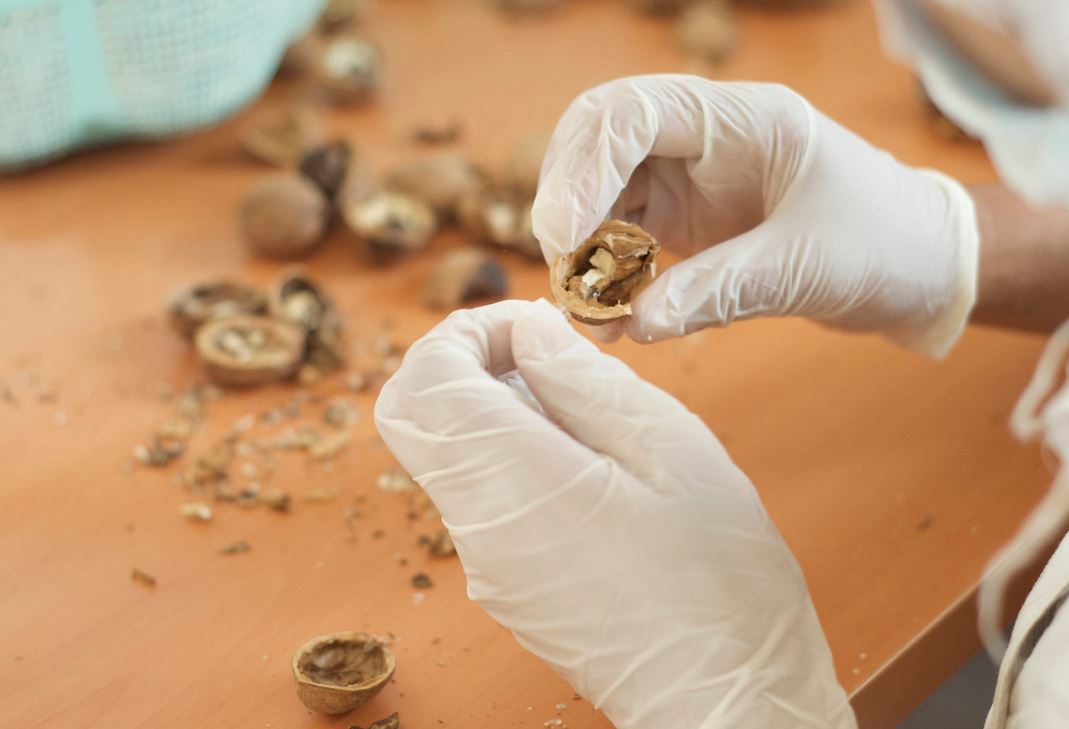
 The High Atlas Foundation (HAF) joined in the only Moroccan festival solely dedicated to celebrating nuts, a three-day festival held last Friday in Asni, a small village at the foothills of the High Atlas Mountains, south of Marrakesh. The weekend of music and markets celebrates the Asni walnut processing plant, located nearby, where about 40 local women process organic walnuts, extracting oil for food and cosmetics. To date, they’ve produced more than 6 tons of processed organic walnuts and 600 liters of organic walnut oil.
Morocco celebrates its certified nuts in 11th annual Asni Festival!
Raw energy balls with date and coconut
They’re healthy. They’re sweet. They’re pretty. They’re dense and filling, so one bite will satisfy you but never make you feel guilty about eating it. And you shouldn’t hold back from making them, either, since they’re done in a matter of minutes.
Alright, enough with the fanfare (cause I’m their #1 fan): what are they? They’re my new favorite kind of raw* energy balls, made almost entirely of two of my favorite foods: dates and coconut.
I was inspired by a video by Laura Miller, a YouTube personality I recently discovered. On YouTube, I subscribed to Tastemade, her network company’s channel, and her personal channel because I think that she is, in a word, awesome.
Jump to 2:33 for the start of this recipe!
[youtube]https://www.youtube.com/watch?v=Kbmlwu2wxYg[/youtube]
I do my fair share of watching Food Network and the Cooking Channel, but I’ve never seen a kitchen presence like hers. Half old-fashioned, half hipster, she has this charisma that makes you want to watch her, laugh at her jokes, and head to the kitchen to try out her gastronomic feats for yourself.
Laura Miller, who has no formal culinary training, is what I personally like to call “chefy.” She takes pride in using healthy, good quality ingredients; making wholesome snacks and meals out of those ingredients; and presenting a final product in a way that makes her proud and makes us at home drool.
Take these date-coconut balls, for instance. They’re so cute because they’re covered in a variety of different “toppings:” chia seeds, hemp seeds, cacao nibs, and cocoa powder.
Let’s get the basics out on the table (no pun intended). A reliable food processor is your best friend for this recipe. Laura utilizes a nice, roomy one. Since I, on the other hand, only own a small food processor, I divided the measurements in half and blended my ingredients together in two batches.
Note that if you’d like to follow along with the video, Laura stands in front of a chalkboard on which she wrote out exact measurements for the energy balls.
1. Pulse 1.5 cups unsweetened shredded coconut in the food processor until it is made into a flour-like texture.
2. Add in 10 medjool dates, pits removed of course, which you may want to soak for 10-15 minutes beforehand in order to make them more workable for the processor. (Fun fact: The dates I used come from Israel; where are yours from?)
3. Add in 1/4 cup cocoa powder, 1 tsp vanilla extract, and 1 tsp sea salt.
4. Pulse! You’ll end up with a sort of dough.
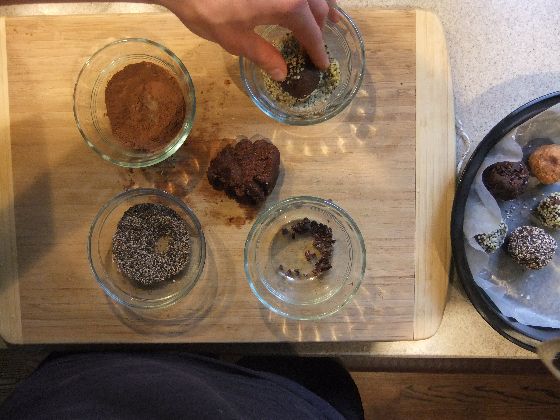
5. Spread out some chia seeds, hemp seeds, cacao nibs, and more cocoa powder – or different “toppings” of your choice, of course – in different corners of your cutting board. Alternately, you can do as I did and pour these things into separate small bowls.

6. Get your hands dirty: Use your palms to roll the dough into balls.
7. Roll them in your “toppings!” With all the pop of color and texture, suddenly the balls will seem like something you might find in a candy shop.
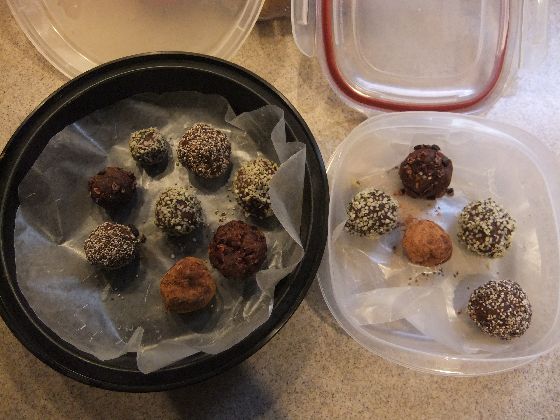
8. Refrigerate or freeze them. In the video, Laura says she prefers to freeze them because she likes the resulting texture. I divided my energy balls into two containers, to put one in the freezer and the other in the fridge, as an experiment to see which I liked best. My preference was the fridge.
These raw energy balls – which, although it probably goes without saying, are vegan – are truly everything you want and need – well, I suppose I can only say with conviction that they’re everything I want and need. Don’t hold back – Laura and I want you to try them today!
*Vanilla extract, which is used in this recipe, is technically not raw.
Images of my energy balls taken by me!
Galilee to Dead Sea: Jordan Valley’s first-ever regional master plan!
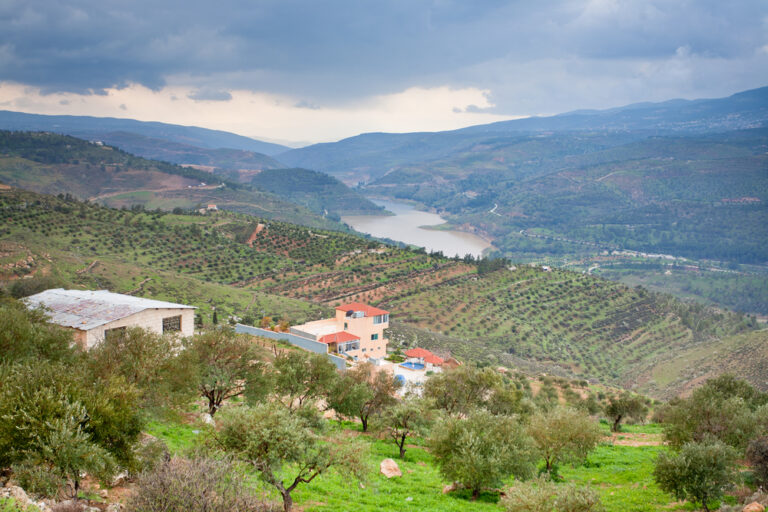
 A consortium of leading environmental groups released a Regional NGO Master Plan for Sustainable Development in the Jordan Valley. They announced the action – the first of its kind – earlier today at a conference held on the Jordan side of the Dead Sea. The strategy is akin to a modern Marshall Plan, it aims to convert a toxic river and highly depressed economic area into an international model for river rehabilitation and regional stability.
Mystery energies of solar power solved!


Researchers at the Qatar Environment and Energy Research Institute worked alongside colleagues at Trinity College Dublin to solve solar energy mysteries related to the physical properties of photovoltaic perovskite materials. Their discovery may lead to more efficient solar energy harvesting.
Car drifter king goes to prison in Saudi Arabia


If you’ve never been to a Gulf-region country – be prepared to scratch your head over the deadly past-time called drifting. The idea is to take your cars out of their carports and then drive your car as fast as possible on the highway, slam on the breaks and then attempt to frighten onlookers and fellow drivers on the road by drifting or sliding your car towards them. People sometimes get killed or badly injured.
This is more likely the reason why women in Saudi Arabia don’t drive. They are too smart to share the road with such losers.
But in all seriousness, offenders caught drifting in Saudi Arabia were rarely punished until now.
Setting an example, the Crown Prince of Saudi Arabia has now clamped down by arresting the drifting legend who calls himself King Al Nadheem, according to recent news reports. This King is reported to have killed one person, while putting the lives of many others in danger and faces 6 years in prison and hundreds of lashes.
What astonishes us though is not just the idiotic and dangerous sport of drifting, but the fact that enthusiastic onlookers clap with glee as these morons slide their cars along the highway.
This is what happens when you have too much money and free gas subsidies on your hands.
People in cars. Drifting or drunk, or drunk while drifting. This world has gone mad.
“The Largest Cleanup In History” – will Boyan Slat’s Ocean Cleanup Array scour plastic from the seas?

World Oceans Day is June 8th – here’s someone who could be it’s Grand Marshall.
Two years back, Green Prophet ran a story about a Dutch engineering student who devised a way to siphon off the gargantuan plastic garbage patches (called gyres) growing unchecked in our seas. Then-19-year-old Boyan Slat claimed his floating “Ocean Cleanup Array”, developed with classmate Tan Nguyen, could clean up each gyre in about 5 years, removing millions of tons of plastic powered by sunshine and using natural ocean currents. Turns out the kid wasn’t just a flash in the eco-pan.
The things I do to feed the world
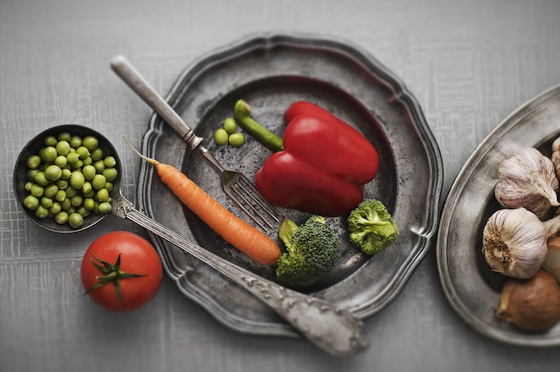
Even the US Customs guy at the New Jersey airport gave me an approving nod: “A technology for hydroponics?” He flips over my business invitation from the NY company to see if there wasn’t something inside. “Well, you know, it’s still,” in a fake finger-wagging voice, “…illegal here?” he says, waiting for my reply.
There was a long line behind me: “I am doing it to save the world – so people can grow better food.”
Was it a trap? The Canadian in me wondered. I get the stamp and I am in New York City. My startup has landed. And ain’t that America!
When I tell people I am creating hardware so hydroponics can be open to everyone I get one of four reactions: the environmentalists give me high-fives, the high-tech geeks crash their operating systems (girl+blond+device=what the ?$%!!), the potheads ask me when they can buy it, and the rest of the world scratches their head.
Hydro-what?
I am building a device to make hydroponics more accessible, so it’s easy for everyone to balance water chemistry. No, not for you to start up your own “Weeds” reality show, but so that we can help America grow better food that’s more nutritious, with less environmental impact.
Hydroponics is nothing I’ve invented. It’s a system used by Asia to grow rice, or theBabylonians for their ancient hanging gardens. You don’t need dirt to grow food, just plenty of aerated water, and a nutrient solution. Some research bodies like the Food and Agriculture Organization at the United Nations argue that it is the world’s only alternative to conventional farming. Not as a replacement, but important as our world’s population swells by the billions. And as we continue to cause climate change, and face drought.
When I speak with chemical companies they know it’s a young industry growing at a fast clip.
But back to people: Imagine young girls in those new STEM (Science, Technology, Engineering, Math) programs that everyone in Education is talking about. Hydroponics could connect food to STEM so that girls can learn math, chemistry, engineering, physics, farming and nutrition at one tasty go.
Hydroponics uses up to 90% less water than soil farming, and you can grow high-density, high-value organic food literally anywhere, year round.
And if you do it right, with the right mix of nutrients, with the right seeds, and at the right pH, well you’re going to grow food that Five Star restaurants want to buy. Those were William Texier’s early customers decades ago in California, years before Texier wrote the book on hydroponics and became the CEO of Europe to the world’s biggest hydroponics nutrient company, General Hydroponics.
But how do you do it right? Soil farming and water farming are not the same. If we can get that magical number to make it super efficient and cost-effective, more people will do it. Just like buying into solar panels.
The environmental benefits to hydroponics farming at home and at large scale seem to be all there. But those metrics aren’t everything for the bottom line. Many who try it at home or for business fail or complain about the taste (see the comments in this NY Times article).
Texier is now based in France but was back to California, seized by a drought, when I got hold of him. When I told Texier that people find hydroponics food dry and a bit bland (a common complaint), he says bluntly: “It’s not because of hydroponics. It’s because of you.”
Double the vitamins, double the taste
With the right nutrients and the right growing conditions, you can get food that’s “200 percent more of everything,” he tells Green Prophet.
Food that’s twice as tasty, and packed with double the amount of vitamins and nutrients, based on lab analyses he’s done: “This should be the first and most important fact when you talk about hydroponics,” he says. “And that means that food with twice the nutritional value should be sold at twice the price.”
Texier’s not convinced yet that hydroponics will save California’s water. That it uses 90% less water is very generalized, Texier says: “When you are dealing with living organisms and complex chemistry,” water use can be hard to pin down. It may be less, but it really depends what you are growing and where, he tells me. And it’s important to take into consideration the power use needed for lighting, if done indoors.
But big US gardening companies see where hydroponics is headed. Scotts Miracle-Gro, that which we see advertised in Lowes’ fliers, recently bought General Hydroponics for an estimated $130 million USD. And you can already findhydroponics systems online at Home Depot.
So US Customs guy: please don’t ask. I will be coming back to New York next week to continue my quest and to grow my my startup business. Yes, my laptop is full of data that comes from the now legal (in some US States) cannabis business but that’s research which is going to help me feed the planet.
Who’s growing what, where, for how much? What food can be grown with the least amount of water for the best taste? That’s my challenge: to connect environmentalists, with high-tech geeks, with know-how from the medicinal cannabis growers to everyone – and their food.
First-ever interfaith “Eco Slam” happening tonight in Jerusalem!

 An inaugural Interfaith Eco Slam is happening in Nachla’ot, Jerusalem tonight, hosted by the Interfaith Center for Sustainable Development (ICSD) and Rabbi Yonatan Neril. Get yourself to the rooftop of 49 Rechov Shabazi for a night of spoken-word poetry that bridges religion and ecology. The event is in honor of World Environment Day, which rolls in tomorrow.
How Theranos’s Elizabeth Holmes saves lives in developing world

Update Nov. 2020: Theranos founded Elizabeth Holmes was charged for fraud while leading Theranos, and now faces criminal charges.
Serious health issues frequently affect us people living in the Middle East. We face long-eradicated diseases like polio. There is also concern about disease caused by terrifying levels of air pollution. In cities like Tehran, people may be seeing air pollution worse than in Beijing. It’s hard to breath in cities like Tehran, but Cairo too. And eating. When your meat is pumped up with toxic contaminants this can’t be good for you. Think of what could be seen in a simple blood test? Cancer? Diabetes? Knowing this information early can save lives not only in the Middle East where general healthcare standards are not great, but also in the US where blood tests cost a lot of money to the uninsured.
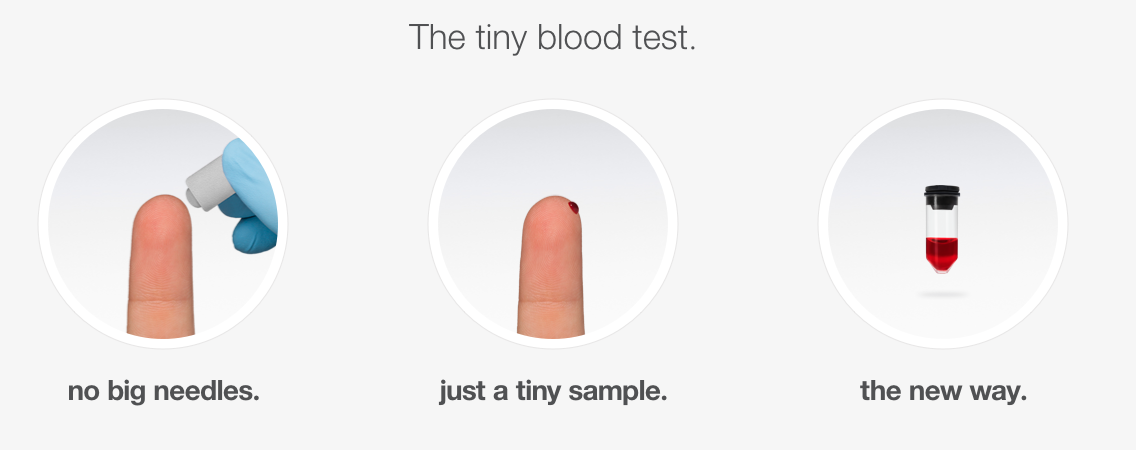
An American start-up medical technology company, Theranos, is now developing a way that will change the face of healthcare, letting extensive blood work be done by a “single drop of blood”. We love the approach.
Founded in 2003 by Elizabeth Holmes, a young chemistry major at California’s Stanford University, Theranos (a combination of the words therapy and diagnosis) is now introducing its unique blood testing into American medical centers, including those that cater to people who have limited financial means.
Holmes, 31, was recently interviewed on a health and wellness program on CNN. During this interview, she said that when a doctor orders a blood test, between 40 and 60 percent of Americans do not have the tests performed due to high costs.
She says: “When a doctor orders a blood test, it usually means a person is already at risk of having some kind of health problem like a serious disease. Human error is also responsible for 93% of errors in the blood test itself,” she said on the show.
The Theranos method is extensive and includes more than 200 different types of tests. The technology is licensed in every US state.
Using a testing procedure called the “nanotainer” – Theranos, though it does not report how, does manage to get results from smaller amounts of blood. The Theranos blood testing method is not only being hailed as much lower in cost to standard testing methods, it is also good in helping to detect certain serious ailments like diabetes and cancer at early stages, making treatment much more successful.
Presumably the company is using lab-on-a-chip methods, with software to amplify signals seen in the blood to confirm a diagnosis.
Theranos test means less pain
Besides the costs factor, taking only a small blood sample amount makes it easier to do tests on children and elderly people whose veins are hard to find for taking blood samples.
“We are very focused on the ability to mitigate the pain people who have to give blood frequently experience as their veins collapse from frequent blood draws. This helps make it possible for little children to get tested without being scared, or for elderly patients, oncology patients and people whose veins are difficult to find,” Holmes added.
This type of innovative bio-technology can work well in developing countries, where facilities to adequately store and work with large quantities of blood test samples may be scarce. This especially holds true for many parts of the developing world, including the Middle East.
Read more on Middle East health issues:
Polio Scare in Syria, Israel and Egypt puts Middle East on Edge
Hard to Breathe in the Middle East – Latest NASA Images
Israeli Meat Fed with Faeces and Pumped with Toxic contaminants
If Jordan waives visa fees, will tourists come?
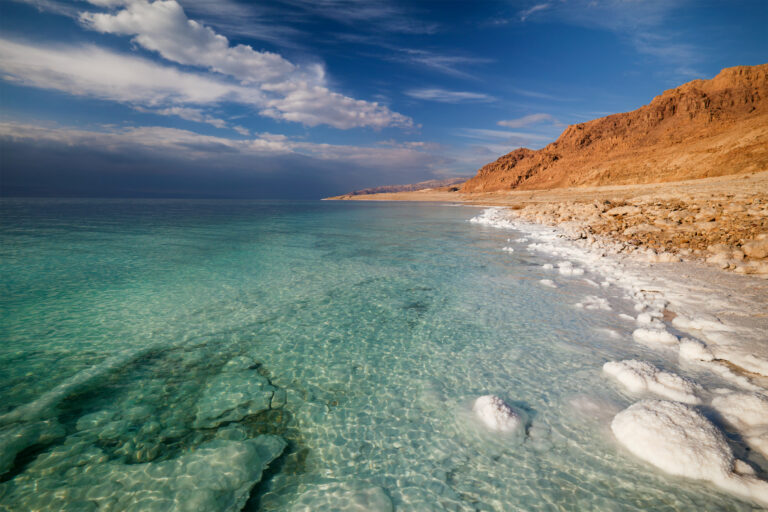
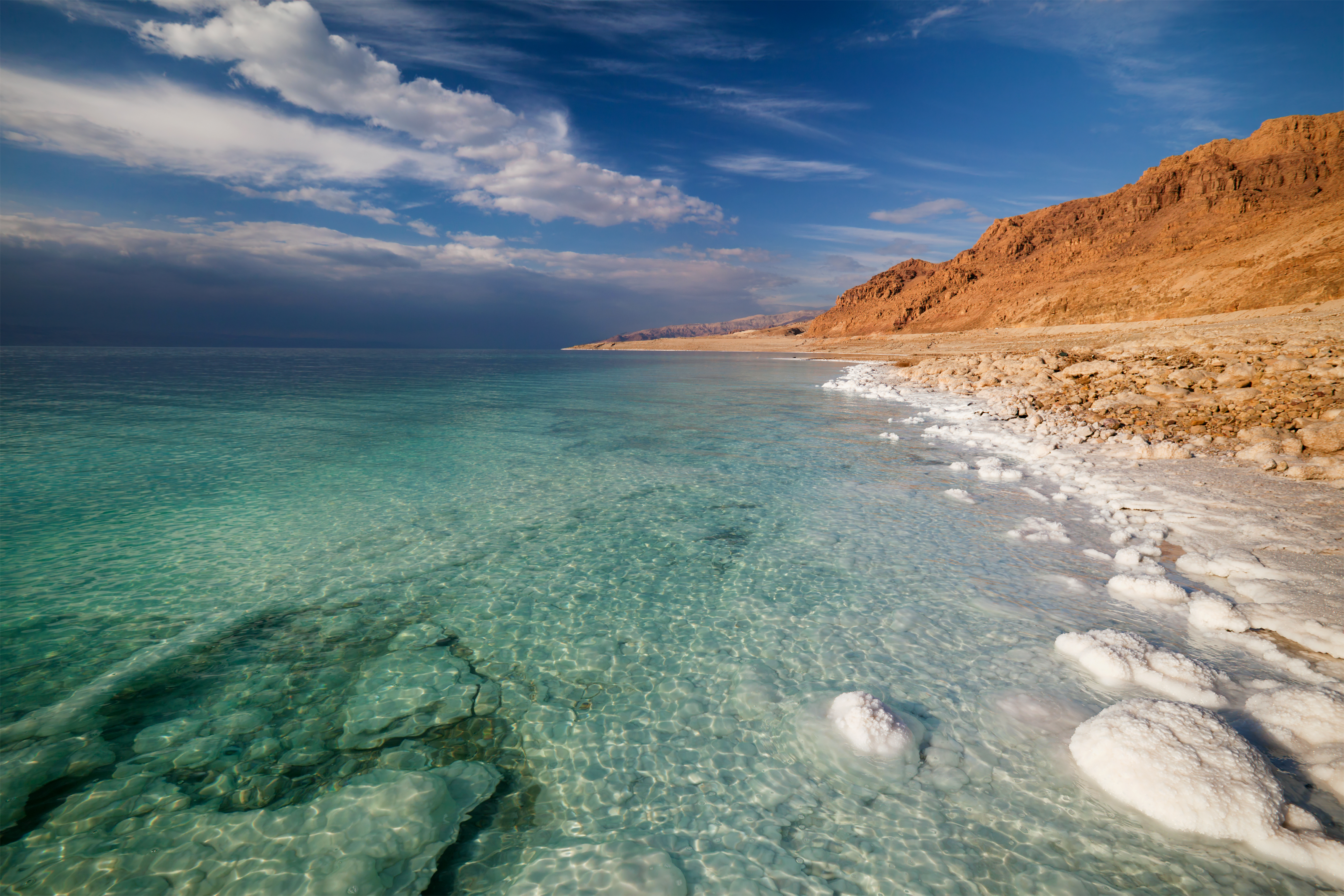 Jordan will waive its 40 dinar ($57) visa fee for incoming tourists to make visits to Jordan “more convenient and affordable for people of all nationalities,” according to a government press release. The action aims to boost tourism to kingdom attractions such as Petra, Pella, and the protected area of Wadi Rum.
It’s just one of several new initiatives to reinvigorate Jordan’s flagging travel industry. The kingdom’s 15 dinar ($21) departure tax will also be waived for all flights from Aqaba and Amman, on condition that visitors buy a ticket to touristic site and spend a minimum of three consecutive nights in Jordan. (Details about how this exemption works are unclear – this tax is now factored into overall airplane ticket fees). The Jordan Tourism Board expects these changes to be in place by September.
Royal Jordanian, the national airline carrier, has announced discounts for flights bought as part of a package, and hotels in Amman, Aqaba, and along the Dead Sea are offering promotional room rates to attract guests.
 The decision will benefit people travelling via tour operators who spend a minimum of two consecutive nights in country. Travelers must still get an airport entry visa, but it will be free. The deal for independent travelers is not yet clear, but they must prove a longer stay in country (three consecutive nights) and show receipts for a “unified tourist site ticket”.
Jordan’s tourism industry has been pummeled by world perception of terrorism and war. Security concerns arising from conflict in neighboring Syria, Iraq, Israel and Gaza spill across the Levant, painting the entire region with the same jittery brush. The murder of the Jordanian pilot Muath Al-Kassasbeh by ISIS jihadists – while not on Jordanian soil – also did little to assuage travel fears. Both the US State Department and British Foreign Office appraise Jordan as safe for tourism, advising only against travel to the Syrian border. Common sense advice like “don’t play with fire”.
 Educated consumers could engage in basic due diligence and verify that Aqaba isn’t Aleppo and Gadara (modern Um Qays) isn’t Gaza. But given limited time and money for holiday-making, many are apparently opting to spend their vacation in places devoid of hyped safety threats – think Cyprus or Lanzarote – deferring visits to Jordan’s holy sites, nature reserves and eco-adventures until its neighbors settle down.
 The Jordanian Ministry of Tourism and Antiquities reported that the numbers of foreign overnight and same-day visitors to Jordan dropped from 8.2 million in 2010 (before the Arab Spring) to 5.3 million last year. Visitors to the UNESCO World Heritage Site at Petra have halved since 2010. The impact is felt across the kingdom’s economy.
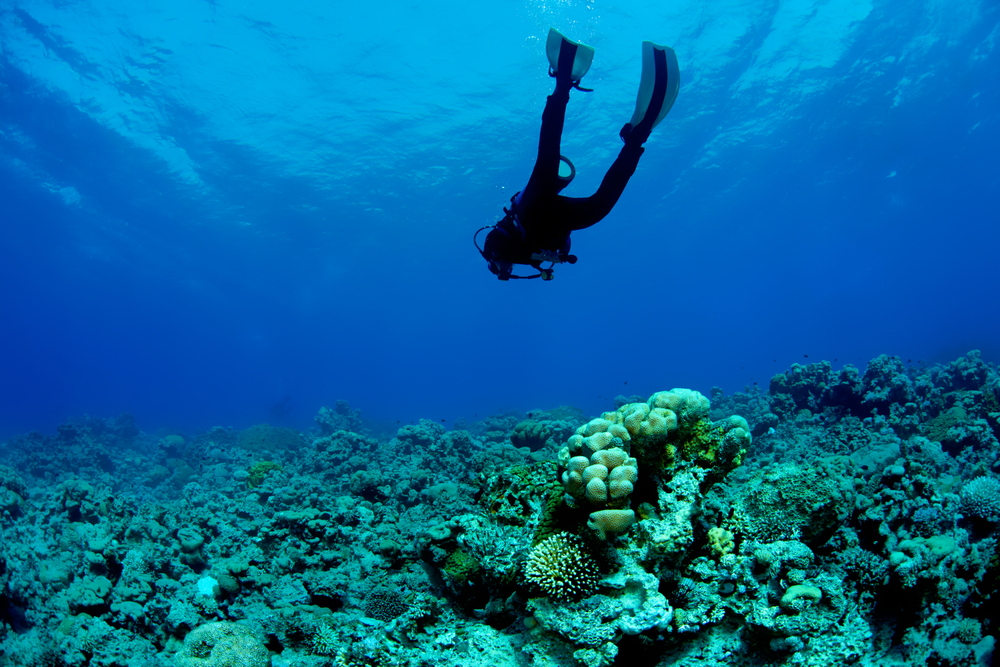 Nayef Al-Fayez, Jordan’s minister of tourism and antiquities, said that the measures aimed to “encourage travelers to add Jordan to their next itinerary” and would help to promote the country as an accessible, safe, and inviting destination.”
Will this pull more visitors into the kingdom? Those that do come are mostly motivated by the natural and cultural beauty. Many more travel here for the same reasons that keep recreational tourists away (aid agencies, NGO workers, media, diplomatic corps). There is also a rigorous influx of medical tourists, and of course refugees.
I’m starting my fifth year in Jordan. It’s beautiful. It’s safe. Come visit.
Images of Dead Sea, Jerash, Wadi Rum, Petra, and Aqaba’s Red Sea coral from Shutterstock.
Solar Impulse flying longest leg of round-the-world-journey
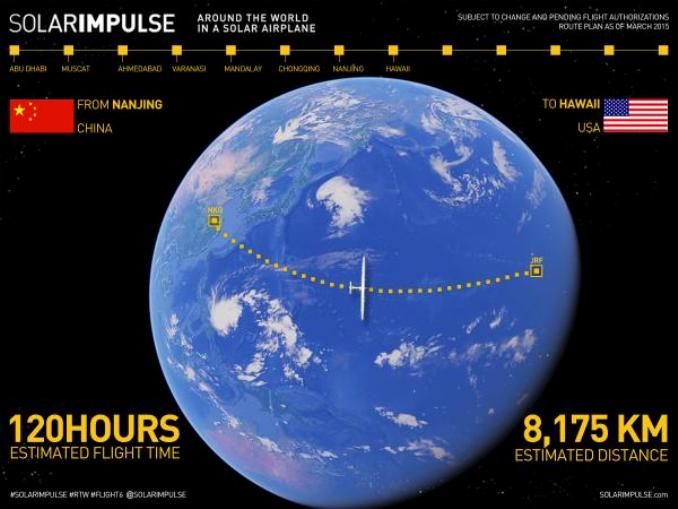
As of posting time for this story, pilot André Borschberg had been flying for over 24 hours on Leg 7 (of 12) of the Solar Impulse 2 trip around the planet. He’s completed about a quarter of his journey from Nanjing to Hawaii, the longest segment of this record-shattering expedition. And it’s all made possible by the energy of the sun.
Does the Cannes Film Festival recycle cans?
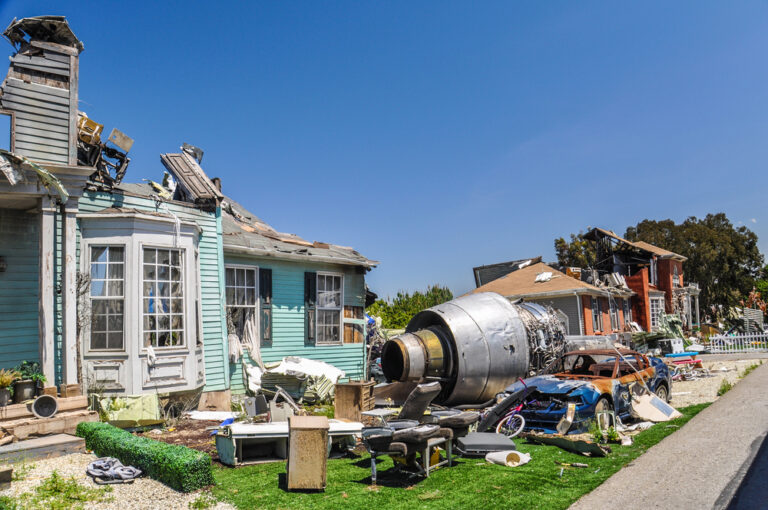
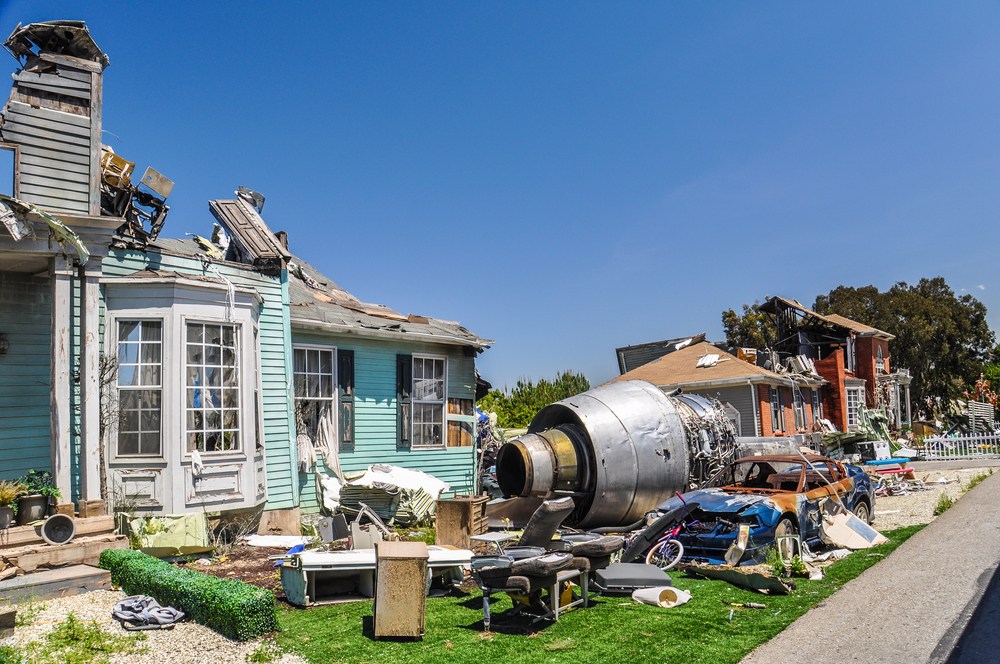 Cannes Film Festival is in full swing this week, but here in Jordan every day is a film festival thanks to vendors who hawk bootleg DVDs for a dinar apiece. That’s less than two bucks for a new release that would otherwise set you back $20 in a Manhattan theater. The downside with Amman’s cheap movies is you don’t always get what’s advertised, and what I planned to watch last night had an unintended Russian soundtrack. So I turned to cable TV and found a gem of a film called Greenlit. Five years old, its message is still worth the price of admission.
5 ways to stop animal trafficking
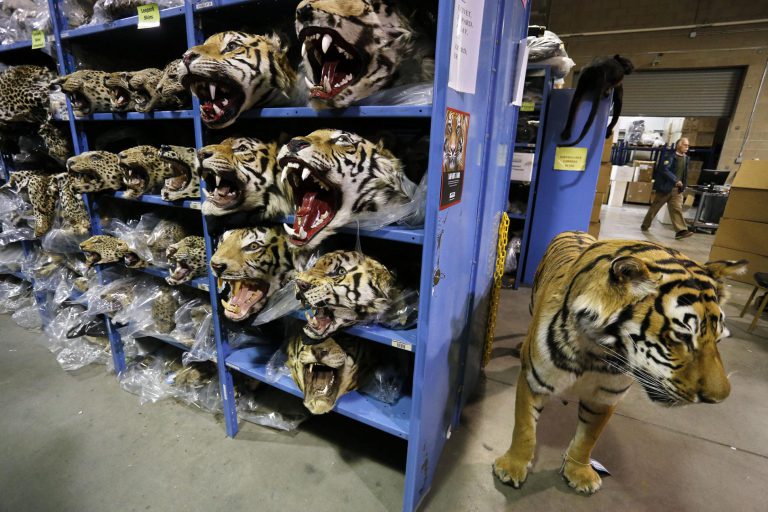

Wild animals shouldn’t live in palaces, connected to leashes and paraded around streets in the Gulf Region like they are trophies. Dolphins shouldn’t be captured to live in cramped, private pools (read this story on the 4 dolphins living in a filthy pool in Egypt). Elephants shouldn’t be killed for tusks, or wild birds kidnapped from the nest to be sold at an exotic pet store.
There are so many moral and spiritual reasons as to why animal trafficking has to stop. Sadly, the deep pockets of Middle East millionaires with wild animal fetishes makes the Middle East a prime location for illegal animal import.
Deep pockets and access to private jets are another reason. So how can we as individuals stop animal trafficking in its tracks? Most of us aren’t brave or bold enough to pack up our lives and head to the jungles – where animal trafficking starts. But we can follow the following guide to help bring an end to this sad and gruesome hobby.
Putting crime in a museum
Wildlife trafficking is wreaking havoc on particularly vulnerable animal populations across the globe, and stands as both a critical conservation concern and a threat to global security.
“This is a real problem that impacts us all, even if we are not the ones making the product purchases,” states Janine Vaccarello, chief operating officer of the Crime Museum in the United States. “We should all take an interest in ensuring these animals are not being treated cruelly and that we no longer diminish their populations.”
The Crime Museum in Washington, DC is putting a spotlight on this critical issue, marking World Environment Day by opening a new temporary exhibit titled “Ivory, Tortoise Shell, & Fur: The Ugly Truth of Wildlife Trafficking.”
The exhibit aims to raise awareness among museum visitors about an often overlooked crime.
“This is an issue that we are taking seriously and are determined to address,” explains William R. Brownfield, Assistant Secretary of State from the Bureau of International Narcotics and Law Enforcement Affairs. “The government is on board with the fight against illegal wildlife trafficking, but it’s also important that consumers get on board, too.”
5 facts about wildlife trafficking:
1. They are going extinct. It is estimated that in the last century we have lost 97 percent of the world’s tigers. In just the last 13 years there has been a 76 percent decline in the elephant population. In 2014 alone, there were over 1,200 rhinoceros killed in South Africa. Each of these animal populations are being severely depleted in large part due to illegal wildlife trafficking.
2. Organized crime pays. Wildlife trafficking has become one of the most lucrative types of transnational organized crime in the world, with annual revenues conservatively estimated to be worth billions of dollars per year. With such a lucrative market, this has led many criminals to engage in this illicit activity, driven by high demand and high profits for illegal wildlife as well as a low risk of detection. The items illegally traded include tiger bone, elephant ivory, bear bile and fish bladders, rhinoceros horn, sea turtle shells, pangolins, and more.
3. Know what you are buying. Despite the conservation concerns, there are people who knowingly purchase such items, but there are also those consumers who buy the products unknowingly, thus further contributing to the issue. They may purchase wildlife products, such as tortoise shell hair clips or elephant ivory carvings, without any awareness of the impact it has on the poaching situation in local communities.
4. Don’t smuggle into America. The US government is taking a strong stand in the fight against wildlife trafficking, through the recently released Implementation Plan for the President’s National Strategy for Combating Wildlife Trafficking. The Plan includes such directives as strengthening domestic and global enforcement, reducing demand, and expanding international cooperation.
5. Consumers have power. Buyers can play a role in helping to combat this global problem, starting with not purchasing any wildlife or wildlife products. When the demand for the products stops, so too will the number of animals being poached. Consumers can also learn about the issue, share that information with family and friends, and drive retailers to stop carrying illicit wildlife products.
5 ways to stop animal trafficking
PHOTOGRAPH BY JEAN FRANCOIS LAGROT
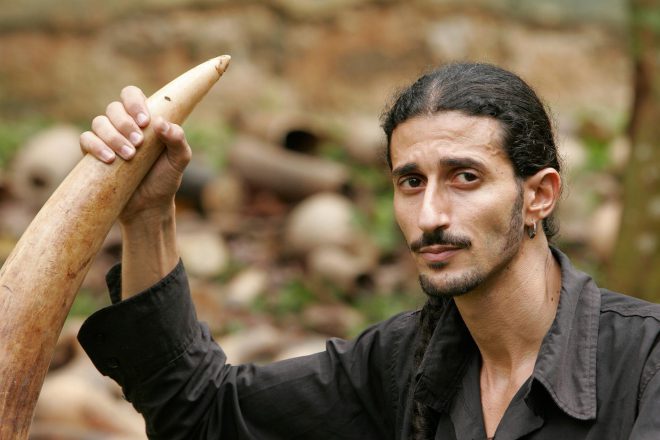
1. Support anti-trafficking people and projects. Ofir Drori has been fighting poachers for 2 decades in Africa. He puts life and limb at stake while making sure those in the chain get arrested and face the punishment of the crime.
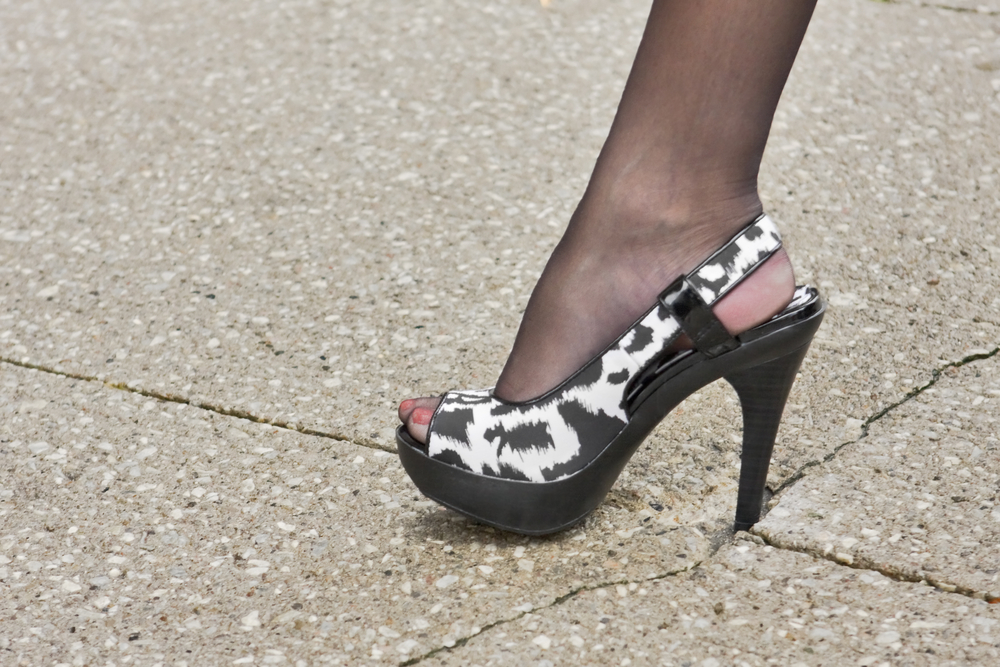
2. Never buy wild animal products. Don’t fetishize them in any way, as fur, as tusks, as horned-rimmed glasses. An ethical question: should we stop wearing animal prints, even if they are fake?
3. Beware of natural medicines from countries like China. They are notorious for using rare animal parts that decimate wild populations of animals. They use tusks, teeth, brains, testicles.
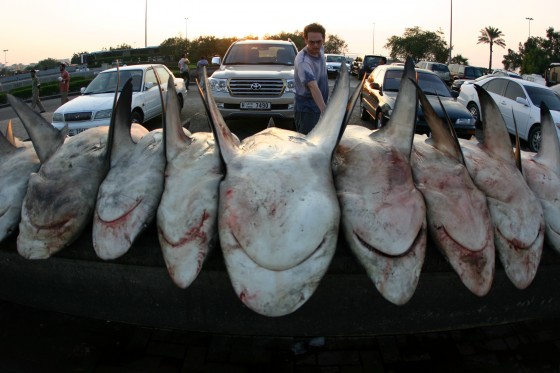
4. Eat only sustainable seafood and meat. Not rare lion steaks. Not sharks. Or shark fin soup. Here are 7 Gulf fish totally okay to eat.
5. Report any illegal wildlife trade or products to your local authorities or to Green Prophet. Wild animals often appear in unregulated markets in the Middle East in Beirut, Tel Aviv, Istanbul, Cairo, Amman and Dubai. You might not believe your eyes when you see it, but it’s more common that you think. As one of our writers found out in the Emirates.
Russel Simmons against wildlife trafficking
Numerous celebrities have also weighed in on this important issue.

“More awareness about the process and consequences of illegal trafficking is the key to stopping the harming of innocent animals,” says Russell Simmons, an entertainment mogul. “Raising public awareness is the first step in stopping the purchase of jewelry made of ivory or tortoise shell or clothes made with real fur and helping these animals.”
The Wildlife Trafficking exhibit was held at the Crime Museum from June 2015, through February 2016, and it provided an opportunity for visitors to view a serious crime issue, and learn how to be a part of the solution. For more information, please visit their website here.
Read more on animal trafficking:
Ofir is stopping poaching in Cameroon
Dubai Porsche driver walks cheetah on a leash
Live Baby Leopard Found in Suitcase En Route to Dubai
Shocking new way to preserve dairy, without a fridge
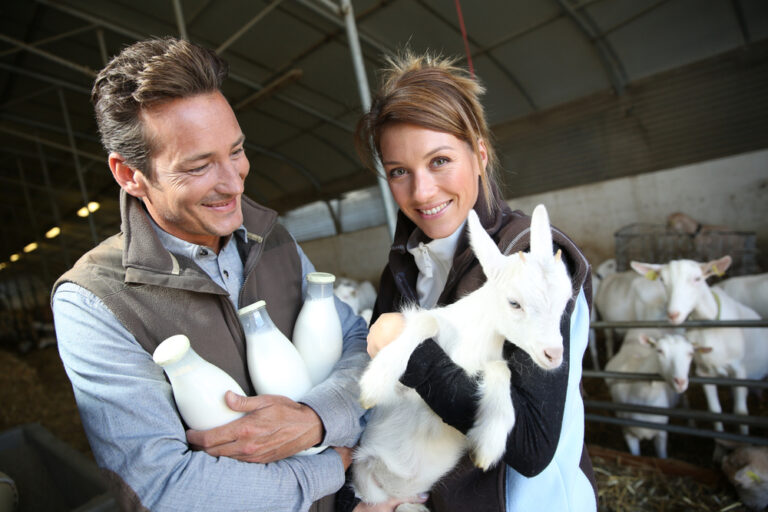

Most people in the developing world need to produce their own food, and most of these people do it inefficiently, making food security far out of reach. People buy a cow, or camels for milk, goats or even sheep to get a daily, fresh supply of dairy. There is virtually no way to preserve it using refrigeration and boiling, or pasteurization, because it is too costly.
And think about all the crazy people going off grid. They too need a cheap and simple, low in energy way to save precious resources milked at the farmstead. Can a simple solar-based solution replace the fridge?
Related: This farmer swears he can milk his billy goat
New, cost-effective answers lie in a simple and shocking technology. Researchers from Tel Aviv University have shown that simple electric pulses, in a process called electroporation, can kill the bacteria that contaminate milk. The process kills bacteria dead and the researcher of the study, Alexander Golberg, says this process can prolong milk’s shelf life.
“We are on a constant hunt for new, low-cost, chemical-free technologies for milk preservation, especially for small farmers in low-income countries,” says Golberg. “For 1.5 billion people without adequate access to electricity, refrigeration is simply not a possibility and boiling does not preserve milk’s freshness over time.”
According to the study, pulsed electric fields, an emerging technology in the food industry that has been shown to effectively kill multiple food-born microorganisms, could provide an alternative, non-thermal pasteurization process.
The stored milk is periodically exposed to high-voltage, short pulsed electric fields that kill the bacteria. The energy required can come from conventional sources or even come from the sun. The technology is three times more energy-efficient than boiling and almost twice as energy efficient as refrigeration.
An alternative for poorer countries
In developed countries, bacterial growth in milk is managed with refrigeration. But certain pathogens like listeria monocytogenes are less sensitive to low temperature so can proliferate during transportation and in storage. “Refrigeration slows the bacteria’s metabolism, but pulsed electric fields kill them,” says Golberg. “They are a fundamentally different approach to controlling microorganisms during storage.
“Our model shows that pulsed electric fields preservation technology does not require a constant electricity supply; it can be powered for only 5.5 hours a day using small, family scale solar panels,” he says. “I believe that this technology can provide a robust, simple, and energy-efficient milk preservation system that would decrease the amount of wasted milk, thus increasing the income of small farmers in developing countries.”
Image of goat milk via shutterstock
Floating farms may soon feed the world!
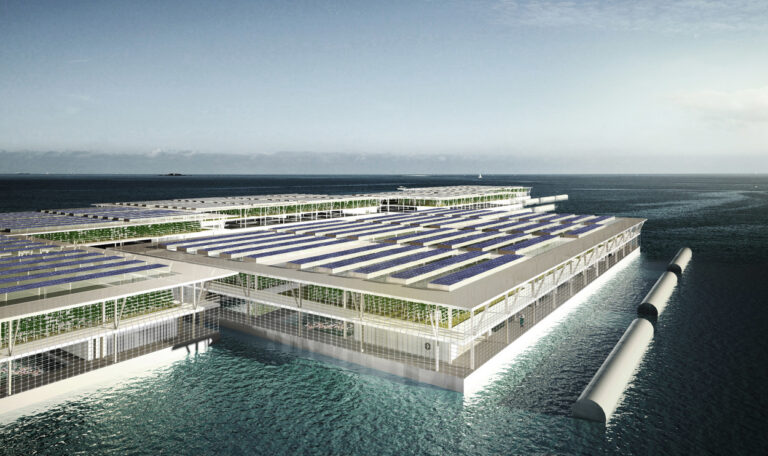
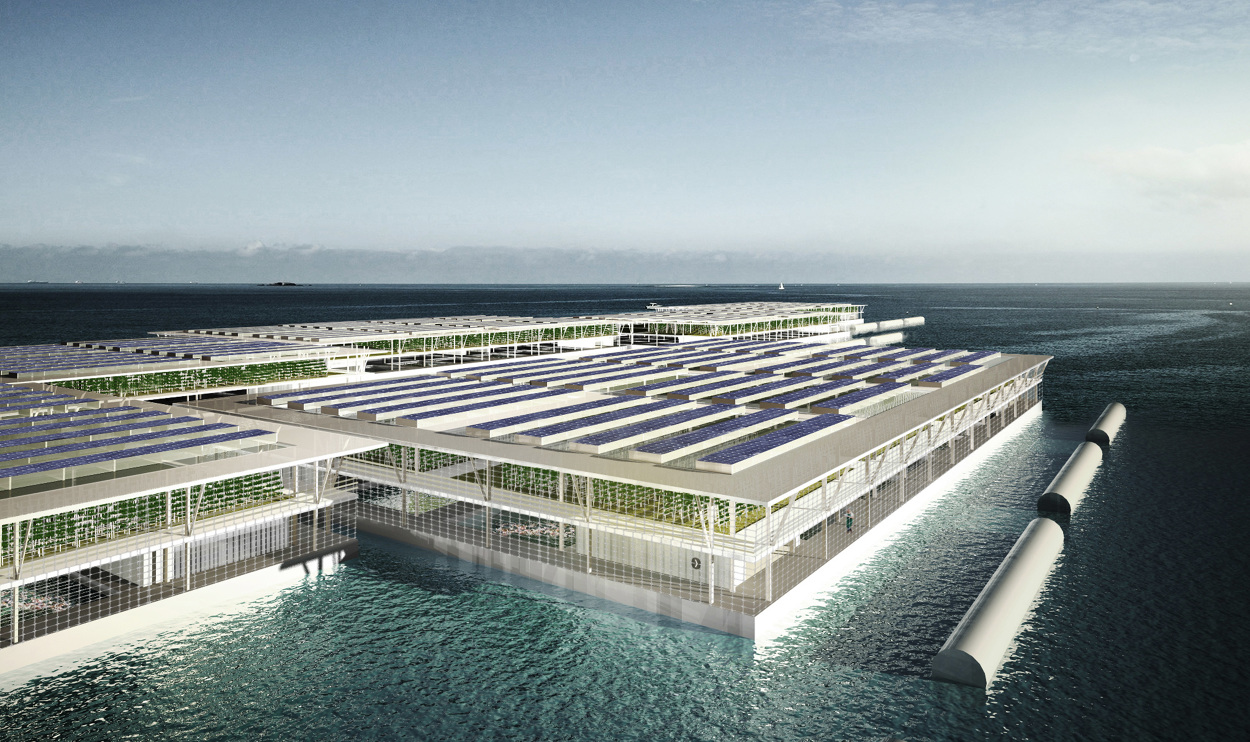 World population will balloon from 7 billion today to more than 9 billion in 2050, with associated food demand predicted to increase by 70% in that same time-frame. How will the agricultural sector meet that demand without stressing natural resources and further accelerating climate change? Take a look at SFFs, a food production solution based on floating farms.