We definitely want to see a lot more news like this: in the heart of a dry, relentless desert in Jordan that gets almost endless days of sun shines a new project to give its people access to clean energy. Thanks to Abu Dhabi’s renewable energy company Masdar, of which zero-energy city Masdar is also named energy-poor Jordan gets a new project under the sun. This month Masdar officially cut the ribbon and inaugurated the Baynouna Solar Park in the Middle East country of Jordan.
The Baynouna project produces enough solar energy annually to power 160,000 homes, making it the largest clean energy project in Jordan. Thanks to the sun, the Masdar-financed project displaces 360,000 tonnes of CO2 per year, supporting the global energy transition towards green energy.
The inauguration was attended by Khalifa bin Mohammed bin Khalid, UAE Ambassador to Jordan, His Sultan Al Jaber, UAE Minister of Industry and Advanced Technology, COP28 President-Designate, and Chairman of Masdar, and Bisher Al-Khasawneh, Prime Minister of Jordan.
Masdar, also known as the Abu Dhabi Future Energy Company, is a UAE-government owned renewable energy company based in Abu Dhabi, United Arab Emirates.
Jordan is one of the poorest countries in the world and unlike neighboring Saudi Arabia does not earn money from oil exploration as most of it is locked up in oil shale.
This new solar energy project is a God-send: Located east of Amman the project started operating in 2020, and commercially was developed as a Power Purchase Agreement (PPA) between Masdar and the National Electric Power Company, Jordan’s state electricity provider. Some $260 million USD in financing now generates 563.3 gigawatt-hours (GWh) of electricity each year, equivalent to 4 percent of the annual energy consumption of Jordan.
This 200 MW solar power plant along with Masdar’s 117 MW Tafila windfarm in Jordan will help Jordan reach its goal of producing 15 percent of its domestic electricity needs from renewable sources. While Jordan gets plenty of sun and has almost endless desert terrain, wind farms are a problem. One of the largest bird migrations is shared with Israel, Syria and Lebanon as millions of birds migrate from Africa to Europe and then back again every year. Israel was also keen on developing wind farms, but environmentalists have shut most ideas in that direction down.
Fusion could solve climate change and power our planet overnight. Small steps were made in the US in Dec. 2022. We are not there yet but the key is to not stop trying.
Fusion is a hypothesized type of nuclear reaction that would occur at, or near, room temperature. It would contrast starkly with the “hot” fusion that is known to take place naturally within stars and artificially in hydrogen bombs which leave radiation behind. The promise of fusion of hydrogen atoms has come and gone over the last 40 years, with headlines being made in science once again. If we can solve fusion, we’ve solved climate change and greenhouse gases forever. Hydrogen is available and abundant and we could all have shisha-like reactors at home, charging our private EV everything, but fusion, well, it’s not so easy. We are going to explore the how, why and whens of fusion.
According to both the Financial Times (Mar 23, pg. 1, 26, and 22) and the Wall Street Journal (Mar. 23, b1 & b8) two scientists will announce indications of room temperature fusion of heavy hydrogen (deuterium): This announcement appeared in the Sci.physics Usenet group on March 23, 1989 –– only ten days after a new technology known as the World Wide Web was announced on Alt.hypertext. The net was alive with excitement about the possibility of cheap and clean energy from a tabletop fusion device somewhat resembling a Shisha Middle East smoking pipe, or a Belgian syphon coffee maker.
SPAWAR- First Generation Cold Fusion Cell. Photo Credit Steven B. Krivit
The price of palladium used in their device rose 30% and the USSR minted a palladium coin. Research teams around the world scrambled to reproduce this “cold fusion” with varying degrees of success. Father of the Hydrogen-bomb Edward Teller expressed scepticism over Pons and Fleischmann’s fusion breakthrough but later worked with researchers. He was hopeful that the fusion that made his weapon so devastating could finally be tamed to serve humankind. It seemed too good to be true! Clean and cheap energy, forever. And it was.
One of the mistakes Pons, Fleischmann and others made is something Green Prophet discussed in our recent article on geological hydrogen. They had assumed electrolysis was 100% efficient but in reality at least 30% of the energy input is converted to heat. They mistook this resistive heating as fusion energy. The good news is that it didn’t work and hit Pons and Fleischmann with a fatal dose of neutron radiation. Fusion faded into the fringe and lost momentum as its proponents moved to more profitable junk science. But hot fusion research continued its slow and unsteady pace.
Fusion, here we go again?
Fusion device, Lawrence Livermore National Laboratory
Anyone old enough to remember the fusion debacle should be forgiven for being sceptical when the America’s Lawrence Livermore National Laboratory (LLNL) announced a fusion breakthrough at their National Ignition Facility (NIF) in December 2022. This new hot fusion device didn’t resemble Pons and Fleichmann’s contraption at all.
It looks more like something Dr. Evil would fire at a comic book superhero. The LLNL scientists used 192 lasers, each with a beam width of about a meter. Together they can produce up to 500 trillion watts. Their light was focused and timed so their ten billionth of a second (0.1 nanosecond) pulses of light each about 1 inch long would simultaneously hit a cylinder containing a sphere smaller than a peppercorn. The sphere contained two isotopes of hydrogen, deuterium and tritium. This hot fusion experiment was a success.
The lasers pumped 2 megajoules (MJ) of energy into the cylinder generating X-rays which compressed and heated the deuterium and tritium enough that some fused and output 3 megajoules. The net energy gain was 1.5 times.
Fusion energy enough for a tea party
The extra megajoule generated by the NIF fusion experiment was enough energy to bring a few cups of water to a boil. That’s worth about three cups of tea. When we put it that way it doesn’t sound like much does it? This experiment was never meant to become a commercial fusion reactor but it shows that it is possible to use laser confinement to release more fusion energy than is put into the system.
LLNL, lasers used to generate energy using fusion
This breakthrough is comparable to the Wright brother’s 12-second flight in 1903. We can’t imagine flying across the world with 36 meter 12 second hops but the brother’s Kitty Hawk experiment with kite and bicycle parts proved that heavier than air flight was possible.
Likewise, LLNL showed that a laser confinement fusion power is possible even if it isn’t practical until it can target its lasers at more than one peppercorn for longer than a ten-billionth of a second.
Composite photograph showing three stories of the Target Bay and many of the final optics assemblies and diagnostics surrounding the Target Chamber at the center. Credit: Jacqueline McBride LLNL.
A brief history of fusion and why it’s so hard
The first nuclear fission chain reaction occurred under the bleachers at University of Chicago’s abandoned Stagg Field. Enrico Fermi led his team to build the Chicago Pile-1 (CP-1) atomic pile out of graphite, uranium, wood and other materials beneath a University of Chicago football stadium. At 3:25 p.m on December 2, 1942 a Manhattan Project scientist named George Weil pulled a control rod from CP-1. With the neutron-absorbing control rod removed, each neutron released by a uranium atom would trigger the release of more than one neutron.
Chicago Pile-1 became the world’s first self-sustaining nuclear fission reactor. This Lego video explains CP-1 atomic fission history”
Until LLNL produces its own Lego fusion video, we have this explanation of December’s NIF laser confinement fusion breakthrough:
Swords, ploughshares, bombs and cups of tea
The December 1942 CP-1 fission experiment ran for 28 minutes, about 16 quadrillion times longer than NIF’s laser fusion breakthrough but CP-1 only produced about 1/2 watt. This wasn’t even enough power to make a nice cup of tea but shortly afterwards Leo Szilard, the man who invented and patented the nuclear chain reaction told Enrico Fermi that this would be a “black day in the history of mankind.” Szilard was right: the Chicago Pile-1 paved the way for the atomic bombs dropped on Hiroshima and Nagasaki Japan less than three years later.
The first nuclear fusion bombs were tested only six years later and the first nuclear fission reactor began generating electricity at Windscale UK in 1950, only eight years after CP-1. Today there are more than 10,000 atomic bombs in at least nine countries and 400 nuclear fission reactors in at least 30 countries. But as of December 2022, 80 years after Chicago Pile-1 we did not have a single self-sustaining fusion reactor.
Why is fusion better than fission?
In nuclear fission, protons and neutrons are split from a heavy atom’s nucleus, generating energy, radiation and lighter elements. In nuclear fusion, the nucleus of light elements are fused together, releasing energy, radiation and heavier elements. One of the advantages of fusion is also what makes it so difficult. In December’s NIF experiment, carefully timed lasers and perfectly spherical heavy hydrogen capsules could only keep the reaction going for about a ten billionth of a second. Alternative tokamak fusion experiments using doughnut-shaped magnetic confinement instead of lasers have also shown promise but so far the longest sustained fusion reaction was only 17 minutes.
But once a nuclear fission chain reaction starts it will run its course unless something stops it. Chicago Pile-1 had no cooling system and its control system relied on pulleys, clotheslines, electric motors, emergency buckets of cadmium salts and a manual control rod operator named George Weil. In retrospect they were lucky. Building an atomic pile beneath an urban football stadium sounds like a “hold my beer” kind of thing to do. If these scientists had removed the control rods and abandoned the project, the nuclear reaction might still be running today after melting a radioactive hole in the earth near downtown Chicago.
CP-1, CP-2 and CP-3 were eventually decommissioned and buried beneath a wooded picnic area. In the 1970s to 80s they were found to be leaching radioactive material into the soil and ground water. This gives us the other big advantage of nuclear fusion: The fuel and fusion reaction can be designed to minimize radioactive waste.
In NIF and other deuterium-tritium fusion reactors, two isotopes of hydrogen (tritium being radioactive with a half-life of 12.33 years) are fused into helium. Most of this helium is the same non-radioactive isotope children use in party balloons. The neutrons released during the reaction can make parts of the reactor radioactive but this is easier to manage than the messy mix of spent Uranium, cesium-137 (half-life 30 years), strontium-90 (half-life 29 years), plutonium-239 (half-life 2400 years), technetium-99 (half-life 211,100 years) released into our water, land and air by fission power plants at Windscale in 1957, Three Mile Island in 1979, Chernobyl in 1986, Fukushima in 2011… There are plenty of reasons why we should continue research into fusion power. One of the reasons we’re impatient with the slow pace of green technological progress may be that our pop-culture mythology distorts the true history of technology. I previously wrote about the long history of efficient lighting. The same could be said of many other things. Rev. Dr. J. W. Carhart was driving a steam-powered car he named The Spark 13 years before Carl Benz patented his first automobile.
An electric skateboard invented by a Roman Catholic Priest named Ányos Jedlik in 1828 predated Elon Musk’s appointment as CEO of Tesla by 180 years. Rather than obsessing over the question “Are we there yet?” we should ask whether we’re still making progress. December’s NIF experiment shows that, yes, we are still making progress towards the goal of fusion energy.
Who is watching your assets over the weekend? Do you have non-toxic fire equipment and is your premise asbestos free?
Fire watch guards help businesses maintain their safety compliance and eliminate the risk of fire. This is especially true at workplaces and warehouses that are prone to fire hazards.
They inspect every nook and cranny for hazards that could increase fire risks or cause other problems. If the guards notice anything, they immediately report it to the right authorities.
General Liability
Whether you own a business, are a landlord, or work at a school, you have to ensure that your property is safe for everyone on it. That includes your clients, customers and employees.
Fortunately, you can protect yourself from a lot of risk with General Liability Insurance. This business liability coverage pays legal defense costs if someone sues your business over an injury, property damage, or advertising mistake.
Many jurisdictions require that construction sites maintain Austin Fire Watch Guards on site until the construction is completed. Failure to do so can result in fines and a construction halt.
Employer’s Liability
Having fire alarms and sprinkler systems is essential for the safety of property owners and businesses. But these measures aren’t complete without a trained professional to monitor the area and respond quickly in case of an emergency.
This form of insurance is designed to protect businesses against losses related to specific errors or omissions that occur as a result of business activities. It typically covers the business owner, employees, and subcontractors.
Construction sites are especially prone to fire hazards due to equipment, materials, and hot labor. Many jurisdictions require that construction sites maintain fire watch guards on-site until they’re complete.
A fire watch guard patrols the building in 15-minute increments and inspects it for safety issues. They also report any potential risks to the appropriate authorities. These guards don’t have the training or equipment of a firefighter, but they can still put out an emergency until a fire department arrives. They’re an excellent addition to any fire protection system and can help you comply with local regulations.
Commercial Auto Insurance
The Road Train can help you get better fuel efficiency. But is it safe?
As a business owner, you put your heart and soul into keeping the company running smoothly. Everything from employees to tools and equipment helps make it happen. But sometimes, something happens that can be detrimental to the business’s efficiency.
One of those things is an accident, which can cause significant damage to your business and its reputation. If your business relies on a company vehicle to get its job done, you need commercial auto insurance to keep the company running efficiently.
Like personal auto insurance, commercial auto coverage helps protect you from losses if your company vehicle gets into an accident. It covers liability, collision, and other costs, and may also provide medical payments and uninsured motorists protection.
Business Owner’s Policy
Often, business owners need a fire watch service to protect their property from fire hazards. This can happen when hot work is in progress or a fire alarm or sprinkler system is malfunctioning.
These fire watch services keep buildings and machinery safe from dangerous fires that could have been prevented. They also act as an extra layer of protection to keep people on the premises safe in the event of a power outage or a natural disaster that results in a fire.
This type of security guard is tasked to manually monitor a building in 15-minute increments to check the integrity of the structure and prevent fires from occurring.
In addition to providing a security solution, this service can help businesses meet compliance requirements for fire insurance policies. They also maintain a record of patrols and ensure that the business meets fire safety regulations. This is a great way to ensure the continued success of your business.
Look for materials in paints and building supplies that suit cradle to cradle ideals in sustainability
It’s no secret that going forward every industry on the planet is looking to become greener and smarter. In fact, it isn’t a choice. Leading NGO commentators have made it clear that for a business to survive, it needs to take its environmental social governance responsibilities very seriously.
An industry that you’d expect to struggle would be construction. It uses a wrath of unsustainable materials on a daily basis. Happily, that seems to be changing as companies like Xiran go the extra mile to create building materials that remove and replace unsustainable elements.
Xiran specialises in SMA (styrene maleic anhydride) derivatives and additive solutions, so let’s explore the benefits in more depth.
What is Styrene Maleic Anhydride (SMA)?
Styrene maleic anhydride is a coating that has a range of applications including but not limited to wall paint, furniture coating, painting metals, and colourants and dispersions. SMA adds protection to materials enabling them to withstand water ingress, corrosion, stains and pigment dispersion.
Advantages of SMA
There are several advantages of using an SMA coating. Let’s explore these in more depth:
Protects surfaces from water – Water can do a lot of damage if it manages to penetrate a material. It can render the material obsolete and it has to be replaced. SMA protects against water penetration and as such any material that is exposed to the weather is now impervious to and repels water. This is called hydrophobia.
Protects against glass transition – When a material such as PVC is manufactured, they go through changes when the material is cooled. To keep the rigidity, durability, and hardness of materials, SMA coatings are used to keep the material stable when it comes under temperature stress. Once applied, the material is now protected from corrosion, scratching, and abrasion, and is overall easier to clean.
Compatible with other resin systems – One significant advantage SMA has is that it is compatible with other resin systems. As such, the trade-off in performance is significantly decreased and often the SMA coating adds to the performance, look, and creates a better end product.
It’s highly versatile – SMA is also an extremely versatile product. It can be combined with alcohols and amines to adapt it to various uses such as dispersants, emulsifiers and surface modifiers. It can also be used with co-resin and matting agents.
SMA and Sustainability
Polymers can be made sustainably
One of the key aspects of using SMA is its sustainability properties. Traditional solvent use is comprised of unsustainable substances that while offering good performance is not so great for the future.
SMA replaces many of the unsustainable ingredients but still delivers exceptional performance, especially in the areas of stain and scrub resistance.
It is durability and performance that promotes sustainability by design. By enhancing and prolonging the life of a material, SMA adds sustainability to a material reducing repair and maintenance times which tend to involve the use of other materials and tools that may have a sustainability cost.
When sustainability is factored in, then products such as SMA are the future and the way forward.
When faced with inflation, investing in solar energy is like money in the bank.
Interest rates indicate how much it costs to take money on loan and how much they yield your savings. If you ask for a bank loan, the interest rate is how much you pay for the loan. If, on the other hand, you deposit money in a savings account, interest is the performance you receive on that sum from your bank.
What are interest rates? The interest rate indicates this cost or this performance as a percentage of the figure you take or give the loan (in the case of the deposit on the savings account, it is you who “from money on loan” to the bank).
In the traditional financial world, the level of the interest rate depends on many things: on the demand and offer of loans, on the specific use of the money given and more.
Interest rates: what are they?
The simple explanation of interest rates is the cost of money. It is measured as a percentage and indicates the cost incurred by those who use a sum of money for a certain period.
In practice, it represents how much it costs to take money on loan and how much they give fruit to your savings.
The example from colleges is that of the interest rates of a financing operation: whether it is a family mortgage or a small saver account or a loan paid to a company, by interest rate we mean the cost of the money granted on loan.
This cost is calculated as a percentage of the total sum paid by loan by the financial subjects who are mainly banks.
Any financial operation has a cost and this corresponds to the interest rate. It is therefore evident that those who obtain the loan pays the interest rate to their creditor (the bank) and that, particularly to those who receive it, it is a revenue.
Interest rates and inflation
In a scenario with growing inflation, the central bank of a country reacts by raising interest rates, that is, the cost of money increases to discourage access to credit; In this way it begins to circulate less currency and, inevitably, inflation tends to decrease. Commercial banks transfer a part of these higher rates to its customers, which reduces the purchasing power of companies and consumers. For example, it becomes more expensive to borrow money for a house or car.
Ultimately, the increases in interest rates acts to slow down the expense and encourage savings. This motivates companies to increase prices at a slower pace, or lower prices, to stimulate demand.
Inflation in a few words
Different classes of activity behave well in inflationary environments.
Material activities, such as properties and raw materials, have been historically seen as coverage against inflation. Some specialized securities may maintain the purchasing power of a portfolio, including some sector securities, bonds indexed to inflation and securitized debt.
Solar powering your house is easier when you are off-grid. It is a buffer against rising energy costs and inflation
Investments sensitive to inflation is accessed in various ways both as direct and indirect investments.
The interest rate in a nutshell
The interest rate is an investment parameter expressed in percentage that indicates the interest rate to which the invested capital is remunerated. Each investment has its own interest rate which provides key information on the same.
So what to do when investing?
The main objective becomes the protection of the value of the portfolios in real terms. Therefore, raw materials and metals (both industrial and precious – think about batteries for electric cars!) as a structural components of the investment wallet will be advisable. The liquid component (cash) will be considered in a function other than the traditional one (risk -free asset), that is, for the optional characteristics that make it a strategic asset in periods of volatility. The liquidity award, which favored the massive appeal to the insertion in the portfolios of private assets (private equity and private credit) will be reconsidered in a structural way. Both for the presence of a strong leverage component in the past generation of returns – now put at risk by the increase in interest rates – and because in a phase of financial repression and endemic volatility the strategic value of liquid assets (liquidable ) increases structurally.
CBD can have a positive effect on love and intimacy
When it comes to relationships, the stresses of modern life, health issues, and difficulties with intimacy can make life hard. But by restoring a sense of calm to the mind and well-being to the body, cannabidiol (CBD) can help. Its effects naturally work to improve the connection between you and your loved ones. Even more than that, it can also prolong the feelings of love and bliss a happy relationship generates. Turns out that taking CBD for Valentine’s Day and beyond makes perfect sense!
Improving Openness with Loved Ones
Anxieties and stress seem to be an unavoidable part of day-to-day life, but all that inner turmoil can isolate us. A mental state of fear and nervousness serves to keep us locked up inside our own thoughts, and holding back emotionally. When it comes to relating to our loved ones, being in this headspace can make us short, snappy, and reactive.
CBD’s ability to reduce stress and soothe feelings of anxiety can help you to achieve a more receptive and relaxed demeanour. When we are feeling calm and at ease, we can be more open and vulnerable with those around us. This sense of vulnerability makes us easier to relate to, and facilitates the building of bonds and stronger relationships with loved ones.
The analgesic effects of CBD can also facilitate better connections in relationships- both romantic and otherwise. The sensation of being in pain causes the brain to enter a sympathetic nervous state- i.e., fight or flight. While in this mode, the body’s primary concern is risk reduction and survival- not ideal conditions for building personal connections.
By reducing feelings of pain, CBD can help the body re-enter a parasympathetic state of rest and relaxation. This is exactly when your whole system will be most receptive to kindnesses, communication, and able to appreciate those around you. When the feelings inside our body are ones of calm and serenity, we can extend these to people around us too.
Enhancing Intimacy and Sensuality
For intimate relationships, stress, anxiety, and pain are some of the most effective passion killers. Thankfully CBD can help here too and this article looks at the mechanisms in our bodies that helps us relax during intimate encounters. CBD can quieten the brain’s inner monologue helps keep us more present in the moment, improving mind-body connection. Reduced pain makes room for the enjoyment of pleasurable physical sensations, and its ability to restore hormonal balance can hugely aid feminine well-being.
For millennia, cannabis has been used to treat erectile dysfunction owing to its vasorelaxant effects. CBD’s ability to enhance blood flow throughout the body, not least to the brain and genitals, makes it an excellent aid in the bedroom. Using high-quality pure CBD oil mixed with coconut oil, you can even make your own intimate lube (just don’t use it with condoms). By enjoying it together for massage and intimacy, you can amp up the sensuality and enhance satisfaction for you both.
Loving Feelings that Linger for Longer
Beyond facilitating closer bonds and more loving relationships, CBD can help prolong the feelings of well-being and joy those relationships generate. Oxytocin, the love hormone, is created in the body during moments of closeness and intimacy. Instances like hugging a loved one or holding a newborn child cause a surge of this feel-good substance throughout the body. It is strongly linked with social reward and the building of affection and bonds between people.
Anandamide signalling has been demonstrated to effect a similar surge in oxytocin as reward in social situations. The endocannabinoid anandamide, known as the bliss molecule for its feel-good effects, is quickly broken down by the body upon its release. CBD inhibits the function of the enzyme FAAH, which is responsible for this breakdown, prolonging the feelings of happiness anandamide creates.
Thus, the feelings of contentment that anandamide produces are prolonged by cannabidiol’s presence in the body. More than this, those higher levels of anandamide also mean that more oxytocin is released in response to being around loved ones. CBD can truly be said to help make the most of your close relationships!
Whether you wish to overcome anxiety, stress, or physical discomfort, or just want to enhance and prolong feelings of love and closeness, CBD is perfectly situated to help. So long as you source your CBD from a reputable supplier, cannabidiol can only help make all your close relationships stronger.
Fairy circles of hydrogen gas in Namibia’s Marienfluss valley photo by Thorsten Becker via Wikipedia
It came to him in a dream. Dmitri Mendeleev, the man who invented the periodic table and periodic law, faced poverty in Siberia, prejudice in Moscow, tuberculosis in St. Petersburg and the Crimean war while convalescing from tuberculosis. On her deathbed his mother cautioned: “Be careful of illusion; work, search for divine and scientific truth.”
In February 1869 he wrote the properties of some elements and played something like chemical solitaire to try to understand the pattern before falling asleep. Mendeleev later wrote: “In a dream I saw a table where all the elements fell into place as required. Awakening, I immediately wrote it down on a piece of paper.”
Hydrogen, the lightest and most abundant element in the known universe, remains where he wrote it, alone in the upper left corner of his periodic table of the elements. In 1888 Mendeleev measured 5.8 to 7.5% hydrogen gas seeping from cracks in the Makiivka coal mine in the Donetsk region of Ukraine. Chemists were well aware of hydrogen’s relationship to water when they named it hydrogen, but his was one of the first scientific measurements of geologic hydrogen.
Hydrogen as the perfect fuel
Fast forward to the 1970s when environmentalists were beginning to understand what Eunice Newton Foote and other 19th century scientists had predicted about the impact of carbon dioxide on our climate. Coal, wood, oil and natural gas all release carbon dioxide when they burned but hydrogen burns clean, producing only water vapor. The hydrogen economy hype seemed too good to be true. Our atmosphere isn’t pure oxygen so a hydrogen flame produces some nitrogen oxides (NOx) but it emits far less pollution that any hydrocarbon would. Scientists and environmentalists were in agreement, hydrogen is the perfect fuel!
Hydrogen hydrogen everywhere but not a molecule to burn
There is one problem. Where will we get the hydrogen? The sun is 73% hydrogen and Jupiter is 90% hydrogen but they’re hardly as convenient as your local gas station. Every molecule of water in the world’s oceans contains two parts hydrogen and one part oxygen. By mass the oceans are 10% hydrogen. But the hydrogen in H2O is stuck tightly to the oxygen so it takes energy to split the hydrogen from the oxygen in water. Electrolysis is a process which uses electricity to do this but efficiency levels are less than 70%. So it takes about six kilowatt-hours of electricity to split the hydrogen from oxygen in a 1-liter bottle of water. (See footnote below)
That would be enough to run a television and refrigerator for about ten hours. If that electricity comes from green or carbon neutral fuels we can consider this to be green hydrogen. Manufactured hydrogen isn’t a replacement for fossil fuels but it can be a useful way to store energy to be burned or used in fuel cells.
Geologic Hydrogen
But what if we didn’t have to split hydrogen from oxygen? What if there were places like the coal mine Mendeleev studied in Ukraine with an even higher percentage of hydrogen? Like the chemical patterns revealed in Mendeleev’s dream, so-called geologic hydrogen was there all along but we weren’t looking for it, or we were looking in the wrong places.
Most known hydrogen producing vents are in Eastern Europe and Russia because people there were looking, partly because Russian scientists had accepted an abiotic petroleum theory that required hydrogen instead of organic matter to create underground oil reserves. The western scientific belief that free geologic hydrogen was rare became a self-fulfilling prophecy. Hydrogen is often used as a carrier gas in chromatography instruments used to survey geologic gas. This made these instruments blind to geologic hydrogen.
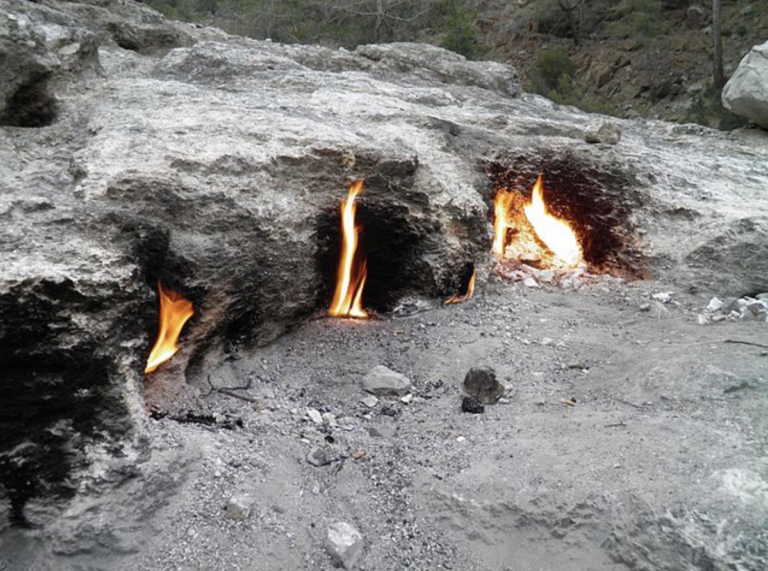
Prospectors started looking harder in response to the energy shortage caused by Vladimir Putin’s invasion of Ukraine in 2022. One such source of “hidden” geologic hydrogen is where an eternal flame burns on Mount Chimaera in Turkey. In his second book of Historia Naturalis (77 AD), Pliny the Elder referred to writings by Ctesias in the fifth century BC suggesting that these vents which “burned with a flame that does not die by day or night” were the origin of the mythical fire-breathing lion-goat monster named Chimera. This is also believed to be the place where the original Olympic torch was lit. The torch in the 2020 Olympics in Tokyo Japan was lit from a cauldron that burned manufactured green hydrogen.
Photo of natural fires on Mount Chimaera, Turkey by Carole Raddato from FRANKFURT, Germany
How does geology create hydrogen?
The exact processes are not known for all sources of geologic hydrogen but some of the basic chemistry would’ve been known by 1904 when Howard Lane built a device that used a reaction between iron and steam to generate hydrogen. Lane’s process was used to inflate balloons for the St. Louis exposition and airships such as the Graf Zeppelin. There are places deep underground where water comes in contact with hot iron-bearing rock. The iron-rich mineral olivine is common in the earth’s mantle and when it comes into contact with water, a reaction called serpentinization occurs which takes oxygen from water and produces hydrogen and another mineral called Serpentinite.
Photo of serpentinite by Hermann Hammer
Other hydrogen generating reactions occur deep within the earth but some, such as radiolysis where the energy from radioactive decay splits water are thought to be too slow to produce useful amounts of hydrogen. The serpentinization reactions may be faster than the slow biological decay which produces coal and petroleum.
Follow the hydrogen faeries
The geology which favors coal, oil and tar-sands is not necessarily ideal for generating and trapping hydrogen. Hydrogen can escape or chemically bond with porous sedimentary rock and some microbes eat it. If high purity geologic sources of hydrogen are common enough to replace some fossil fuels, we may find ourselves in a new age of hydrogen prospecting.
I need to figure out how to prospect for hydrogen among the faery rings in this field about 50 meters from our house. 😉
Fortunately nature gives us some clues. Fairy circles are circular patches where grass and other plantlife is altered. Like the Chimera of Turkey, various legends tried to explain what caused them. In English and Celtic folklore said they were caused by faeries dancing in a circle and if a human joined them, they would be forced to dance until they passed out. We now understand that many are caused when trees, mushrooms, decaying stumps and other organic matter alter the soil. But they can also be caused by hydrogen seeping from underground cracks.
A Science.org article entitled Hidden Hydrogen by Eric Hand describes some recent discoveries of geologic hydrogen. One is by a man named Luke Titus who read a 1944 Geologic survey of South Australia during the Covid-19 lockdown. He learned about the use of divining rods and other unusual prospecting techniques and boreholes on Kangaroo island which produced up to 80% pure hydrogen. Mr. Titus acquired prospecting rights in the region and founded a company called Gold Hydrogen.
Other promising sources of geologic hydrogen have been found in Brazil, Namibia, Iceland, Canada, Finland and the US.
The Hidden Hydrogen article describes a 1987 discovery in Mali where a water-well driller was smoking near where wind came from the dry bore hole. He set off an explosion with a flame that was “…like blue sparkling water and did not have black smoke pollution. The color of the fire at night was like shining gold, and all over the fields we could see each other in the light.”
Another place where geologic hydrogen is well known are the black-smoker vents found where volcanic oceanic ridges meet the water of the deep ocean. The relative inaccessibility of this hydrogen is a reminder that there is a difference between knowing where hydrogen exists and being able to economically extract it without causing other unwanted environmental destruction.
For chemists, geologists and environmentalists, geologic hydrogen may be a flash in the pan, or it might be a new hydrogen “gold rush” that forever changes the world.
_____________
Footnote: My father is a retired science teacher who once called the local power company after calculating how much electricity it would take to split enough water to generate enough hydrogen and oxygen to raise the Titanic. When company officials realized he wasn’t an industrial customer, they didn’t call him back. Assuming a 131186287 liter Titanic just below the surface and I get: 131186287L/1865L/ 6 kWh = 70,348kWh * 6 = 422,092kWh 422,092 kilowatt-hours * 0.12/kWh = $50,651 This is surprisingly inexpensive though this is only in the ideal case where an intact Titanic lies just beneath the surface, not where it sits on the bottom 3800 meters below. The inverse provides perspective the titanic volume of hydrogen and oxygen that must come together to produce 422,092 kWh of energy.
Sultan Al Neyadi, SpaceX Crew-6 mission specialist, will be the second United Arab Emirates astronaut to fly to space and the first Arab to spend an extended journey in space. (Image credit: SpaceX)
Crew-6’s Muslim astronaut flew to space this morning. Sultan Al-Neyadi is the second from the United Arab Emirates to go to space and he’s the first Arab to go on an extended mission to space.
HIs journey will coincide with the Islamic holy month of Ramadan (March 22 to April 20), where adherents are expected to fast during the daylight hours. Al-Neyadi noted that as a space traveler on a special mission, he is required to keep eating normally during the first six-month excursion to the International Space Station (the ISS) and the first time an Arab had stayed in space for an extended journey.
Al-Neyadi told reporters while livestreaming from NASA’s Johnson Space Center in Houston that all astronaut’s need to keep a relatively consistent meal schedule during the mission, and that he is not able to do any kind of activity “that can jeopardize the mission or maybe put the crewmember in a risk.” If the schedule permits, he may fast for Ramadan on some days: “We’ll see how it goes,” he said.
A couple challenges to time-observant religious acts aboard the international space station: for one, you experience 16 sunrises and 16 sunsets so counting days can only be in a 24 hour time frame. On top of that, we met an astronaut in Jaffa a month ago, who talked about eating in space: American astronaut Randolph Bresnik has been on several missions to space, including long-term stays on the international space station.
Because of the lack of gravity, “you never feel hungry in space,” Bresnik explained. That would be a bonus for someone planning to fast, but unsafe if you need to stay fit and alert on a long-term mission in challenging conditions.
Bresnik also explained how daily exercise is necessary to stay fit, and the most exciting to the kid and adult crowd was how the space crew gets rid of human, solid waste. While urine is recycled, solid matter is put into a special garbage container which incinerates when it hits earth’s orbit.
Bresnik was in Jaffa, Israel giving a talk to children at the Dajani Science Center, a new educational hands-on center in the center of the city, reaching out to a diverse population of Arabs and Jews in Israel.
Bresnik once carried a peace flag with him from Jerusalem’s YMCA and told a crowd all about the challenges of eating in space. He told us how important space journeys (and staying on the ISS) are for international cooperation and prospects of peace. People from diverse backgrounds and countries get to live together and cooperate on a global scale, sharing science, dreams and daily rhythms of life where each part is dependent on the other. But the work starts on earth where teams train intensively together for years before they launch.
Al-Neyadi is now part of that international club and is expected to stay in space for 6 months. He is only the second Emirati to travel into space, following Hazza Al Mansouri’s eight-day stay on the ISS in September, 2019.
Al Neyadi, a father of 6, spoke from inside the Dragon capsule once it reached orbit on March 2: “Allow me to say a few words in Arabic first… As-Salamu ‘Alaikum wa Rahmatullahi wa Barakatuhu,” he said. “Thank God, we made it to space. I would like to thank my mum and dad, and our distinguished leaders.”
Al Neyadi will carry out 16 science experiments for universities and will be taking part in about 200 experiments designed by NASA. He will also be involved in maintenance work on the ISS, and might even go on a spacewalk.
How heart tissues beat in space will be one of his experiments: “This is something like a cutting edge technology that one day, when we start 3D printing organs, this is really important to see how the structure is built in microgravity,” Al Neyadi said. “So this can give us a really good insight how these tissues are built.”
The Sustainable Ohio Public Energy Council residents and small businesses in Dayton, Ohio received 100% renewable energy while saving money with electric aggregation for their electricity supply charges for a period of 12 months.
This article examines whether Ohio is an excellent place to invest in real estate in 2023. Topics include the state of the Ohio economy, current trends in the Ohio real estate and housing market, and hot places to invest in Ohio real estate in 2023. If you want to learn more about the Ohio real estate market, read this article carefully because investing in the real estate industry can be fun and financially rewarding! Realtors Tiffin, Ohio, will help you choose the right home or profitably sell your current home. They will also provide all the information you need and help with the legal side of buying real estate in Ohio.
Ohio Housing Market Overview
Located in the center of the United States, Ohio is the seventh most populous state in the country. Ohioans live in one of the best states to work in, with affordable real estate, excellent schools, large cities with thriving economies, and a wide range of leisure and entertainment options. Known as the Buckeye State, Ohio is home to the Rock and Roll Hall of Fame, the National Museum of the United States Air Force, Cedar Point Amusement Park, and Hocking Hills State Park. Ohio has also produced seven U.S. presidents. In addition, the first ambulance service was established in 1865 in Cincinnati. It was the first state to pass a law protecting working women. Ohio also has a lot to offer sports fans. The Cincinnati Red Stockings were the first professional baseball team.
Moreover, two of the top 10 cities to live in in 2020 were Cincinnati and Columbus, Ohio. The most significant population growth is observed in and around large cities. Ohio has a developed public transportation system in the state’s major cities. Ohio has the seventh-largest economy in the United States. Manufacturing and finance are two of the largest industries booming in this state. It produces enormous amounts of plastic, rubber, and metal, more than any other state in the United States. On the realtor email list in Ohio, you can find a list of realtors with the experience and knowledge to quickly help you find the property you want, in the location you wish, at the price you want. Before we dive into real estate investment opportunities, let’s look at the state of Ohio’s economy and the impact of COVID-19.
The Ohio State Economy and the Impact of COVID-19
Nearly 900,000 Ohioans have lost their jobs due to the COVID-19 pandemic. Since then, the state has taken over about half of these jobs. The entertainment, trade, transport and public services, health care, and education sectors provide the most significant number of jobs. Despite the considerable impact of COVID-19, Ohio is gaining momentum to rebuild its economic potential. In general, the state’s population is actively growing, especially in large cities. Ohio has a large and diverse job market, affordable housing, and a low cost of living. And it is committing to invest in renewable energy.
Ohio real estate market in 2023
When looking at the current housing market, we highlight three key indicators: recent population growth, number of jobs, and real estate affordability in Ohio cities. If the real estate market meets these three indicators, they are at a high level, and it can be a good and profitable investment.
Ohio Housing Market Trends
There are vital points to consider with Ohio housing market trends. First, Ohio is home to about 12 million people, and the population has grown steadily by about 2% over the past decade. This growth rate is lower than the national average but still stable. A notable trend is Ohio’s aging population. Over the next five years, more than one in four Ohioans will be 60 or older. It will be interesting to see how this will affect the Ohio housing market.
The state’s major cities are seeing the most significant population growth. Home values are valued conservatively in the state, and there is a growing labor market. Ohio has one of the largest economies in the country. It is home to 25 Fortune 500 companies and 338 colleges and universities, some with interesting efforts to make their cities green. Ohio also has many people working in health care. In 2020, Ohio ranked the 9th best shopping state in America. It has one of the best infrastructure ratings and a low cost of doing business. A growing labor market and the economy are always signs of a healthy housing market.
Affordable prices and profitable investment opportunities
Ohio is generally very affordable in terms of real estate prices compared to the rest of the United States. Affordability and low cost of living are two key factors why people come to Ohio. The average mortgage payment in Ohio is $765 per month, well below the national average. Approximately 35% of the population rents housing, and the average rent is about $600 per month. The state needs affordable rental housing for low-income families. The lack of accommodation for the poor is a key trend that can also be observed in other countries.
Optimal places for investment
The best places to invest in real estate in Ohio in 2023 include Cleveland, Cincinnati, Columbus, and Dayton. Each of these real estate markets has different advantages and disadvantages regarding investing, and it is essential to familiarize yourself with interesting information about each city.
Investing in the Cleveland, Ohio, real estate market in 2023
Cleveland’s housing market is one of the state’s most popular real estate investment destinations. It’s easy to see why. For the past twenty years, Cleveland has been growing, and residents of Cleveland enjoy lake views and many interesting cultural attractions. In recent years, the center of Cleveland has undergone reconstruction at the cost of $50 million. The project envisions several acres of green spaces around public places, apartments, commercial buildings, and other essential places.
The city’s top cultural attractions include the Cleveland Museum of Art, MOCA Cleveland (Museum of Modern Art), and the Rock and Roll Hall of Fame. Cleveland’s job market offers high-paying jobs in industries such as I.T., healthcare, and manufacturing. In reality, there need to be more qualified people to fill these gaps. However, the coronavirus pandemic has seriously affected Cleveland’s labor market and economy. The service and healthcare sectors suffered the most labor losses. Because Cleveland’s economy is so dependent on the healthcare industry, there was a concern when job losses peaked in April. Since then, the healthcare industry has grown and is gradually developing. The median home price in the Cleveland area is around $167,000. Last year, the price increased by 7.9% and was expected to increase by another 5.1%.
Akron, Ohio
Akron is full of public parks
Located just 45 minutes from Cleveland, Akron is known as the “Rubber Capital of the World” with a long history of tire manufacturing. Akron has a reasonably large area with a zoo and many unique neighborhoods. The median home price in Akron is around $80,000. Housing prices have increased by 8.6% since last year, and growth of 8.2% is expected next year. Certain areas of Akron offer profitable investment opportunities for investing cash flow in various real estate properties.
Parma, Ohio
Parma is a prominent suburb of Cleveland with a median home value of $140,000. Property prices in Palma are high but still well below the national average. In addition, property prices have increased by 9% over the past 12 months and are expected to increase by 8.2% next year. More and more people own housing rather than renting it. As a densely populated area, residents of Parma enjoy a mix of bars, cafes, and parks. Parma is also known for its public schools. With an average rent of $850, Palma is a very affordable place to live and invest in real estate.
Lorain, Ohio
Lorain is located 35 minutes west of Cleveland. The median home price is $85,000. Residential construction grew by more than 7% last year and is expected to grow by more than 8%. Lorain offers rental housing that starts at around $650, making it one of the cheapest places to live. This Cleveland suburb is excellent for families, with good schools and many parks.
Profitable investments in the Cincinnati, Ohio, real estate market in 2023
The abundance of jobs available in the job market, entertainment, and affordable housing prices in Cincinnati in 2023 earned it a place on the list of the best cities. The unemployment rate is relatively low here. Cincinnati’s workforce is predicted to grow by more than 6% over the next decade. More work means more people. Over the past decade, people have been actively moving to Cincinnati. Population growth is not the fastest in the country, but stable. With an expanding labor market, this trend is likely to continue. The median home price in the Cincinnati metropolitan area was $201,822. Last year, housing prices rose by 7.7%, and next year it is expected to grow by 5.9%. Cincinnati is a very affordable city, especially compared to other major cities in the country. Cincinnati’s rental market thrives because of the many students who study here. About 55% of people rent housing, and the average rent is lower than the national average. The housing market around the Cincinnati metropolitan area offers a unique opportunity for real estate investors. Available cash flows and long-term valuations in select Cincinnati neighborhoods.
Profitable investment in the Columbus, Ohio, real estate market in 2023
Columbus is the state capital of Ohio’s most populous city, with over 922,000 residents. Columbus is the best city for students because of the large number of colleges, affordable housing prices, and many diverse entertainment activities. Ohio State University is located in Columbus and is one of the largest employers in the region. Key industries in the Columbus metropolitan area include healthcare, public education, I.T., insurance, retail, and finance. The average household income exceeds the national average. The median home price in the Columbus area is $223,000. The home values increased by 7.6% and are expected to increase by 5.8% in the next 12 months.
Profitable investments in the Dayton, Ohio, real estate market in 2023
Dayton’s population is approximately 139,756, and it is located between Columbus and Cincinnati. Home prices in Dayton hover around $68,000. The home values increased by 16.3% compared to last year and are expected to grow by about 9% next year. Most Dayton residents rent their homes. On average, people pay less than $700 a month for rent. Dayton attracts young professionals and has a vibrant and diverse nightlife. The National Museum of the United States Air Force is also in Dayton. Canton, Ohio, is about an hour from Cleveland and 30 minutes from Akron. With 70,000 inhabitants, it is an excellent place to live with the family. The Pro Football Hall of Fame is located here. Median home prices have increased approximately 8% since 2019 and currently stand at $117,000. House prices are expected to rise by 7.7% next year. Living in Canton is affordable, with an average rent of less than $600 per month.
Therefore, is Ohio an excellent place to invest in real estate in 2023? You have to decide if this is a good option for you. There is a lot of potential, especially in regions where the population and employment are growing. Affordable housing and a relatively low cost of living can be found even in Ohio’s larger cities.
Hicham Husami from Lebanon has announced on Al-Manar TV (Hezbullah-Lebanon) that he has invented the Lira Ecological Car, the first car produced in an Arab country to run on electric and solar energy. It’s clunky and lacking slick design, but when people can’t afford the fuel to run their cars or diesel generators, it’s a godsend.
Husami said in a news clip translated by MEMRI that the car has a range of about 150 miles, and its fast-charge battery runs on solar panels. There are solar panels on the roof of the car as well. Due to the economic crisis which has led to an energy crisis, Lebanese are turning solar to run homes and small businesses to keep the power on.
“In order for this experiment to be successful, one should not drive it near the Central Bank building, so it will not skid and collapse,” he joked.
Here is the transcript from the interview on TV:
Reporter: “At a time when the Lira [Lebanese Pound] has lost all its reputation and value, this place conceals a Lira of another kind — a Lira that cannot talk, but can drive using solar energy. Let us take a look.”
Hicham Husami: “Despite the circumstances and the collapse of the Lebanese Pound, we invented the first car produced in the Arab world — in Lebanon — that operates on electric and solar energy. We have the honor to call it the Lebanese Lira.
Reporter: “It’s a solar car, called the Lira. In Lebanon, this is not a figment of imagination. It is a real project in progress. The man behind this car is an optimistic and determined Lebanese engineer.”
Husami: “I’m an industrialist. Because we are going through an economic crisis, we need new ideas that will revive this country, and will provide new job opportunities to our young men and women. We must not just wait for relief when the key to relief is in our hand.
“This car can drive you for 200 kilometers during the day without charging it. You can charge the batteries in half an hour. If you are in a place with no electricity and there is sunlight, the car recharges itself, through solar energy. Despite the crisis we are going through, we can stand on our feet. Lebanon is the first Arab country to produce solar cars.”
Reporter: “The idea of the Lira car is an honest manifestation of the Lebanese will to live and survive. In order for this experiment to be successful, one should not drive it near the Central Bank building, so it will not skid and collapse.”
Late last year Husami was interviewed by the Chinese newspaper Xinhua, “It’s a shame that the Lebanese can barely afford gasoline, and it’s even more painful to see people suffering to access the commodity every now and then,” Hussami said
Raw juicing, behavioral approaches, organic food, spring water and CBD may help cancer. Look for alternatives, often complementing traditional therapies.
When you are diagnosed with something as serious as cancer, it can be difficult to think ahead and take practical steps to move forward. However, this is something that you have to do when it comes to things such as your treatment. There are various treatment options you can consider for cancer, but some of these might not have received FDA approval, which means that you might not be able to access them in the United States.
For those who are prepared to travel for their cancer treatment, it is well worth exploringalternative cancer treatment in Mexico. A lot of people these days want to open up as many doors for themselves as possible when it comes to treatment, and this is why they consider options such as this. There are many reasons why people who have received a cancer diagnoses decide to do this, and we will look at some of these reasons within this article.
Some Reasons This Is Worth Considering
There are various reasons why this is something that is well worth considering, and more and more people these days are exploring the alternatives. Some of the reasons you might want to do this are:
A New Opportunity for Treatment
One of the things to remember is that if you decide to have your treatment within the United States rather than traveling, you might be limiting your treatment options and opportunities. This is because certain treatment might not have yet been approved by theFood & Drugs Administration, and this then means that you cannot get that treatment within the USA. By traveling outside the US, you can open up new doors and more opportunities when it comes to getting treatment for the cancer.
Excellent Facilities
Another reason why you might want to consider getting alternative cancer treatment in Mexico is that it enables you to access state-of-the-art facilities at leading cancer centers. When you go for local treatment options close to where you live, you are also limiting the facilities you can access as well as the treatments you can consider. If you want to boost your chances of finding the ideal facility where you can accesscancer treatment, it is a good idea to explore the options available to you outside the United States.
Innovative Treatment Alternatives
A key reason why people decide to explore alternative treatments in Mexico is that it enables them to access innovative treatments that they cannot yet access within their home country. Unfortunately, there is a lot of red tape involved in the approval of treatments, and this could make the difference between being able to get a treatment that could help you or having to settle for whatever is offered. If you are prepared to travel, you have a better chance of accessing innovative treatment alternatives for cancer.
These are some of the key reasons why people decide to look at options and alternatives when it comes to cancer treatment.
Green Prophet does not endorse medical treatments. Please see your physician, Chinese doctor, or trusted herbalist before making any decisions about your health.
You want to invest in renewable energy or a better future. But whether it’s wind, sun or geothermal, you still need to play the same rules in the market if you are trading from home.
According to many, making unconventional trade moves (atypical for the general public) gives traders the superior edge needed to avoid the pitfalls of simple buy-and-hold investing. Options contracts are something that most casual investors often overlook when they start putting their money to work. Yet, these contracts that allow people to speculate on the future direction of individual securities or the overall stock market combine specificity with flexibility and act as an attractivehedging tool even when you are investing in impact companies focused on sustainability.
For the uninformed, options get classified as financial derivatives that supply buyers the possibility, but not the obligation, to sell or buy an underlying security by a specific date at an agreed-upon price. As mentioned, they give investors risk-reduction strategies, get utilized as a hedging device, offer low-cost approaches for speculators to go short or long in the market with limited downside risk, and deliver spread and combinations tactics to traders that can be super limber.
Options have been around for more than four decades but are now turning heads regarding newbies to the investment sphere. That is so because of the belief they are too sophisticated for newcomers. Plus, the labels dangerous and risky have gotten unjustifiably attached to them by media outlets, making them seem like a problematic financial instrument when that does not have to be so. Below, we get intooption portfolio management and how everyone can take advantage of these contracts en route to attaining sizeable monetary gains.
How Options Can Generate Income
Anyone can now access trading software and options to buy shares with an investors account at the bank. But don’t make rookie mistakes.
There are multiple ways that options can generate income. Before that gets explained, it must get outlined that two types of options exist. They are calls and puts. The first gives traders the right to buy securities within a specified period, while the latter gives them the right to sell. Also, three categories of positions are in play in options trading, much like in other types. These are shorting, predicting that a stock’s value will fall.A long investing position estimates that its price will grow, and neutral means that the prediction is that it shall remain consistent.
Some more established widely used options strategies are covered calls, married puts, the protective collar, and the strangle and straddle option approaches.
With a covered call, investors purchase shares in a stock. Then they select to offload a call options contract to get the shares for a premium. Regardless of what occurs, they keep the premium from the sale, which offsets any losses in the case of the price dropping.
Also called a protective put, a married one is a similar maneuver to a covered call. Though, here, traders own shares in a stock. Plus, they have a put option to sell them. In a protective collar, traders own stock and vend a covered call while purchasing a protective put. That functions well with a neutral position that aims to hedge against the stock’s price dropping, coming with little risk. Note that the premium paid for buying the put option can get offset via offloading the call option.
A strangle strategy begins by getting a call and put options on securities with the same expiration date. It is a game plan utilized with multiple options contracts when one is confident that they know the direction that the underlying asset will move in the short and long term. The risk here is the cost of the premiums paid for the options contracts.
In a straddle option, investors get a put and call for the same asset and expiration date. The approach differs from the strangle in that traders purchase the put and call for the identical strike price, and they are unsure of the direction it will go. Again, the primary hazard here is the premiums paid on the contract. If the asset plummets, investors end in the black, and if it goes past the call strike price substantially, then there is little limiting profitability. Thus, the security mustbe volatile enough to offset the costs of the contracts.
Trading Volatility: Taking Advantage of Price Movements
Without question, options can supply leverage, meaning traders can pay small premiums, relatively minor ones, for market exposure in regard to the contract value. So, they can notch decent gains from noted dramatic favorable movements in the underlying product. Though, if the underlying stock does not drop or jump in the anticipated timeframe of the option, then the leverage could dramatically augment the investment’s percentage loss. Those are its downside implications.
Prices are continuously adjusting in financial markets. That is a positive because traders would not make money if they did not change. However, sometimes, these shifts happen more quickly than others. As volatility increases, so does the potential to make money quicker. That said, higher volatility also means greater risk. Once one gets a fair-value price, they can utilize appropriate options tactics based on their acceptable risk. It is vital to never trade anything on emotions. To have a plan and stick to it, modifyingfair-value estimates for positions, particularly regarding the longer-term options where conditions will likely change. Never panic when things go negative for a week or even a month. Be confident in the conducted research and the projected price expectations. When a trader spreads risk, several misfired positions will not significantly affect the long-term overall performance of his portfolio.
Renowned strategies traders use to capitalize on securities that exhibit high volatility are buying puts, writing calls, shorting straddles or strangles, ratio writing, and performing iron condors. The latter two did not get discussed, and in an iron condor, the investor, on the same expiration date, combines a bear call spread with a bull put one, attempting to capitalize on a volatility retreat that shall result in the stock trading in a narrow range during the options’ lifespan. In this strategy, the maximum gain usually equals the net premium received. Ratio writing means nothing more than writing more options than purchased. And, in its most rudimentary form, it utilizes a two-to-one ratio with two options, written or sold, for every bought. The logic in play here is to capitalize on a substantial fall in implied volatility before the deadline of the option expires.
Leveraging Options to Increase Your Returns
In options trading, investors can boost their buying power byusing leverage. Therefore, with less capital, they can still effectively control more prominent positions, and when a trade goes their way, the returns can be more than decent. In the eyes of many, leverage is the best advantage that options have over other financial tools, and why they are a preferred instrument for those who do not have sizeable capital to invest. That is so because options customarily cost far less than stocks. Hence, if an investor has $5,000 in their account, they can buy options contracts on a specific security that permits control, let us say, of $50,000 in value. They can earn more from the same price gains from the traded underlying stock. And that can get also get leveraged to protect profits and make them.
Green investing means choosing companies that think about the future of our planet and beyond.
Know that, as an unwritten rule, a limit of the fifty-to-one leverage ratio in stock trading gets enforced. Therefore, when someone buys a stock for $50, investors can only offload it short for $2.50. Nevertheless, options contracts have no leverage cap built-in, meaning it is possible to utilize the leverage of five hundred to one. Call ones allow a leverage one-to-one hundred. So, for instance, purchasing a call option contract on a stock trading at $50 should cost $500. Yet, if the stock jumps by $60, the call option will go to $5,000. $5,000 – $500 = $4,500. Ergo, the trader will snag a profit of $4,500, getting an effective 500% ROI.
Combining Options with Technical Analysis
Technical analysis is a tool that uses patterns in market data to spot trends and make predictions. Hundreds of technical indicators exist that traders can use to try and make valid estimations on how things will develop depending on the type of security and investment style utilized. When it comes to options trading, the implementation of technical analysis is somewhat of a controversial topic that stems from evidence showing that multiple hedge funds have proven in the past that timing the market accurately is extremely hard to do, as no magic indicators can get found that consistently give ideal sell and buy signals. Still, technical analysis provides everyone a context to what is occurring on the market and should not get neglected by anyone.
The best approach is to keep things simple and use a 200-day moving average. Other indicators to look into are volume profiles, the relative strength index, the intraday momentum one, andBollinger bonds as a way to measure volatility.
Managing Risk When Trading Options
Without question, figuring out how to properly manage risk for stock options is likely the most crucial step in working towards maximizing profits using this investment tool. Most experts suggest focusing on trades that provide consistent 5-10% returns instead of trying to hit home runs. Also, they recommend placing orders to sell or buy specific stocks once they hit a certain price. That gets called a stop-loss, and it has gotten created to restrict an investor’s loss on a security position. Another handy risk mediating time is sizing positions within a portfolio using a distinct dollar amount an investor is willing to trade. Diversifying trades and paying for quality forecasting software is also a must to lower the odds of facing option trading losses.
The Bottom Line
It is paramount that everyone considering to trade options has a clear plan on how they will go about this endeavor and stick to their predefined objectives, not moving the goalposts as they go. Options carry no guarantees and remember that as the holder, you risk the entire sum of the premium you pay, and as the writer, you accumulate much higher risk. Those serious about this practice should buy reputable forecasting/market monitoring software and place stop-loss orders.
Climate change is heating our seas so less oxygen can be absorbed. What does this mean for reef health? Chinese and Israeli researchers give data for policy makers.
Our life depends on oxygen. Water in rivers and the seas pick it up and dissolve it, and in this way, water is the blood for our earth. Water carries oxygen to the roots of trees and plants in the soil and also to plants, coral, algae and tiny creatures in our seas and oceans. Like fungi living in symbiosis with plants and trees helping them gather nutrients, algae in the sea work alongside coral.
Now with climate change happening and a rising of temperatures in the sea, coral reefs are having a harder time than ever as the globe gets warmer. You can see the effects in famous dive spots in Sinai, Egypt, where reef after reef is just dead and dusty. Marine researchers from Israel and China, working together, are sounding an alarm.
Corals can’t cope
Corals face an ongoing reduction of oxygen in the sea water: They can survive but they pay a heavy physiological price that endangers the survival of the corals’ next generations: an impaired ability to capture prey and a growing reliance on energy provided by their symbiotic algae, with a decline in the reproductive processes, the researchers report.
These findings emerge from a recent study conducted at the University of Haifa: “Although corals survive, they pay a penalty. We are concerned that any further environmental changes, especially those affecting the corals’ interaction with their symbiotic algae, will seriously compromise their ability to cope with the declining oxygen levels,” notes Hagit Kvitt of the University of Haifa, who led the study.
Coral reefs are essential for healthy marine ecosystems and human ecology. They provide a habitat for around 25% of all marine organisms and contribute to the biodiversity of the marine system. In addition, coral reefs function as the “rainforests” of the sea: the coral lives in symbiosis with algae that are contained inside its cells and provide about 90% of its energy through the process of photosynthesis.
Global warming is affecting marine life in many ways, one of which is the decrease in seawater oxygen levels. Rising temperatures cause on the one hand a decline in the amount of oxygen dissolved in the ocean and on the other an increase in the metabolism of marine animals, including their need for oxygen.
“Consequently, the need for oxygen increases while oxygen levels decrease, which poses a greater threat to the animals than the rise in temperature itself,” the researchers explain. “Previous studies have found that some past mass extinction events were likely caused by a similar combination of rising temperatures and decreasing oxygen levels.”
The current study is published in the journal Frontiers in Marine Science and incuded researchers from the Israel Oceanographic and Limnological Research Institute in Eilat, in cooperation with researchers from China.
How researchers measured oxygen in reefs
The team sought to monitor the impact of the ongoing decrease in oxygen levels on the physiology and gene expression of a reef-building coral. Previous studies examined the changes in gene expression upon a decrease of oxygen over 12 hours, a relatively short period compared to conditions expected in nature. Studies examining the impact of 11 days of oxygen depletion focused solely on the physiological response and did not examine changes in gene expression.
The unique feature of the current study is that it examined both the physiological changes and the changes in gene expression over a longer period – 14 days – when the corals were kept at an oxygen level 90% below the normal level of their natural habitat (a drop from 6 mg/l O2 to 0.3-0.6 mg/l O2).
The results of the study show that within the first 12 hours the coral activated processes that helped it cope with the oxygen depletion: it increased its energy production by means that are not dependent on oxygen, it increased the number of mitochondria to improve its utilization of cellular oxygen, and began to increase its nutrient acquisition from the symbiotic algae.
After a longer period – between one and two weeks – a decline was seen in processes related to reproduction, in particular those of sperm production, as well as a decline in the production of the stinging mechanism, that functions in prey capture and self defense.
According to the researchers, the study is very significant in terms of our understanding of the heavy price we will pay for climate change in the future: “This in turn will help us formulate policies for coping with the climate change we are bringing on ourselves,” the researchers conclude.
Jews bake hamantaschen on Purim, a holiday when kids dress up and eat the symbolic ears of Haman, a man from the Persian court who tried to use his influence to eliminate the Jews.
It isn’t often you can bite into a cookie with a load of ancient history behind it. Call them Hamentaschen or Oznei Haman, or Haman’s Ears but make sure to bake up a batch of these buttery, traditional Purim cookies.
Filled cookies and pastries echo one of Purim’s “hidden” threads. See our previous post about the Purim story and the goodies basket here. As Queen Esther concealed her Jewish origins until the time was right, Jews created delicacies that conceal a sweet surprise inside their pastry shells. Hamentaschen is the Yiddish name for a cookie that translated into Oznei Haman in Israel, where Jews of every ethnic origin enjoy them on Purim.
This year, why not walk right past the boxes of bakery cookies full of artificial colors and too much sugar? Try baking your own, where you control the ingredients. You’ll present these home-made Hamentaschen with pride.
How to make homemade hamantaschen
Yield: about 24 Hamentaschen cookies
Ingredients for dough:
3/4 cup sugar
2 cups all-purpose flour (can be whole wheat or the flour you love for cooking)
1 1/2 teaspoon baking powder
1/4 teaspoon salt
1/2 cup butter or shortening
1 egg, beaten
2 to 3 tablespoons water
Grated rind of 1 orange
Cookie Filling:
Any firm jam. Try also Nutella, chocolate, or poppy seeds.
Putting the cookies together
Sift sugar, flour, baking powder and salt into mixing bowl.
Add butter or shortening and mix in till you have fine crumbs.
Stir in the egg and water. If using whole wheat flour, you will need the larger amount of water.
Add the grated rind and stir well.
Knead lightly for a few seconds to obtain a smooth dough.
Wrap the dough in a clean, re-used plastic bag and put in the refrigerator to chill 1 hour. You can also make them at night and bake in the morning. Or freeze the dough and though before you want to bake it. Like oily Hanukah treats Purim cookies are best fresh.
Dust your working surface with flour and roll the dough out on it. Cut out rounds with a biscuit cutter or a large glass. If the dough is difficult to work with, sprinkle more flour on it and on the working surface.
Place 1 teaspoon filling in the center of each round and bring the edges up to make a triangle that reveals the filling. Pinch the edges shut.
Bake at 350°F or 190°C for 10 minutes. The cookies should be a golden brown. If still pale, bake another 2 minutes. Set on a wire rack to cook and become crisp. Store in a jar or put them in the traditional Purim Mishloach manot or shalech mones (and also called a Purim basket) –– gifts of food or drink that are sent to family, friends and others on Purim day.
Enjoy!
Other delicious pastries to include in your Purim basket this year:
Emmer wheat is an ancient wheat from the Middle East
Some people believe that CRISPR, a low-cost tool used in gene editing, is the devil. The concerns aren’t unfounded. What if a newly “edited” grain or plant or animal escapes from its cage and changes the face of the wild genome in question?
Should we, for instance, edit out disease in human populations? Or ADHD? What if we do, and those edits bring a cascade of other problems we couldn’t have predicted. A Chinese doctor He Jiankui went to jail in 2019 for editing a human gene that creates HIV-immunity in embryos and then implanted them in women who did not know this fact.
But what about gene editing for food as climate change puts a strain on water? GMOs or gene-edited plants do exist. And while naturalists don’t want to eat them, science can use gene editing tools, like CRISPR to reverse engineer and discover information they need while selecting beneficial traits from a wild population. That’s what is happening now in a study between American and Israeli researchers. They are using gene editing tools to pinpoint climate resistant genes in wheat.
When it comes to agriculture to grow climate-tolerant plants, current regulation in most Western countries does not permit genetic enhancement through artificial intervention designed to change the gene expression. A new study from UC Davis and the University of Haifa, attempts to use gene editing in a responsible manner to help pinpoint resilient genes in ancient cultivars of wild wheat.
In a recent study the group used gene editing and hydroponics to pinpoint which genes are responsible for long roots. Long-rooted wheat can search for water and minerals better in the wild and is a more ideal gene trait if seed bank researchers want to produce seeds from wild varieties that are climate resilient.
“This is the first time that a gene associated with drought tolerance has been discovered and its function is validated in wheat,” said Gilad Gabay, the first author of an article published in the prestigious journal Nature Communications. “Given the importance of wheat for global nutrition, on the one hand, and the fact that global warming is leading to an expansion of arid areas and impairing agricultural crops, on the other, this discovery is highly significant and will allow wheat to be grown in a wider range of climatic conditions,” he added.
The roots of ancient farming
There is an established theory that farming started with the emmer wheat in the area around Israel, Jordan and Lebanon fifteen thousand years ago. As seed banks start to proliferate around the Middle East, and younger generations turn to farming, new ideas are formulating. Consider the bread maker Haguy Ben Yehuda north of Tel Aviv who discovered an emmer wheat variety he is now baking into bread.
One of the largest wild wheat seed banks in the world is at the University of Haifa has been looking at how they can select the best cultivars from ancient grains. Tamar Krugman says: “Our gene bank includes thousands of strains of wild wheat from Israel and around the world.”
She and her colleagues at UC Davis applied gene editing technologies to help them identify a cluster of genes that make long-rooted wheat in the hope that they can replicate those seeds and use them in the future to grow hearty wheat in drought conditions. Climate change is expected to make some parts of the Middle East uninhabitable. See climate exodus, Middle East.
Details about the wheat study
In the first stage of the study, the researchers identified wheat cultivars in which significant difference were found in the field in yield production (over 2,000 kg per hectare) and in the plant biomass. However, what caught their attention was the fact that these differences were larger in arid conditions. In the second stage, tests in wheat fields and by using hydroponic methods found that these gaps in yield were due to differences in the root lengths.
In the third stage, the researchers used advanced genomics and bioinformatics tools to identify the genomic region that may include genes associated with the root architecture in wheat plants. This identification is considered extremely complex, since bread wheat has an enormous genome – over five times the human genome – that includes three distinct sub-genomes that include six copies of very chromosome.
In the final stage, the researchers managed to validate the function of the genes in the development of roots through the use of pioneering genome editing and genetic engineering techniques in wheat research developed recently at the laboratory of Dr. Jorge Dubcovsky.