Japan Mines Seabed “Fire Ice” – The World’s Most Dangerous Source of Energy?

burning methane hydrate fire iceJapan Oil, Gas and Metals National Corporation, a Japanese state-owned prospecting company says it has successfully extracted methane gas from an undersea methane hydrate deposit in the Nankai trench south of Japan’s main island of Honshu. This marks the first successful extraction of methane from such deep sea deposits. The team expects their pilot rig could extract up to 10,000 cubic meters of methane gas per day. Deep sea methane hydrates could supply Japan’s energy needs for 100 years.

For a resource-poor country still recovering from the aftermath of the March 2011 tsunami and Fukushima nuclear disaster, this sounds almost too good to be true. But methane hydrate mining carries unique risks which could make this one of the most dangerous sources of energy.
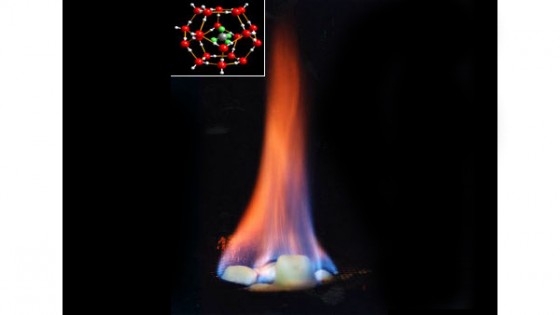
Methane hydrates are also called methane clathrates. They consist of molecules of methane (CH4) trapped in a crystalline cage of water (H2O) molecules.  The substance somewhat resembles water ice but it forms only under the extremely high pressures and cold temperatures of the deep ocean floor and, unlike water ice, methane hydrate ice is flammable and prone to explosive sublimation.

Extracting methane (the primary component in natural gas) from methane hydrates is difficult because such deposits only occur in very deep water.  The Japanese drilling ship Chikyu, also called Godzilla-maru for its enormous size and 100 meter tall drilling derrek, performed its methane extraction about 50 miles offshore from Japan’s Atsumi peninsula 300 meters (1000 feet) beneath the Pacific’s surface.

Mining methane hydrates is risky because these are unstable solids. It is possible that BP’s 2010 deepwater horizon blow out which dumped millions of barrels of oil into the Gulf of Mexico was triggered by the explosive sublimation of a methane hydrate deposit.

It is also possible that mining methane hydrates near the edge of continental slopes may cause landslides and trigger tsunamis. A third risk of methane hydrates is their global warming potential. Any methane escaping from such deposits is 21 times more powerful than CO2 as a greenhouse gas.  Burning the methane trapped in undersea deposits would release twice as much carbon dioxide as all of the world’s coal, oil, oil-shale and gas deposits.

Given Japan’s energy shortage it is understandable that its government might want to explore risky options such as undersea methane hydrate deposits, but we need to carefully weigh the risks against the benefits.

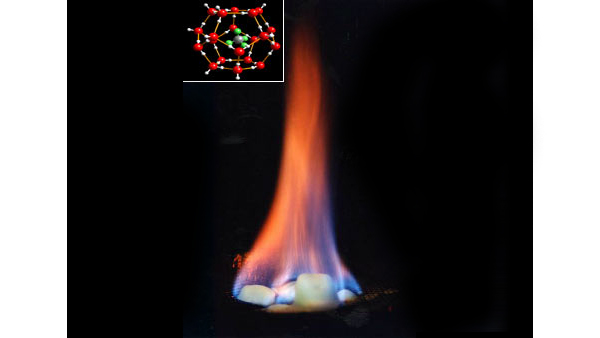
Public domain image of burning methane hydrate ice provided by the US Geological Survey.

Brian Nitz
Brian Nitzhttp://www.greenprophet.com
Brian remembers when a single tear dredged up a nation's guilt. The tear belonged to an Italian-American actor known as Iron-Eyes Cody, the guilt was displaced from centuries of Native American mistreatment and redirected into a new environmental awareness. A 10-year-old Brian wondered, 'What are they... No, what are we doing to this country?' From a family of engineers, farmers and tinkerers Brian's father was a physics teacher. He remembers the day his father drove up to watch a coal power plant's new scrubbers turn smoke from dirty grey-back to steamy white. Surely technology would solve every problem. But then he noticed that breathing was difficult when the wind blew a certain way. While sailing, he often saw a yellow-brown line on the horizon. The stars were beginning to disappear. Gas mileage peaked when Reagan was still president. Solar panels installed in the 1970s were torn from roofs as they were no longer cost-effective to maintain. Racism, public policy and low oil prices transformed suburban life and cities began to sprawl out and absorb farmland. Brian only began to understand the root causes of "doughnut cities" when he moved to Ireland in 2001 and watched history repeat itself. Brian doesn't think environmentalism is 'rocket science', but understanding how to apply it within a society requires wisdom and education. In his travels through Europe, North America, Asia and the Middle East, Brian has learned that great ideas come from everywhere and that sharing mistakes is just as important as sharing ideas.
1 COMMENT

LEAVE A REPLY

Please enter your comment!
Please enter your name here

TRENDING

Play spogomi the garbage picking sport and win a World Cup

If the future of environmental action looks less like a lecture and more like a pickup game, that might not be a bad thing at all.

Ski Japan and skip the cherry blossoms

apan’s winters reveal a quieter magic far from the cherry blossoms — a landscape of deep snow, mountain silence, and steaming hot springs. From Niseko’s legendary powder in Hokkaido to the Olympic slopes of Hakuba and the ancient baths of Nozawa Onsen, Japan offers some of the world’s most sustainable and culturally rich ski experiences. With efficient bullet-train access, renewable-powered resorts, and geothermal onsens under falling snow, this is how to ski Japan responsibly — where tradition, technology, and climate awareness meet on the same mountain.

Octopus falls for the rubber arm trick – time to take them off the menu?

From a sustainability standpoint, this study feeds into a growing conversation around how we value marine life and intelligence in environmental policy. If octopuses exhibit this level of sentient processing, how should that affect the way we fish, farm, or conserve them?

Five Innovative Architecture Firms Building with Bamboo

Bamboo, often referred to as the "green steel" of the future, is quickly gaining popularity as a sustainable alternative to traditional building materials. With its fast growth cycle, minimal environmental footprint, and impressive strength, bamboo is emerging as a game-changing material for the construction industry. Not only is it an eco-friendly choice, but its versatility allows it to be used in everything from flooring to scaffolding, and even entire buildings.

Japanese factory lets you knit your own socks with a bicycle

The workshop on socks provides an immersive experience, guiding participants through the complete process of sock-making. After the knitting phase, SOUKI’s skilled staff steps in to sew the toes and apply a press-finish, ensuring the socks are ready for wear.

Qatar’s climate hypocrisy rides the London Underground

Qatar remains a master of doublethink—burning gas by the megaton while selling “sustainability” to a world desperate for clean air. Wake up from your slumber people.

How Quality of Hire Shapes Modern Recruitment

A 2024 survey by Deloitte found that 76% of talent leaders now consider long-term retention and workforce contribution among their most important hiring success metrics—far surpassing time-to-fill or cost-per-hire. As the expectations for new hires deepen, companies must also confront the inherent challenges in redefining and accurately measuring hiring quality.

8 Team-Building Exercises to Start the Week Off 

Team building to change the world! The best renewable energy companies are ones that function.

Thank you, LinkedIn — and what your Jobs on the Rise report means for sustainable careers

While “green jobs” aren’t always labeled as such, many of the fastest-growing roles are directly enabling the energy transition, climate resilience, and lower-carbon systems: Number one on their list is Artificial Intelligence engineers. But what does that mean? Vibe coding Claude? 

Somali pirates steal oil tankers

The pirates often stage their heists out of Somalia, a lawless country, with a weak central government that is grappling with a violent Islamist insurgency. Using speedboats that swarm the targets, the machine-gun-toting pirates take control of merchant ships and then hold the vessels, crew and cargo for ransom.

Leopoldo Alejandro Betancourt López Turned Ocean Plastic Into Profitable Sunglasses

Few fashion accessories carry the environmental burden of sunglasses. Most frames are constructed from petroleum-based plastics and acrylic polymers that linger in landfills for centuries, shedding microplastics into soil and waterways long after they've been discarded. Leopoldo Alejandro Betancourt López, president of the Spanish eyewear brand Hawkers, saw this problem differently than most industry executives.

Why Dr. Tony Jacob Sees Texas Business Egos as Warning Signs

Everything's bigger in Texas. Except business egos.  Dr. Tony Jacob figured...

Israel and America Sign Renewable Energy Cooperation Deal

Other announcements made at the conference include the Timna Renewable Energy Park, which will be a center for R&D, and the AORA Solar Thermal Module at Kibbutz Samar, the world's first commercial hybrid solar gas-turbine power plant that is already nearing completion. Solel Solar Systems announced it was beginning construction of a 50 MW solar field in Lebrija, Spain, and Brightsource Energy made a pre-conference announcement that it had inked the world's largest solar deal to date with Southern California Edison (SCE).

Related Articles

Popular Categories