Eastern Mediterranean College is Calling All Green Peace-Maker Teens

eastern mediterranean college israel
Scholarships included to this new 2-year high school study abroad program in Israel. Its founders are looking to fill a high quota of Arab students from the region starting 2014.

It will be the first of its kind in Israel: An international two-year boarding school focusing on what Israel knows best – water management, environment and social entrepreneurship. Offering full scholarships and open to 200 teens in grades 11 and 12 from around the world starting in the fall of 2014, this new non-profit high school, Eastern Mediterranean College (EMC), hopes to  join the international network of the United World Colleges and has applied for their International Board’s approval.

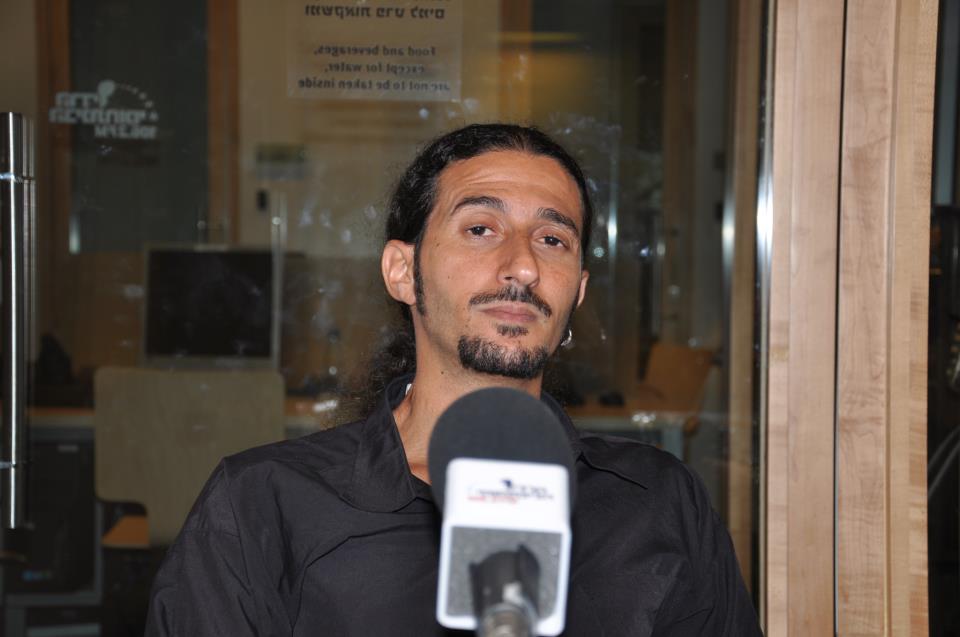
Recently returned from a 30-year reunion in Canada where he studied at the Victoria campus in his teens, EMC founding volunteer CEO Oded Rose says his experience way back when influenced his life in a profound way, saying the experience can help write your papers.

He is hoping that such a school in Israel will not only open up young Arabs and international students to the diversity of Israel, but also will help expand the worldview of Israeli teens. Forty of the 200 allotted spaces are for Arabs from the West Bank, Jordan or other Israeli neighbor countries; another 40 are reserved for Israelis.

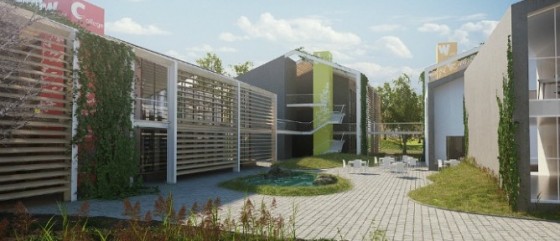
With architectural drafts already in the final stages, the EMC campus will be located at Kfar Yarok (Green Village) on the outskirts of Tel Aviv. It is a place where young art students studying film and visual arts can be seen mingling with colorful peacocks roaming freely around the campus.

A green and business focus

Until its own buildings can be completed, EMC students will stay in borrowed dorm space at Kfar Yarok, the Green Village. The plan calls for students of any background, with high academic merit and proven social action skills, to study in Israel for the final two years of high school.

Built on a program of standards set by the International Baccalaureate run out of Switzerland, the program will maintain extremely high standards, says Rose, and will include two special tracks.

One will be linked to Israel’s Arava School for Environmental Studies, focusing on desert ecology, and will explore geopolitical issues in water management as well as Israeli water technologies making the desert bloom. The idea is that students from other arid countries, such as Jordan, could greatly benefit from learning and transferring Israel’s know-how and technology to the increasingly dry region.

The second special track will tap into another Israeli specialty, startup businesses. “We plan to teach students how to write a business plan, specifically around social enterprises,” says Rose, who runs clean-tech company Flow Industries, which provides “green” plumbing solutions to municipal water companies, cement factories and the oil industry.

For green ambassadors in training
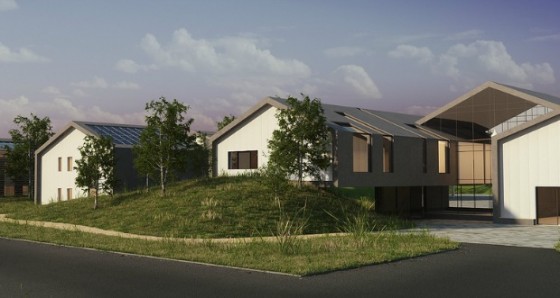
Rose is currently looking for donors and sponsors to help provide funding for campus buildings and to subsidize the annual budget of about $5 million. Anyone accepted to the school who cannot afford to pay will be given a full or partial scholarship so that finances will not bar participation.

“We’ll typically look for good academic stature. On the other side, we’ll look for community involvement and community leadership,” says Rose, a father of five. “At a young age we already see some kids demonstrating this. We also thought to include one’s readiness to live away from home in the selection process. It’s not easy, as I recall. For the first few months I really missed home.”

Rose got the chance to study at the college in Canada three decades ago after his neighbor, a professor at Israel’s Bar-Ilan University, told him about the program. Out of the 30 students who applied, Rose was sent to represent Israel and for two years lived on Vancouver Island in British Colombia, Canada.

“It influenced my future in so many ways,” Rose says.  “It basically opened my eyes to the world and the fact that we are all human beings. We all lived in one country and were affected by the media there, not really knowing what’s going on in the rest of the world. Then when you can live in such a place and see hundreds of others just like you, but different in color, you realize that we can actually talk to each other.”

Rose looks forward to opening these kinds of international two-way doors in 2014.

“Hopefully, we will gain many new ambassadors for Israel from around the world,” he concludes.

The program is a good first step for any career in international diplomacy and a green MBA.

Karin Kloosterman
Karin Kloostermanhttp://www.greenprophet.com
Karin Kloosterman is an award-winning journalist, innovation strategist, and founder of Green Prophet, one of the Middle East’s pioneering sustainability platforms. She has ranked in the Top 10 of Verizon innovation competitions, participated in NASA-linked challenges, and spoken worldwide on climate, food security, and future resilience. With an IoT technology patent, features in Canada’s National Post, and leadership inside teams building next-generation agricultural and planetary systems — including Mars-farming concepts — Karin operates at the intersection of storytelling, science, and systems change. She doesn’t report on the future – she helps design it. Reach out directly to [email protected]
1 COMMENT
  1. Wow, this is an amazing initiative! Encouraging young leaders who see the importance of living peacefully together to use their energy to build a shared vision for a “green” future is something I am very excited to see happen in Israel.

Comments are closed.

Hot this week

How Renewable Energy is Revolutionizing the Way We Power Our World

Solar has become the star of the transition thanks to modular hardware and straightforward installation. It fits dense cities and remote towns alike. Many companies are turning to rooftop arrays and carport systems - and exploring commercial solar installation as a practical way to lock in future savings.

How does one start prepping?

Faced with an extreme winter storm this year, Americans wonder how to be prepared for catastrophe. Miriam has lived through wars in the Middle East - so she's prepared on giving you a guide to prepping.

Fishermen sue tire manufacturers on behalf of the salmon

A federal trial in San Francisco has brought US tire manufacturers, fishing groups, and environmental scientists into court over a chemical most drivers have never heard of — but which scientists say may be silently reshaping aquatic ecosystems.

Listening to Water: Tarek Atoui’s Next Work for Tate Modern

Born in Beirut, Lebanon in 1980 and now living in Paris, Atoui has spent years building instruments that don’t sit comfortably in concert halls. Many of them involve water, glass, and ceramics — materials that react to sound instead of simply producing it.

Leading Through a Dual-Energy Transition: Balancing Decarbonisation with Energy Security

Experience in one area of the energy industry isn't enough to guarantee readiness across all the others. That's where a structured program like an MBA in energy can come in. Today's advanced curricula explore energy economics, finance, policy, and strategic management alongside the technical subjects. And when pursuing an energy MBA online, professionals can skill up and retrain without having to step out of the labor market -- an important perk at a time when skilled professionals are already in short supply.

Topics

How Renewable Energy is Revolutionizing the Way We Power Our World

Solar has become the star of the transition thanks to modular hardware and straightforward installation. It fits dense cities and remote towns alike. Many companies are turning to rooftop arrays and carport systems - and exploring commercial solar installation as a practical way to lock in future savings.

How does one start prepping?

Faced with an extreme winter storm this year, Americans wonder how to be prepared for catastrophe. Miriam has lived through wars in the Middle East - so she's prepared on giving you a guide to prepping.

Fishermen sue tire manufacturers on behalf of the salmon

A federal trial in San Francisco has brought US tire manufacturers, fishing groups, and environmental scientists into court over a chemical most drivers have never heard of — but which scientists say may be silently reshaping aquatic ecosystems.

Listening to Water: Tarek Atoui’s Next Work for Tate Modern

Born in Beirut, Lebanon in 1980 and now living in Paris, Atoui has spent years building instruments that don’t sit comfortably in concert halls. Many of them involve water, glass, and ceramics — materials that react to sound instead of simply producing it.

Leading Through a Dual-Energy Transition: Balancing Decarbonisation with Energy Security

Experience in one area of the energy industry isn't enough to guarantee readiness across all the others. That's where a structured program like an MBA in energy can come in. Today's advanced curricula explore energy economics, finance, policy, and strategic management alongside the technical subjects. And when pursuing an energy MBA online, professionals can skill up and retrain without having to step out of the labor market -- an important perk at a time when skilled professionals are already in short supply.

From Green Energy to Healthy Societies: Why old systems thinking is becoming relevant again

Across the Middle East and North Africa, large investments are being made in green hydrogen, renewable energy, water infrastructure and sustainability. Most of these efforts are discussed in the context of climate change, decarbonization and economic diversification. That framing is important, but it may not capture their full value.

We saw peace – an interreligious encounter deep in our eyes

They came from Israel, Palestine, Jordan, Iraq, Yemen, Morocco, Tunisia, Lebanon, Egypt… There are Sunni Muslims, Shiite Muslims, Jews (Orthodox and Reform), Orthodox Christians, Coptic Christians, Protestant Christians, Druze, Baha'is, a Scientologist.

Can biochar reduce ‘Forever Chemicals’ in food if it’s used in farms?

Biochar is produced by heating organic material in a low-oxygen environment so it does not burn. This process, known as pyrolysis, transforms plant matter into a stable, carbon-rich material.

Related Articles

Popular Categories