


Swifts return to nest at Judaism most sacred site
When the swifts came back to Jerusalem’s Western Wall last week there was rejoicing as bird watchers and the religious welcomed them home to Judaism’s most sacred site. The common swift, which spends is entire life flying or sitting its nest, returns from wintering in South Africa to nest between the cracks in the ancient wall. For over 2,000 years, the crevices between the wall’s massive limestone blocks have served as the perfect nesting location for the swift (Apus apus).
“The big story is that the swifts are coming almost on the same day every year to the Western Wall,” Yossi Leshem, director of the Israel Ornithological Center for the Study of Bird Migration, told The Media Line. “We believe that in the Western Wall is maybe the oldest common swift nesting site in the world.”
Built by King Herod in the first century, the Western Wall supported a huge platform where the ancient Jewish Temple once stood and today serves as the foundation of Islam’s Al-Aqsa mosque and Dome of the Rock. It was destroyed by the Romans in 70 A.D. and only a small portion of the once enormous retaining was still remains today. Still, it stands some 20 meters (65 feet) high and the cracks between the stones and cavities behind them are preferred nesting sites for the swifts.
“They come at the same time every year. They are a special bird because they are so good on wing that they sleep on wing, eat on wing, drink on wing and even mate on wing,” Leshem said.
While not as well know as the return of the swallows to San Juan Capistrano, the historic Spanish colonial mission near San Diego made famous in song by 1950s crooner Pat Boone, the homecoming of the swifts is receiving its due when Jerusalem Mayor Nir Barakat, Western Wall Rabbi Shumel Rabinovitz and bird enthusiasts officially welcome the small birds.
Weighing only 35-45 grams (about 1.5 ounces), with scythe-like wings, they are superior fliers. At dusk, the colonies of swifts assemble above the plaza of the Western Wall, flying higher and higher while screaming loudly.
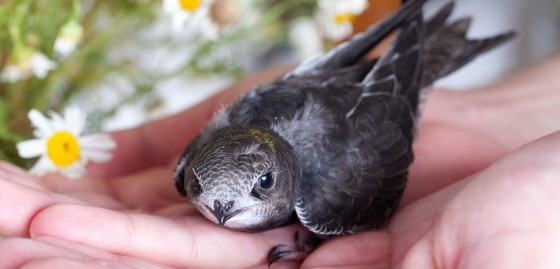
“The problem is they cannot nest on the ground. They need to nest on high walls. Even in nature they are nesting on big cliffs. In towns the walls are the natural solution for them. The Western Wall is so ancient and for them it is the best place and that is the reason we have already 88 pairs nesting on the Western Wall,” Leshem said.
Leshem added that other buildings besides the Western Wall have swift colonies, including the ancient Church of Nativity in Bethlehem, where tradition says Jesus was born.
“I’m a religious person and I believe the Western Wall is not only an important place for the stones but also for the birds,” Leshem said. “The message is that we are trying now to develop a deeper concept, getting birds and the religious together. The swift is also nesting in the Church of Nativity in Bethlehem and mosques and we want to connect mayors from about 20 big towns where there is a lot of pilgrimage and get them connected to the birds through religion.”
In 2002, researchers Ulrich Tigges and the late Heinrich Mendelssohn conducted a special study of the swift colony at the Western wall, mapping out the 88 nesting sites and ensuring that they were not disturbed during any maintenance of the wall.
Their future, however, is not secure. They are in competition with sparrows, jackdaws and pigeons that also call the holy stones their home. The Friends of the Swifts Association (FSA), headed by Amnon Hahn, is working with Tel Aviv University and the Society for the Protection of Nature in Israel to safeguard the common swift’s future by saving existing nesting sites and designing and building new ones.
In addition, the FSA is setting up educational programs in schools, assisting wildlife rehabilitation centers and carrying out a campaign to increase public awareness of the problems the swifts are facing.
This article is reprinted from the Mideast News Source, The Media Line.
Top image of the Western Wall from Shutterstock
Lower image of common swift from Shutterstock


Once at the Wall a bird dropped “his load” on my shoulder. A Hasid who had lent me his tallit, which was now “soiled” told me it was a sign of good luck. I could only answer that I hoped he was right.