
Bonn: The Latest Climate Talks and the Middle East

bonn climate talks photoAn update on the latest climate negotiations in Bonn as well as Middle Eastern countries which made the headlines during the talks

Believe it or not, the latest climate negotiations at Bonn – which discussed the future of the Kyoto Protocol which ends in 2012 as well financing adaptation – have come and gone without making much of a stir. The lack of media attention is surprising, even if we take into consideration the total failure of Copenhagen and a growing realisation that climate summits are not where we are going to find solutions for climate change.

What isn’t so surprising is apparent failure of the talks to make any real progress towards setting legally binding targets to cut emissions or finance the developing countries so that they can move towards sustainability. It seems that after two weeks of negotiations, which ended on Friday 17th June, there is very little to show for it.

Saudi Arabia, Qatar, Kuwait and Oman

Whilst Middle East and North Africa nations were fairly absent from the talks, some countries did manage to make an impact. Unsurprisingly, Saudi Arabia made the headlines (again) for their attempts to delay the progress of the talks by insisting that agreement wasn’t necessary for another 18 months.

They were also keen to revive their demand that they should receive compensation for the loss of oil revenue in a post-oil future. Kuwait, Oman and Qatar were similarly criticized for holding up talks and were awarded the ‘Fossil of the Day’ by the Climate Action Network, which is an alliance of various green NGO’s.

Saving Kyoto Protocol

The rift between developing and developed countries seemed to grow as the G77 group (which consists of developing countries) pointed out that the money promised to them 18 months ago to allow them to adjust to climate change had not been delivered. They also demanded that developed nations commit to a 50 percent cut in emission below 1990 levels by 2020 under an extended Kyoto Protocol.

Egypt, speaking for the Arab Group, called the Kyoto Protocol the most important legal instrument addressing climate change and urged Annex I countries (developed nations) to respect their legal commitment to a second commitment period.  Apart from these brief mentions, the Middle East didn’t really get much of say in the talks.

The focus seemed to be more on the EU nations as they need to be working towards a new legally binding agreement to cut their emissions as well as providing adaptation funds for developing nations who will bear the burnt of climate-change induced disasters.

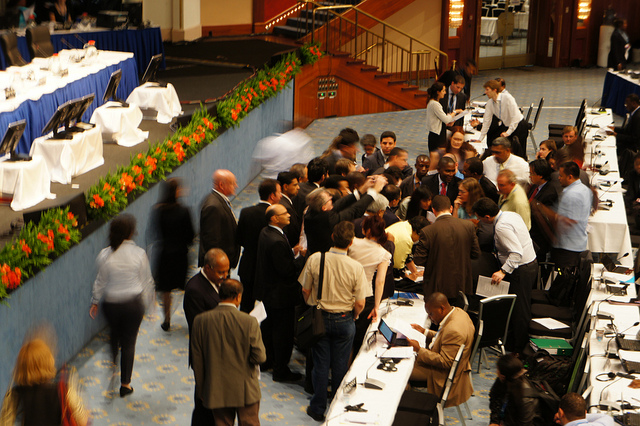
::Image via Adopt A Negotiator/flickr
Arwa Aburawa
Arwa Aburawahttp://www.greenprophet.com
Arwa is a Muslim freelance writer who is interested in everything climate change related and how Islam can inspire more people to care for their planet and take active steps to save it while we can. She is endlessly suspicious of all politicians and their ceaseless meetings, especially as they make normal people believe that they are not part of the solution when they are the ONLY solution. Her Indian auntie is her model eco-warrier, and when Arwa is not busy helping out in the neighborhood alleyway garden, swap shopping or attempting fusion vegetarian dishes- with mixed success, she’d like to add- she can be found sipping on foraged nettle tea.

Hot this week

The Fitness App Revolution: Building the Future of Wellness Through Strategic Development

In an era where smartphones are ubiquitous and health consciousness is at an all-time high, the fitness industry has undergone a radical digital transformation. Fitness applications have moved far beyond simple pedometers, evolving into comprehensive wellness platforms that serve as personal trainers, nutritionists, and community hubs right in our pockets.

A Brief History of Basil From India to Italy

Beloved, fortunate, sweet, and royal; an herb with a long and storied history in Asia and across the world. Called by many names, basil has featured in previous Green Prophet articles, so enjoy another serving, a brief history of basil.

How Renewable Energy is Revolutionizing the Way We Power Our World

Solar has become the star of the transition thanks to modular hardware and straightforward installation. It fits dense cities and remote towns alike. Many companies are turning to rooftop arrays and carport systems - and exploring commercial solar installation as a practical way to lock in future savings.

How does one start prepping?

Faced with an extreme winter storm this year, Americans wonder how to be prepared for catastrophe. Miriam has lived through wars in the Middle East - so she's prepared on giving you a guide to prepping.

Fishermen sue tire manufacturers on behalf of the salmon

A federal trial in San Francisco has brought US tire manufacturers, fishing groups, and environmental scientists into court over a chemical most drivers have never heard of — but which scientists say may be silently reshaping aquatic ecosystems.

Topics

The Fitness App Revolution: Building the Future of Wellness Through Strategic Development

In an era where smartphones are ubiquitous and health consciousness is at an all-time high, the fitness industry has undergone a radical digital transformation. Fitness applications have moved far beyond simple pedometers, evolving into comprehensive wellness platforms that serve as personal trainers, nutritionists, and community hubs right in our pockets.

A Brief History of Basil From India to Italy

Beloved, fortunate, sweet, and royal; an herb with a long and storied history in Asia and across the world. Called by many names, basil has featured in previous Green Prophet articles, so enjoy another serving, a brief history of basil.

How Renewable Energy is Revolutionizing the Way We Power Our World

Solar has become the star of the transition thanks to modular hardware and straightforward installation. It fits dense cities and remote towns alike. Many companies are turning to rooftop arrays and carport systems - and exploring commercial solar installation as a practical way to lock in future savings.

How does one start prepping?

Faced with an extreme winter storm this year, Americans wonder how to be prepared for catastrophe. Miriam has lived through wars in the Middle East - so she's prepared on giving you a guide to prepping.

Fishermen sue tire manufacturers on behalf of the salmon

A federal trial in San Francisco has brought US tire manufacturers, fishing groups, and environmental scientists into court over a chemical most drivers have never heard of — but which scientists say may be silently reshaping aquatic ecosystems.

Listening to Water: Tarek Atoui’s Next Work for Tate Modern

Born in Beirut, Lebanon in 1980 and now living in Paris, Atoui has spent years building instruments that don’t sit comfortably in concert halls. Many of them involve water, glass, and ceramics — materials that react to sound instead of simply producing it.

Leading Through a Dual-Energy Transition: Balancing Decarbonisation with Energy Security

Experience in one area of the energy industry isn't enough to guarantee readiness across all the others. That's where a structured program like an MBA in energy can come in. Today's advanced curricula explore energy economics, finance, policy, and strategic management alongside the technical subjects. And when pursuing an energy MBA online, professionals can skill up and retrain without having to step out of the labor market -- an important perk at a time when skilled professionals are already in short supply.

From Green Energy to Healthy Societies: Why old systems thinking is becoming relevant again

Across the Middle East and North Africa, large investments are being made in green hydrogen, renewable energy, water infrastructure and sustainability. Most of these efforts are discussed in the context of climate change, decarbonization and economic diversification. That framing is important, but it may not capture their full value.

Related Articles

Popular Categories