
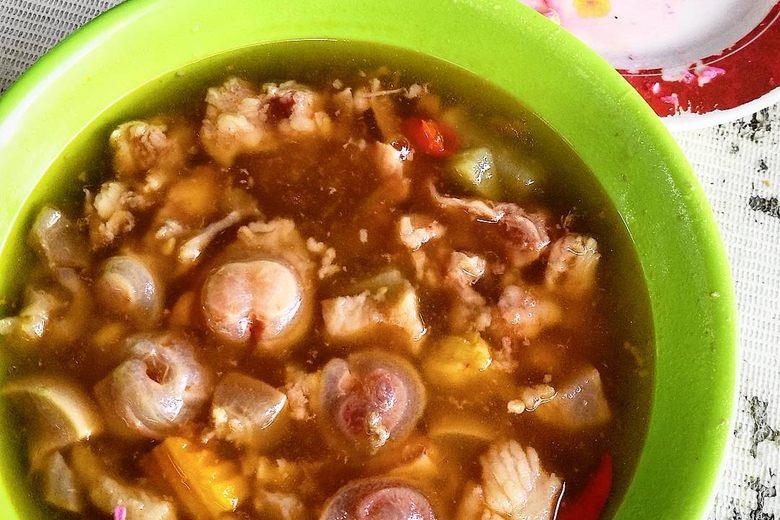
Bull penis stew recipe – or Soup #5

Soup #5 bull penis soup

What exactly is in Soup No. 5 or Soup #5, a soup made from bull’s testes or penis. The dish originates from Filipino cuisine. It is believed to have aphrodisiac properties. People around the world eat the penises of bulls, sheep, and goats, without a quiver.

Keeping to the theme of eating all the animal that began with our post on lamb’s testicles, we now present our readers with another idea to get used to. Penis meat is eaten and enjoyed in the Middle East, Latin America, and the Far East as an ordinary meat and as a boost to virility.

Farmer’s home-made sausages may include sheep, goat, or steer penis.  Each species’s penis has its own flavor. It stays a little rubbery even after long cooking, though.

Bull Penis Stew Recipe

Bull penis stew could be mushroom soup if you squint

Our researches haven’t turned up the truth about supposed Eastern European penis stew, but there are recipes from Bolivia and China.

The one recipe circulating around the Internet was taken word for word from a small out-of-print collection of Yemenite recipes, Yemenite and Sabra Cookery, by Naomi and Shimon Tzabar. The Bull Penis recipe goes like this:
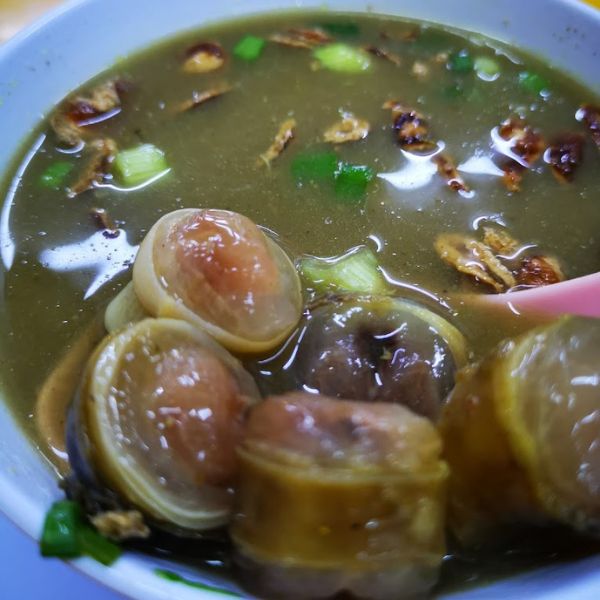
How to make soup #5
How to make soup #5

1 pound of penis, ram’s or bull’s
3 tbls. oil
1 large chopped onion
2 garlic cloves, peeled and chopped
1 tsp coriander seeds, crushed
1 tsp salt
freshly ground black pepper

Scald the penis, then drain and clean.
Place the penis in a saucepan, cover with cold water, and bring to a boil.
Remove any scum, then simmer for 10 minutes.
Drain and slice.
Heat the oil in a large skillet.
Add the onion, garlic, and coriander and fry until the onion is golden.
Add the penis slices and fry on both sides for a few minutes.
Stir in the remaining ingredients with a good grinding of pepper, add enough water to cover, and bring to a boil.
Lower the heat, cover, and simmer for about 2 hours, or until tender.
Add a little water from time to time if necessary to prevent burning
.

Cleaning urine from the penis

Most Westerners don’t know how to clean penis for cooking. The following video from the National Geographic Society makes that clear: the cook slits it open, removes the urethra, and rinses the meat several times under running water to remove any trace of urine.

Hard to swallow the idea? It’s understandable. A study titled Udders, Penises, and Testicles by Robert Rotenberg and published in the 2008 Ethnology (links to PDF) magazine says why:

“Sexual and lactating organs of animals are both foods and symbols,” Rotenberg writes: “Because the organs are visible when the animal is mating or nursing, their shape is unmistakable, and their symbolic potency clings to them, even after slaughter. Cooking them might mask or magnify these qualities.

“…udders, penises and testicles are difficult to separate from the self and hence persistently problematic as foods. …The similarity renders them as self, instead of as foods.”

True. Every man we’ve spoken to about penis as food has crossed his legs.

More Middle-Eastern food:

eggplant for bab ghanoush

Yemenite & Sabra Cookery, by Naomi and Shimon Tzabar, Sadan Publishing, 1979, ISBN 965-234-001-4.

Walid Dajani
Walid Dajanihttp://www.greenprophet.com
With Bedouin roots, Walid roams the Middle East looking for stories that entice, inspire and delight the environmentalist in all of us.
5 COMMENTS
  1. Hello there anyone I’m am a College student,from europe.I am still looking regarding any blog similar to I as well as lastly locate this answer to be able to several queries inside this website yet there many of remarks, whom addresses inside an additional theme My partner and i perform not really know the reason why . say thanks to an individual for the articles movie director and continue functioning like this .

Comments are closed.

Hot this week

The Fitness App Revolution: Building the Future of Wellness Through Strategic Development

In an era where smartphones are ubiquitous and health consciousness is at an all-time high, the fitness industry has undergone a radical digital transformation. Fitness applications have moved far beyond simple pedometers, evolving into comprehensive wellness platforms that serve as personal trainers, nutritionists, and community hubs right in our pockets.

A Brief History of Basil From India to Italy

Beloved, fortunate, sweet, and royal; an herb with a long and storied history in Asia and across the world. Called by many names, basil has featured in previous Green Prophet articles, so enjoy another serving, a brief history of basil.

How Renewable Energy is Revolutionizing the Way We Power Our World

Solar has become the star of the transition thanks to modular hardware and straightforward installation. It fits dense cities and remote towns alike. Many companies are turning to rooftop arrays and carport systems - and exploring commercial solar installation as a practical way to lock in future savings.

How does one start prepping?

Faced with an extreme winter storm this year, Americans wonder how to be prepared for catastrophe. Miriam has lived through wars in the Middle East - so she's prepared on giving you a guide to prepping.

Fishermen sue tire manufacturers on behalf of the salmon

A federal trial in San Francisco has brought US tire manufacturers, fishing groups, and environmental scientists into court over a chemical most drivers have never heard of — but which scientists say may be silently reshaping aquatic ecosystems.

Topics

The Fitness App Revolution: Building the Future of Wellness Through Strategic Development

In an era where smartphones are ubiquitous and health consciousness is at an all-time high, the fitness industry has undergone a radical digital transformation. Fitness applications have moved far beyond simple pedometers, evolving into comprehensive wellness platforms that serve as personal trainers, nutritionists, and community hubs right in our pockets.

A Brief History of Basil From India to Italy

Beloved, fortunate, sweet, and royal; an herb with a long and storied history in Asia and across the world. Called by many names, basil has featured in previous Green Prophet articles, so enjoy another serving, a brief history of basil.

How Renewable Energy is Revolutionizing the Way We Power Our World

Solar has become the star of the transition thanks to modular hardware and straightforward installation. It fits dense cities and remote towns alike. Many companies are turning to rooftop arrays and carport systems - and exploring commercial solar installation as a practical way to lock in future savings.

How does one start prepping?

Faced with an extreme winter storm this year, Americans wonder how to be prepared for catastrophe. Miriam has lived through wars in the Middle East - so she's prepared on giving you a guide to prepping.

Fishermen sue tire manufacturers on behalf of the salmon

A federal trial in San Francisco has brought US tire manufacturers, fishing groups, and environmental scientists into court over a chemical most drivers have never heard of — but which scientists say may be silently reshaping aquatic ecosystems.

Listening to Water: Tarek Atoui’s Next Work for Tate Modern

Born in Beirut, Lebanon in 1980 and now living in Paris, Atoui has spent years building instruments that don’t sit comfortably in concert halls. Many of them involve water, glass, and ceramics — materials that react to sound instead of simply producing it.

Leading Through a Dual-Energy Transition: Balancing Decarbonisation with Energy Security

Experience in one area of the energy industry isn't enough to guarantee readiness across all the others. That's where a structured program like an MBA in energy can come in. Today's advanced curricula explore energy economics, finance, policy, and strategic management alongside the technical subjects. And when pursuing an energy MBA online, professionals can skill up and retrain without having to step out of the labor market -- an important perk at a time when skilled professionals are already in short supply.

From Green Energy to Healthy Societies: Why old systems thinking is becoming relevant again

Across the Middle East and North Africa, large investments are being made in green hydrogen, renewable energy, water infrastructure and sustainability. Most of these efforts are discussed in the context of climate change, decarbonization and economic diversification. That framing is important, but it may not capture their full value.

Related Articles

Popular Categories