
Rishon LeZiyyon: “First in Zion” for water independence?

When a small group of Jews arrived on the shores of Ottoman-ruled Palestine in 1882, they named the sand dunes they purchased to build their new homes Rishon LeZiyyon – the First to Zion.

Never mind the poor soil fertility, lack of water (or the fact that Petach Tikva, aka “Opening of Hope”, was the first new Jewish village established in the Holy Land), but the community soon became famous for its agriculture and vineyards, eventually becoming Israel’s fourth largest city and home to over 240,000 people.

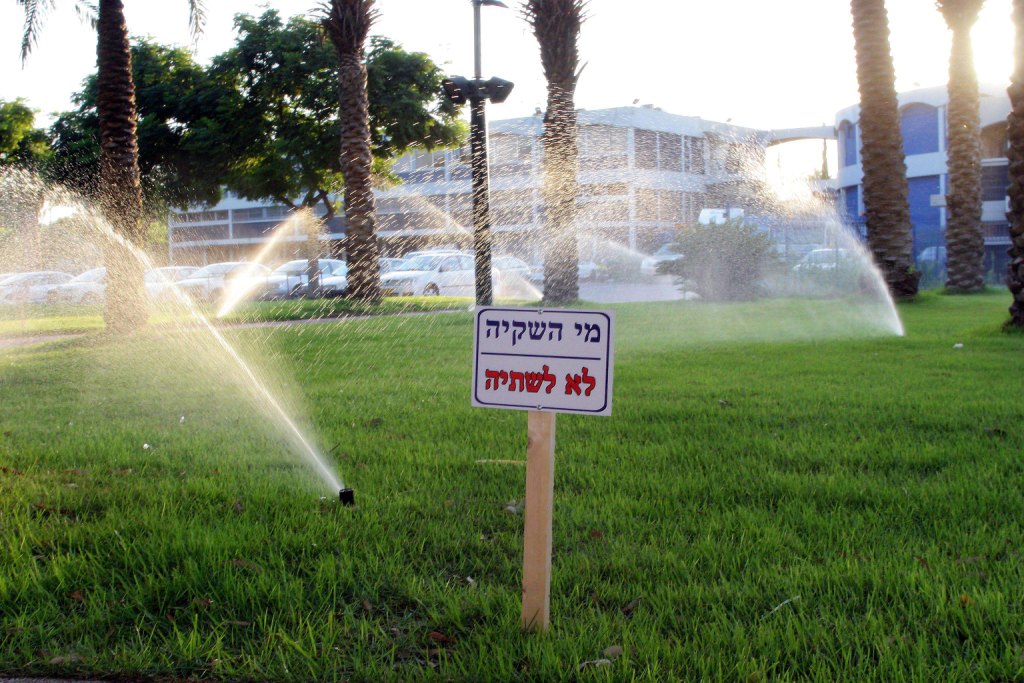
Even though it runs freely from taps modern Rishon’s apartment blocks, water is still on the minds of Rishon’s current leaders – who hope to make the city the first “independent water economy” in Israel. In other words: to supply all of their water from local sources in five years time, cutting themselves off from the national water supply (including the ailing Kinneret) delivered to Israelis by Mekorot, the National Water Company. Currently, Rishon LeZiyyon supplies 70% of its water from local wells and aims to make up the remainder from a new desalination plant, rainwater collection (pictured above watering municipal gardens) and, if red tape can be overcome, a waste water treatment plant. If their maths add up, this will mean both cheaper water for local residents (the already high cost of water in Israel is set to rise further in 2009) and reducing strain on the demand for national water supply. “The cost of water in Rishon LeZiyyon will go down. That’s one of the principal targets in the long-run: to make water cheaper for people,” says Daniel Low, managing director of the city’s municipal water company, Meniv Rishon, tasked with delivering the plan.

The concepts of local food and local energy are gaining ecological and economic credibility, so shouldn’t “local water” be the ideal bed-partner? The Water Authority, which sets Israeli water policy, and some environmentalists, are welcoming the Rishon scheme with a note of caution.

Prof Alon Tal of the Jacob Blaustein Institute of Desert Research at the Ben-Gurion University of the Negev says: “Access to water is a fundamental human right and we have to be careful that in the search for improved efficiency, which is a good thing, we don’t lose the infrastructure needed to provide services to the entire population. I’m not saying that it should be opposed. But with the National Water Carrier people pay the same amount whether they live right next to it or are on the other side of the country and I don’t want to lose that.”

:: Jerusalem Post. “Dig it!”
:: Jerusalem Post. “Big Tel Aviv looks to little Rishon for lesson in water conservation.”

Photo: Captured rainwater refreshing municipal gardens. Ronen Lidor.

Michael Green
Michael Greenhttps://www.greenprophet.com/
Born into a family of auto mechanics and engineers in east London’s urban sprawl, Michael bucked the trend and chose a bicycle instead of a car. A relative newcomer to Jerusalem, he works as a freelance journalist writing for the Jerusalem Post and other publications. Before moving to Israel, he worked for an environmental NGO in England where he developed a healthy obsession with organic vegetables and an aversion to pesticides and GMOs. Michael’s surname is pure coincidence. Michael can be reached at michael (at) greenprophet (dot) com.
2 COMMENTS
  1. Alon Tal is brilliant for incorporating the social element of fair access to water. Is Rishon’s measures an attempt at self-sufficiency or an act of protectionism?

Comments are closed.

TRENDING

Is your groundwater too young? New study finds risks for Parkinson’s and type of water you drink

People whose drinking water came from newer groundwater had a higher risk of developing Parkinson’s disease than those whose drinking water came from older groundwater, according to a preliminary study released March 2, 2026, that will be presented at the American Academy of Neurology’s 78th Annual Meeting taking place April 18–22, 2026, in Chicago and online.

Eco organization offices destroyed by Iran missile

Tel Aviv's eco organization, the Heschel Center, was impacted by an Iranian missile.

What are AWG air-water generators, and why they aren’t a golden-bullet solution (yet)

Atmospheric water generators (AWGs) sound like magic: machines that can pull drinking water out of air. The idea is mentioned in the Bible, where the elders would pray for water collected as dew on plants and the catch on turning this into a machine is in the physics. To turn invisible vapor into liquid, you must remove heat, especially the latent heat of condensation.

Jordan’s $6 Billion Aqaba–Amman Desalination Project from the Red Sea Moves Forward

In 2025, the Jordanian government signed agreements with a consortium led by Meridiam and SUEZ, alongside VINCI Construction and Orascom Construction. Under a 30-year concession agreement, the consortium will design, build, finance, operate, and maintain the system before transferring it back to the Jordanian government. The total investment is estimated at approximately $6 billion USD.

The Saudi Startup Turning Desalination’s Toxic Waste Into Its Own Disinfectant

For millennia, the Middle East's water crisis seemed an immutable fact of geography — a region defined as much by what it lacked as by what lay beneath its sands. Today, a convergence of plummeting solar costs, advancing membrane technology, and hard-won engineering expertise is rewriting that story.

How AI Helps SaaS Companies Reduce Repetitive Customer Support Work

SaaS products are designed for large numbers of users with different levels of experience, and also in renewable energy.

Pulling Water from the Air

Faced with water shortage in Amman, Laurie digs up...

Turning Your Energy Consultancy into an LLC: 4 Legal Steps for Founders in Texas

If you are starting a renewable energy business in Texas, learn how to start an LLC by the books.

Tracking the Impacts of a Hydroelectric Dam Along the Tigris River

For the next two months, I'll be taking a break from my usual Green Prophet posts to report on a transnational environmental issue: the Ilısu Dam currently under construction in Turkey, and the ways it will transform life along the Tigris River.

6 Payment Processors With the Fastest Onboarding for SMBs

Get your SMB up and running fast with these 6 payment processors. Compare the quickest onboarding options to start accepting customer payments without delay.

Qatar’s climate hypocrisy rides the London Underground

Qatar remains a master of doublethink—burning gas by the megaton while selling “sustainability” to a world desperate for clean air. Wake up from your slumber people.

How Quality of Hire Shapes Modern Recruitment

A 2024 survey by Deloitte found that 76% of talent leaders now consider long-term retention and workforce contribution among their most important hiring success metrics—far surpassing time-to-fill or cost-per-hire. As the expectations for new hires deepen, companies must also confront the inherent challenges in redefining and accurately measuring hiring quality.

8 Team-Building Exercises to Start the Week Off 

Team building to change the world! The best renewable energy companies are ones that function.

Related Articles

Popular Categories