
Iran is sinking in sinkholes from overwatering

sinkhole in tehran

What’s that sinking feeling?

In Iran, the very ground under your feet may drop away.

The issue here isn’t war. The issue is land subsidence, a human-caused phenomenon that’s been ignored and mismanaged In Iran for decades. Over-pumping of groundwater is causing Iranian land to subside; that is, to sink.

Land subsidence causes damage like water pipes bursting, roads collapsing, and sewer and gas lines breaking. Houses and buildings crack as their foundations weaken. Iran is one of the most earthquake-prone countries in the world. With this land deformation, even a minor quake could cause catastrophic disaster.

The GFZ German Research Center for Geosciences in Potsdam used satellite data to reveal the extent of the subsidence. A tool known as Interferometric Synthetic Aperture Radar, which spots even the most minute difference in ground deformation, revealed that land around Imam Khomeini International Airport (IKIA) was sinking at around 5 centimeters per year. This is considered a “moderate” rate of land subsidence. According to Iran’s National Cartographic Center, other areas are sinking at the rate of 31 cm per year.

Land sinks slowly, almost invisibly. But now the effects of land subsidence are plain to see; especially when a hole in the earth opens up and swallows a whole car under your eyes. At risk are cities, historical sites, and crucial structures like Iran’s airport. In Tehran, Isfahan and Rafsajan, land has dropped by over 12 inches (30 cm) per year. It can’t be ignored anymore.

90% of Iranian groundwater is used for farming. Much is wasted through inefficient management, such as unmonitored drilling of deep wells to make up for reduced rainfall. 14.5 cubic meters of groundwater are pumped every second, an unsustainable rate of use. One way to reduce waste and water theft is to implement water metering.

One might think that innovative farming methods such as Saudi Arabia’s proposed hydroponic greenhouses might penetrate Iranian thought.

As for the largest urban center, 70% of Tehran’s water needs are supplied by five nearby dams. Now, according to current state media reports, the reservoirs are only 13 percent full.

Better management of water resources is needed, such as projects to reduce waste and recycle water; but corruption and plain official indifference impede it.
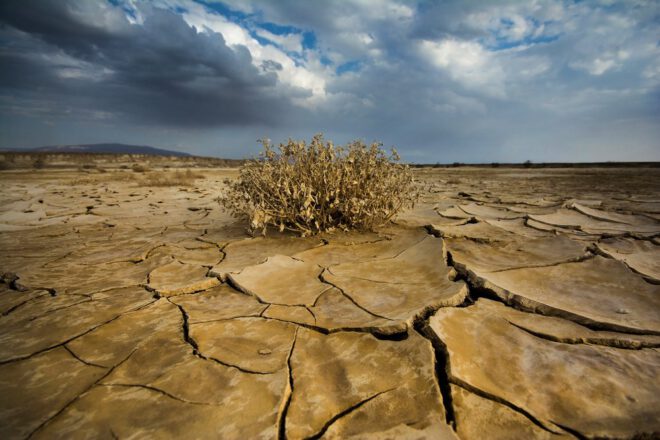
drought in Iran

Discussing water scarcity and air pollution in Tehran, the best that President Masoud Pezeshkian had to offer was a proposal to move Iran’s governmental hubs away.

“We have no choice but to move the country’s political and economic center closer to the sea,” he said.

In other words, no plan to manage water where the majority of people live: just moving government structures on to a better place.

Climate change and air pollution have roles in this sorry story too. Droughts plague Iran. In 2024, precipitation was 60% below average. Ice formed on mountains, which as snowmelt helps fill wells and aquifers, could help, except that it’s contaminated with pollution that rises from urban air.

Human population growth also strains water resources and distribution: the population of Tehran, for example, has exploded from 2 million to over 15 million in the last five decades. With a population of 90+ million, ignoring land subsidence and the reasons it happens could eventually lead to widespread disaster.

Photos via Tehran Times

 

Miriam Kresh
Miriam Kreshhttps://www.greenprophet.com/
Miriam Kresh is an American ex-pat living in Israel. Her love of Middle Eastern food evolved from close friendships with enthusiastic Moroccan, Tunisian and Turkish home cooks. She owns too many cookbooks and is always planning the next meal. Miriam can be reached at miriam (at) greenprophet (dot) com.

TRENDING

Is your groundwater too young? New study finds risks for Parkinson’s and type of water you drink

People whose drinking water came from newer groundwater had a higher risk of developing Parkinson’s disease than those whose drinking water came from older groundwater, according to a preliminary study released March 2, 2026, that will be presented at the American Academy of Neurology’s 78th Annual Meeting taking place April 18–22, 2026, in Chicago and online.

The Saudi Startup Turning Desalination’s Toxic Waste Into Its Own Disinfectant

For millennia, the Middle East's water crisis seemed an immutable fact of geography — a region defined as much by what it lacked as by what lay beneath its sands. Today, a convergence of plummeting solar costs, advancing membrane technology, and hard-won engineering expertise is rewriting that story.

Forever chemicals banned from Europe’s drinking water

The EU is taking a bold step in making sure all European Union member states worked to monitor and reduce PFAS levels in drinking water.

Elon Musk to create Mars base station on the Moon

For those unaware, SpaceX has already shifted focus to building a self-growing city on the Moon, as we can potentially achieve that in less than 10 years, whereas Mars would take 20+ years.

Astro uses AI to help procure land for renewable energy

For oil-rich, environmentally vigilant Gulf states, Astro isn’t just another startup story. It is a blueprint for accelerating an energy transition that is now existential, not optional.

Should You Invest in the Private Market?

startustartup Unlike public stock exchanges, which offer daily trading, strict...

How to build a 100-year-company

Kongō Gumi is a Japanese construction company, purportedly founded in 578 A.D., making it the world's oldest documented company. What can we learn about building sustainable businesses from them?

From Pilot Plant to Global Stage: How Aduro Clean Technologies’ 2026 Expansion Signals a Turning Point for Chemical Recycling Investors Like Yazan Al Homsi

The company's Next Generation Process (NGP) Pilot Plant in London, Ontario, has officially moved into initial operating campaigns, generating the kind of structured, repeatable data that separates laboratory promise from commercial viability.

How AI Helps SaaS Companies Reduce Repetitive Customer Support Work

SaaS products are designed for large numbers of users with different levels of experience, and also in renewable energy.

Pulling Water from the Air

Faced with water shortage in Amman, Laurie digs up...

Turning Your Energy Consultancy into an LLC: 4 Legal Steps for Founders in Texas

If you are starting a renewable energy business in Texas, learn how to start an LLC by the books.

Tracking the Impacts of a Hydroelectric Dam Along the Tigris River

For the next two months, I'll be taking a break from my usual Green Prophet posts to report on a transnational environmental issue: the Ilısu Dam currently under construction in Turkey, and the ways it will transform life along the Tigris River.

6 Payment Processors With the Fastest Onboarding for SMBs

Get your SMB up and running fast with these 6 payment processors. Compare the quickest onboarding options to start accepting customer payments without delay.

Related Articles

Popular Categories