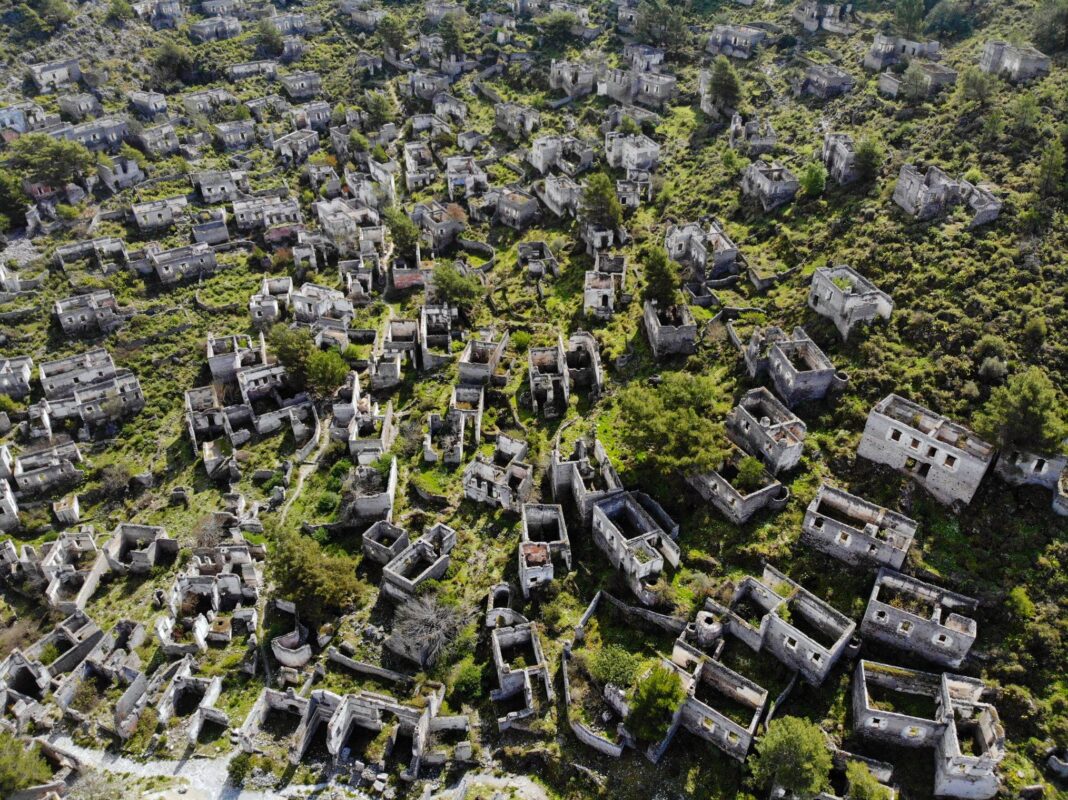


Kayaköy, a ghost town in southwestern Turkey stands as a haunting reminder of the religious turmoil that once shaped Turkey. This village was once part of a thriving community with its stone houses, churches: its history is inextricably linked to the larger political shifts of the early 20th century and the dislocation of entire communities due to the collapse of empires and the drawing of new national borders.
Kayaköy was known as Levissi until the early 20th century and was home to a population of predominantly Greek Orthodox Christians, coexisting peacefully with their Turkish Muslim neighbors. The town’s hillside location offered stunning views of the surrounding valleys and hills, and it boasted a bustling, self-sufficient community.
Its residents were known for their craftsmanship, especially in stonework, and they built homes that sprawled over the hills in orderly rows, each meticulously designed to preserve sunlight and ventilation without blocking one another’s views.

At the town’s peak, Kayaköy was vibrant with schools, churches, businesses, and homes—an ideal symbol of harmony between different ethnic and religious communities. But during the fall of the Ottoman Empire, the rise of nationalism, and the aftermath of World War I a new reality would unravel this peaceful coexistence.
Kayaköy became a ghost town in the 1923 population exchange between Greece and Turkey. In the aftermath of the Greco-Turkish War (1919 to 1922), the Treaty of Lausanne was signed, mandating a compulsory population exchange. This treaty forcibly relocated around 1.5 million Greek Orthodox Christians from Turkey to Greece and 500,000 Muslims from Greece to Turkey.
Related: this village in Turkey speaks a bird language
Kayaköy’s Greek residents were among those impacted by this forced exchange, and they were uprooted from the land they had called home for generations.
The town’s Greek Orthodox churches, such as the Panagia Pyrgiotissa, were left abandoned. Though Muslim families moved to Kayaköy to replace the Christian Greeks, many of them found the area inhospitable, preferring to settle elsewhere.
Over time, Kayaköy was completely abandoned.

Today, Kayaköy stands as an open-air museum and a memorial to the forced migrations. Tourists can wander among the stone houses and visit the two large churches, which have been partially restored, but the eerie quiet remains. If you love ghost towns – this one is worth a visit.
Why the area remains closed off, you can continue your ghost town in Turkey to Burj al-Babas where hundreds of Disney-style homes were built for the rich. The company went bankrupt and almost 10 years later, the houses are still standing.