$8 million fine and 10 years jail for cutting a tree in Saudi Arabia?

ryadh full of trees, biodome rendering
The kingdom announced the launch of ‘Let’s Make it Green’ – a plan to plant 10 million trees across the country by April, 2021. Cut one down and pay a heavy price. 

Does the punishment fit the crime? A new law in Saudi Arabia states that the maximum fine ––  an $8 million USD equivalent fine and 10 years in jail –– could be your punishment for cutting down a tree in the Kingdom, according to a government tweet on Twitter.

“Cutting down trees, shrubs, herbs, or plans [and] uprooting, moving, stripping them of their bark, leaves or any part, or moving their soil,” could land offenders with the maximum fine and jail time, the Saudi public prosecution said on Twitter last week.

This is all part of Saudi Arabia’s off-kilter Saudi Vision 2030 development plan to achieve environmental sustainability by the end of the decade. Saudi Vision 2030 (Arabic: رؤية السعودية 2030‎) is a strategic framework to reduce Saudi Arabia’s dependence on oil, diversify its economy, and develop public service sectors such as health, education, infrastructure, recreation, and tourism.

One part of their plan is to build an eco-city to bring in tourists from around the world, in what I would call an eco-nightmare city on the Red Sea called Neom. They have already forcefully displaced people living there, leaving one who refused to vacate dead

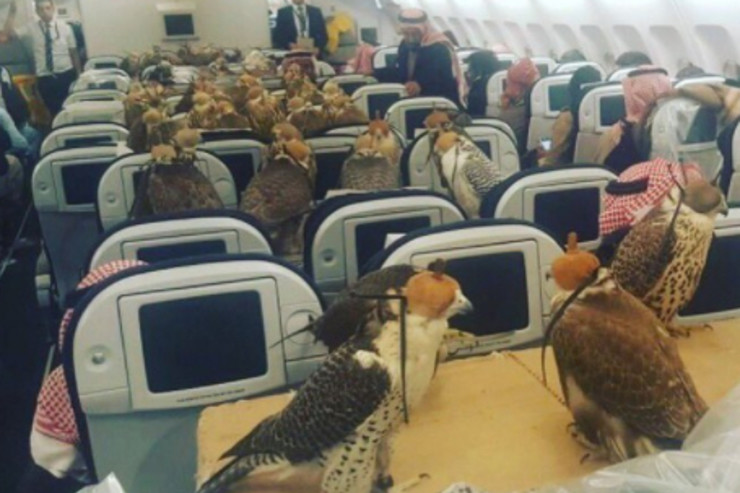
Saudi’s idiosyncratic ways with its prince in charge (the one who hires planes for falcons) also includes interesting experiments that other fiscally-minded nations might not try, like investing in hydrogen fuel for buses

falcons plane saudi arabia

As it’s sometimes hard to separate fact from fiction in Saudi Arabia: a fine for tree-cutters is a good thing, but not one so steep. Would it ever be enacted or just a threat until the wrong Joe makes a mistake? We might think it be better to take an even-handed approach and focus on the treehuggers in Saudi Arabia and reward them when they do good. 

The fact that the Kingdom last month announced the launch of ‘Let’s Make it Green’ – a plan that seeks to plant 10 million trees across the country by April 2021, seems like a good idea. Saudi Aramco, the largest oil producer, and the richest company in the world has vowed to plant 1 million trees. But where will the water come from for all those trees? Planting them is one thing. Taking care of them quite another. Energy intensive desalination?

Economic and social reforms have gained momentum since Saudi’s de facto ruler, Crown Prince Mohammed bin Salman, announced his ambitious vision in 2016 to reduce the country’s heavy dependence on oil.

“We will seek to safeguard our environment by increasing the efficiency of waste management, establishing comprehensive recycling projects, reducing all types of pollution and fighting desertification,” reads the vision.

According to Jewish Law it is forbidden to cut a tree-bearing fruit. In practice it happens. We’ve yet to hear of someone who has gone to jail for it. On the upside, planting trees can shape a nation. Israel’s mission with the Jewish Agency to plant trees since its founding in 1948 has led to it becoming the only country in the world with net positive trees than it had 100 years ago.

Planting trees is a great way to suck up carbon dioxide. Environmentalists I’ve spoke with say it’s likely a whole lot more sustainable than carbon capture. 

Top image: a rendering of Riyadh, a city that aims to plant 7 million trees 


Karin Kloosterman
Karin Kloostermanhttp://www.greenprophet.com
Karin Kloosterman is an award-winning journalist, innovation strategist, and founder of Green Prophet, one of the Middle East’s pioneering sustainability platforms. She has ranked in the Top 10 of Verizon innovation competitions, participated in NASA-linked challenges, and spoken worldwide on climate, food security, and future resilience. With an IoT technology patent, features in Canada’s National Post, and leadership inside teams building next-generation agricultural and planetary systems — including Mars-farming concepts — Karin operates at the intersection of storytelling, science, and systems change. She doesn’t report on the future – she helps design it. Reach out directly to [email protected]

Hot this week

How Renewable Energy is Revolutionizing the Way We Power Our World

Solar has become the star of the transition thanks to modular hardware and straightforward installation. It fits dense cities and remote towns alike. Many companies are turning to rooftop arrays and carport systems - and exploring commercial solar installation as a practical way to lock in future savings.

How does one start prepping?

Faced with an extreme winter storm this year, Americans wonder how to be prepared for catastrophe. Miriam has lived through wars in the Middle East - so she's prepared on giving you a guide to prepping.

Fishermen sue tire manufacturers on behalf of the salmon

A federal trial in San Francisco has brought US tire manufacturers, fishing groups, and environmental scientists into court over a chemical most drivers have never heard of — but which scientists say may be silently reshaping aquatic ecosystems.

Listening to Water: Tarek Atoui’s Next Work for Tate Modern

Born in Beirut, Lebanon in 1980 and now living in Paris, Atoui has spent years building instruments that don’t sit comfortably in concert halls. Many of them involve water, glass, and ceramics — materials that react to sound instead of simply producing it.

Leading Through a Dual-Energy Transition: Balancing Decarbonisation with Energy Security

Experience in one area of the energy industry isn't enough to guarantee readiness across all the others. That's where a structured program like an MBA in energy can come in. Today's advanced curricula explore energy economics, finance, policy, and strategic management alongside the technical subjects. And when pursuing an energy MBA online, professionals can skill up and retrain without having to step out of the labor market -- an important perk at a time when skilled professionals are already in short supply.

Topics

How Renewable Energy is Revolutionizing the Way We Power Our World

Solar has become the star of the transition thanks to modular hardware and straightforward installation. It fits dense cities and remote towns alike. Many companies are turning to rooftop arrays and carport systems - and exploring commercial solar installation as a practical way to lock in future savings.

How does one start prepping?

Faced with an extreme winter storm this year, Americans wonder how to be prepared for catastrophe. Miriam has lived through wars in the Middle East - so she's prepared on giving you a guide to prepping.

Fishermen sue tire manufacturers on behalf of the salmon

A federal trial in San Francisco has brought US tire manufacturers, fishing groups, and environmental scientists into court over a chemical most drivers have never heard of — but which scientists say may be silently reshaping aquatic ecosystems.

Listening to Water: Tarek Atoui’s Next Work for Tate Modern

Born in Beirut, Lebanon in 1980 and now living in Paris, Atoui has spent years building instruments that don’t sit comfortably in concert halls. Many of them involve water, glass, and ceramics — materials that react to sound instead of simply producing it.

Leading Through a Dual-Energy Transition: Balancing Decarbonisation with Energy Security

Experience in one area of the energy industry isn't enough to guarantee readiness across all the others. That's where a structured program like an MBA in energy can come in. Today's advanced curricula explore energy economics, finance, policy, and strategic management alongside the technical subjects. And when pursuing an energy MBA online, professionals can skill up and retrain without having to step out of the labor market -- an important perk at a time when skilled professionals are already in short supply.

From Green Energy to Healthy Societies: Why old systems thinking is becoming relevant again

Across the Middle East and North Africa, large investments are being made in green hydrogen, renewable energy, water infrastructure and sustainability. Most of these efforts are discussed in the context of climate change, decarbonization and economic diversification. That framing is important, but it may not capture their full value.

We saw peace – an interreligious encounter deep in our eyes

They came from Israel, Palestine, Jordan, Iraq, Yemen, Morocco, Tunisia, Lebanon, Egypt… There are Sunni Muslims, Shiite Muslims, Jews (Orthodox and Reform), Orthodox Christians, Coptic Christians, Protestant Christians, Druze, Baha'is, a Scientologist.

Can biochar reduce ‘Forever Chemicals’ in food if it’s used in farms?

Biochar is produced by heating organic material in a low-oxygen environment so it does not burn. This process, known as pyrolysis, transforms plant matter into a stable, carbon-rich material.

Related Articles

Popular Categories