
Jordan, which has long received a lion’s share of USAID for survival, and which receives $1.5 billion USD every year to help with water and basic needs, is one of the poorest countries and most water-scarce countries on Earth. In parts of Amman, the most unwalkable city on the planet, households still receive municipal water only once a week. You order a truck and a you pay $50 or so for the company to fill up your water tank. If you are lucky, you build 2 or 3 tanks so you can be sure about your next shower.
National renewable freshwater availability stands at well under 100 cubic meters per person annually, which is far below the international benchmark for “absolute scarcity.” And Jordan has started building itself as a greenhouse and agriculture center of the region.

Now Jordan is advancing one of the the largest infrastructure project in its history: the Aqaba–Amman Water Desalination and Conveyance Project. The plan links a massive Red Sea desalination plant to a 450-kilometer pipeline that will transport water north to the capital. An original plan over the years was the Red Dead Canal, a partnership with Israel. But after decades of inaction from both sides, they want to do it alone if they can pull off the billions in financing needed.
In 2025, the Jordanian government signed agreements with a consortium led by Meridiam and SUEZ, alongside VINCI Construction and Orascom Construction. Under a 30-year concession agreement, the consortium will design, build, finance, operate, and maintain the system before transferring it back to the Jordanian government. The total investment is estimated at approximately $6 billion USD.
What the Desalination Project Will Deliver
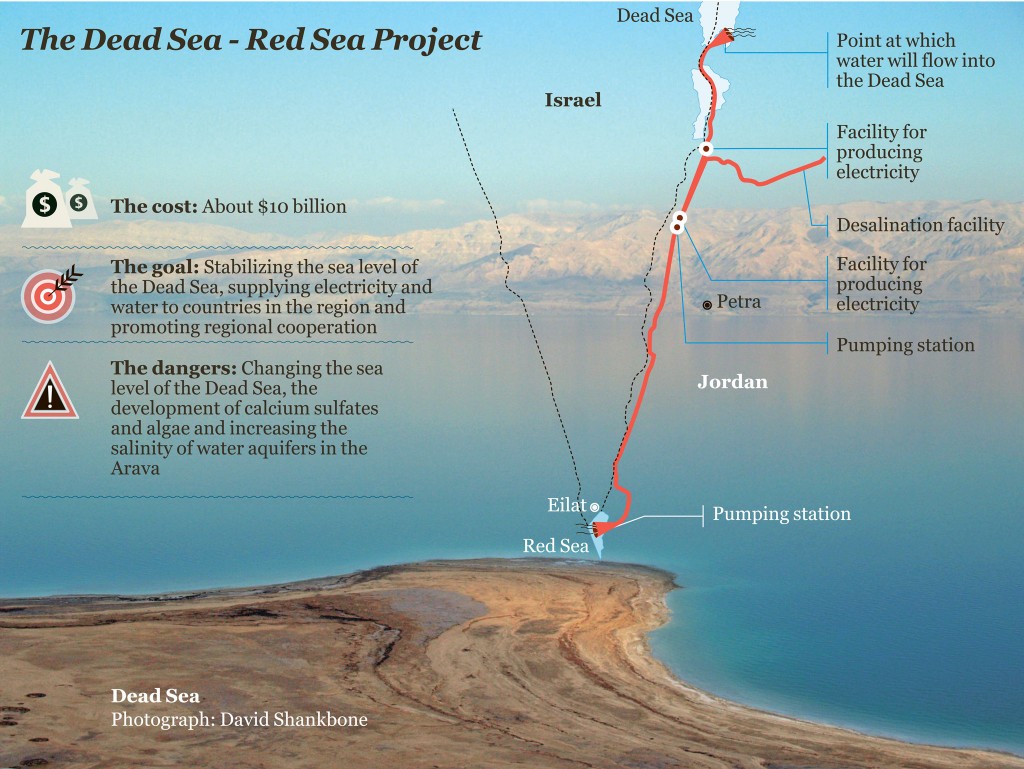
At full capacity, the system is expected to supply 300 million cubic meters of desalinated water per year, covering roughly one-third to 40% of Jordan’s drinking water demand.
The system includes:
- A large reverse osmosis desalination plant near Aqaba on the Red Sea
- A 300-mile conveyance pipeline to Amman
- High-capacity pumping stations lifting water more than 1,000 meters in elevation
- Expanded storage infrastructure in the Amman region
The plant’s projected output — about 800,000 to 850,000 cubic meters per day — would make it one of the largest seawater reverse osmosis facilities in the world. Saudi Arabia, which borders Jordan, currently runs the largest desalination plant in the world, a title taken from Israel not long ago. Israel has long been a pioneer of membrane technology, which is the technology needed to separate salt and brine from the water.
According to SUEZ, the project “will significantly strengthen Jordan’s long-term water security while integrating environmental best practices in desalination.”
Who Will Profit from Jordan’s Water?

The financing structure is a public-private partnership. The consortium will raise a significant portion of the capital through a mix of private equity and project debt. Multilateral development banks are expected to participate, including institutions such as the European Bank for Reconstruction and Development and the International Finance Corporation, alongside export credit agencies and commercial lenders.
Jordan’s government will ultimately purchase the water under long-term offtake agreements, creating predictable revenue streams for the concession holders over three decades.
That means: Infrastructure investors like Meridiam earn a stable, long-term return. SUEZ generates operating revenue from managing one of the region’s most strategic water assets. Construction giants VINCI Construction and Orascom Construction secure multi-billion-dollar engineering contracts. Lenders collect interest over the concession period. Jordan gains water security.
The question now is whether the financial model keeps water affordable for citizens while delivering returns to international investors? Locals I have spoke with found the cost of water to be negligible in their montly expenses, but will the costs increase going forward? In some countries the cost of water is free, and in others water is difficult to obtain, like on islands in Thailand where you can’t think of drinking tap water. Desalinated water is drinkable, as long as added minerals are put in place. Can Jordan do this?
Another option is for Jordan to strengthen trade with Saudi Arabia, which operates extensive desalination infrastructure along the Red Sea, producing over 3 billion cubic meters of water daily and accounting for nearly 50% of global desalination capacity. If the Vision 2030 ever comes to be, this is probably what will happen in reality.