Sink holes from over-watering farmers’ fields

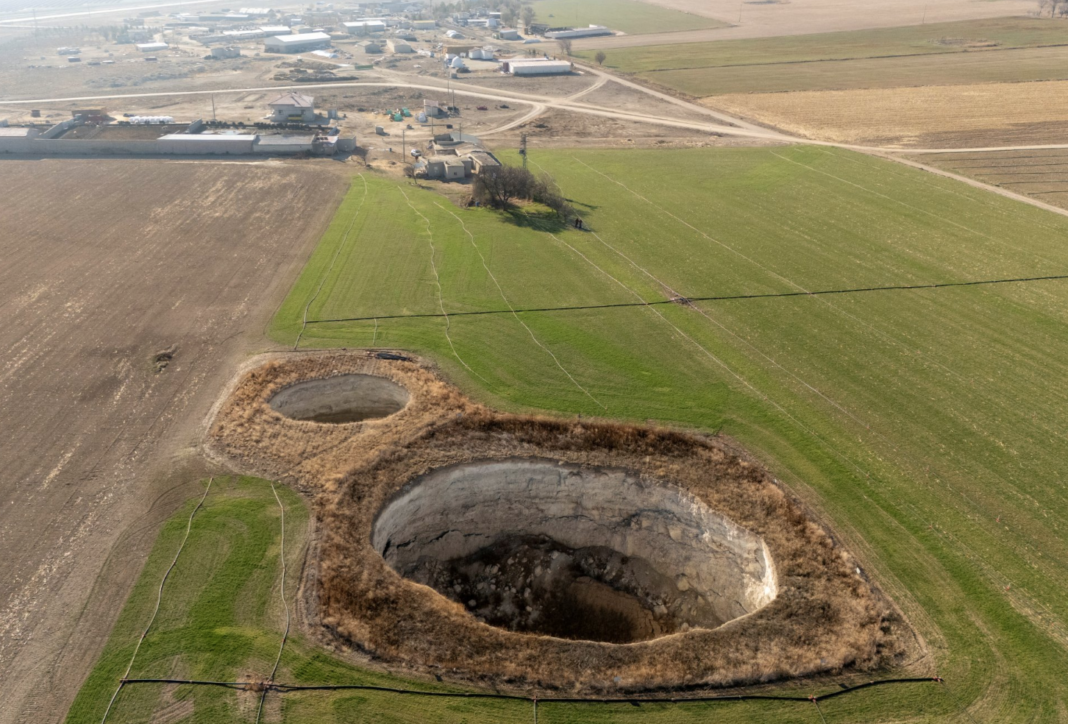
Sink holes appearing in Konya, Turkey due to overuse of irrigation water
Sink holes appearing in Konya, Turkey due to overuse of irrigation water. Via Reuters.

Sinkholes are rapidly appearing in Turkey’s central Anatolian farming region, particularly around Konya and Karapınar. These giant gaping holes in the ground in areas of farmland, known locally as obruk, are not random geological events. They are linked to prolonged drought, climate-driven heat stress, and heavy groundwater extraction for agriculture in one of the country’s most important breadbaskets. As rainfall declines and evaporation increases, natural aquifer recharge has slowed, while demand for irrigation water has surged. There are an estimated 700 new sink holes that have popped up this winter, according to Reuters.

Related: Explore Istanbul’s coolest neighborhood Balat

In Konya, large-scale farming relies heavily on groundwater wells. Farmers often respond to drought by pumping more water and overwatering crops, especially where irrigation remains inefficient or poorly regulated. When groundwater is withdrawn faster than it can be replenished, underground cavities lose pressure and stability. Over time, the land above can suddenly collapse, creating sinkholes that damage fields, roads, and infrastructure and threaten lives. Sinks holes have appeared in Iran, and also in Israel in the area of the Dead Sea. A giant sink hole collapsed an entire road in Bangkok, Thailand earlier this year.

Climate change has intensified drought through higher temperatures and shifting rainfall patterns, while decades of groundwater overuse for agriculture have compounded the damage. As in Turkey, farmers often drill deeper wells and irrigate more aggressively during dry years, accelerating aquifer depletion and land subsidence. Scientists warn that this cycle—drought followed by over-pumping—can permanently damage water systems and agricultural viability.

Related: learn more about Tunisia’s lagoons and hanging gardens for sustainable agriculture.

Across Turkey, the Dead Sea basin, and Iran, the lesson is consistent: groundwater is being treated as an endless emergency reserve. In reality, once aquifers are drained or destabilized, the land itself begins to fail. Sinkholes are not just geological curiosities; they are warning signs that climate change, drought, and overwatering are colliding with unsustainable farming practices.

Read more on resource overuse on Green Prophet:

Green Prophet: Turkey’s deadly sinkholes threaten agriculture and people

Green Prophet: Sinkholes and shrinking shores of the Dead Sea

Green Prophet: Land subsidence in Iran is a looming disaster

TRENDING

Is your groundwater too young? New study finds risks for Parkinson’s and type of water you drink

People whose drinking water came from newer groundwater had a higher risk of developing Parkinson’s disease than those whose drinking water came from older groundwater, according to a preliminary study released March 2, 2026, that will be presented at the American Academy of Neurology’s 78th Annual Meeting taking place April 18–22, 2026, in Chicago and online.

The Saudi Startup Turning Desalination’s Toxic Waste Into Its Own Disinfectant

For millennia, the Middle East's water crisis seemed an immutable fact of geography — a region defined as much by what it lacked as by what lay beneath its sands. Today, a convergence of plummeting solar costs, advancing membrane technology, and hard-won engineering expertise is rewriting that story.

Forever chemicals banned from Europe’s drinking water

The EU is taking a bold step in making sure all European Union member states worked to monitor and reduce PFAS levels in drinking water.

Elon Musk to create Mars base station on the Moon

For those unaware, SpaceX has already shifted focus to building a self-growing city on the Moon, as we can potentially achieve that in less than 10 years, whereas Mars would take 20+ years.

Astro uses AI to help procure land for renewable energy

For oil-rich, environmentally vigilant Gulf states, Astro isn’t just another startup story. It is a blueprint for accelerating an energy transition that is now existential, not optional.

Should You Invest in the Private Market?

startustartup Unlike public stock exchanges, which offer daily trading, strict...

How to build a 100-year-company

Kongō Gumi is a Japanese construction company, purportedly founded in 578 A.D., making it the world's oldest documented company. What can we learn about building sustainable businesses from them?

From Pilot Plant to Global Stage: How Aduro Clean Technologies’ 2026 Expansion Signals a Turning Point for Chemical Recycling Investors Like Yazan Al Homsi

The company's Next Generation Process (NGP) Pilot Plant in London, Ontario, has officially moved into initial operating campaigns, generating the kind of structured, repeatable data that separates laboratory promise from commercial viability.

How AI Helps SaaS Companies Reduce Repetitive Customer Support Work

SaaS products are designed for large numbers of users with different levels of experience, and also in renewable energy.

Pulling Water from the Air

Faced with water shortage in Amman, Laurie digs up...

Turning Your Energy Consultancy into an LLC: 4 Legal Steps for Founders in Texas

If you are starting a renewable energy business in Texas, learn how to start an LLC by the books.

Tracking the Impacts of a Hydroelectric Dam Along the Tigris River

For the next two months, I'll be taking a break from my usual Green Prophet posts to report on a transnational environmental issue: the Ilısu Dam currently under construction in Turkey, and the ways it will transform life along the Tigris River.

6 Payment Processors With the Fastest Onboarding for SMBs

Get your SMB up and running fast with these 6 payment processors. Compare the quickest onboarding options to start accepting customer payments without delay.

Related Articles

Popular Categories