Make America cool again, says Make Sunsets a startup that’s geo-engineering the climate

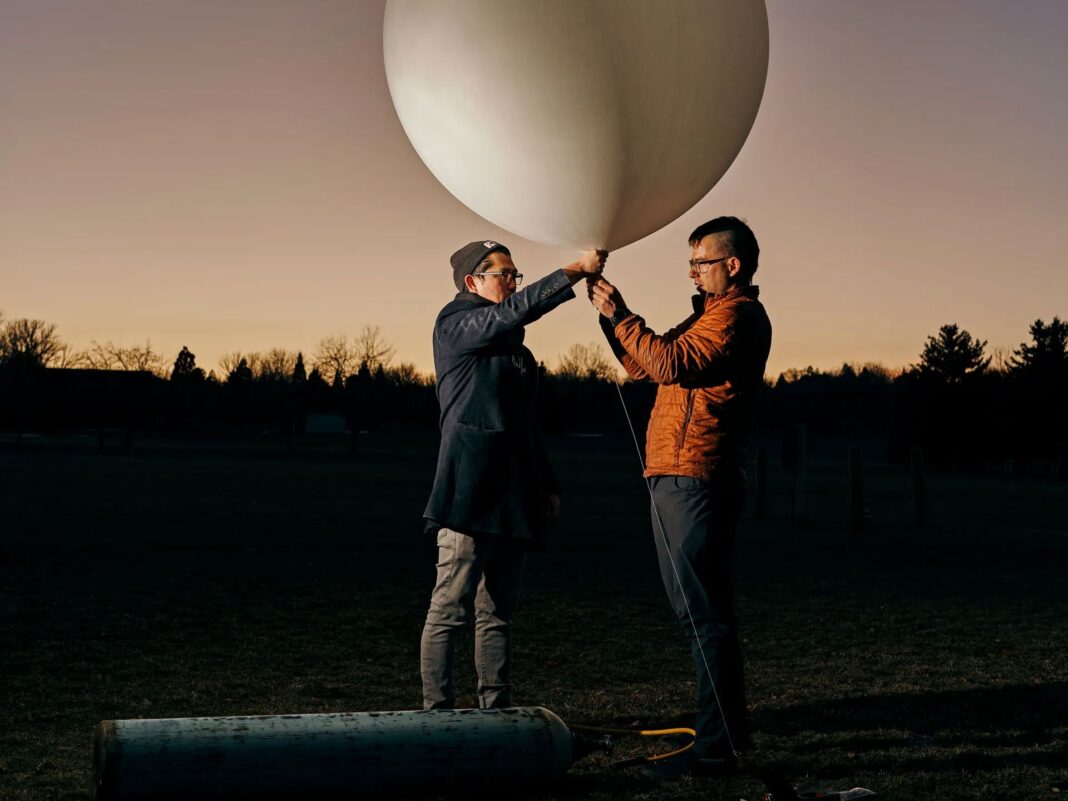
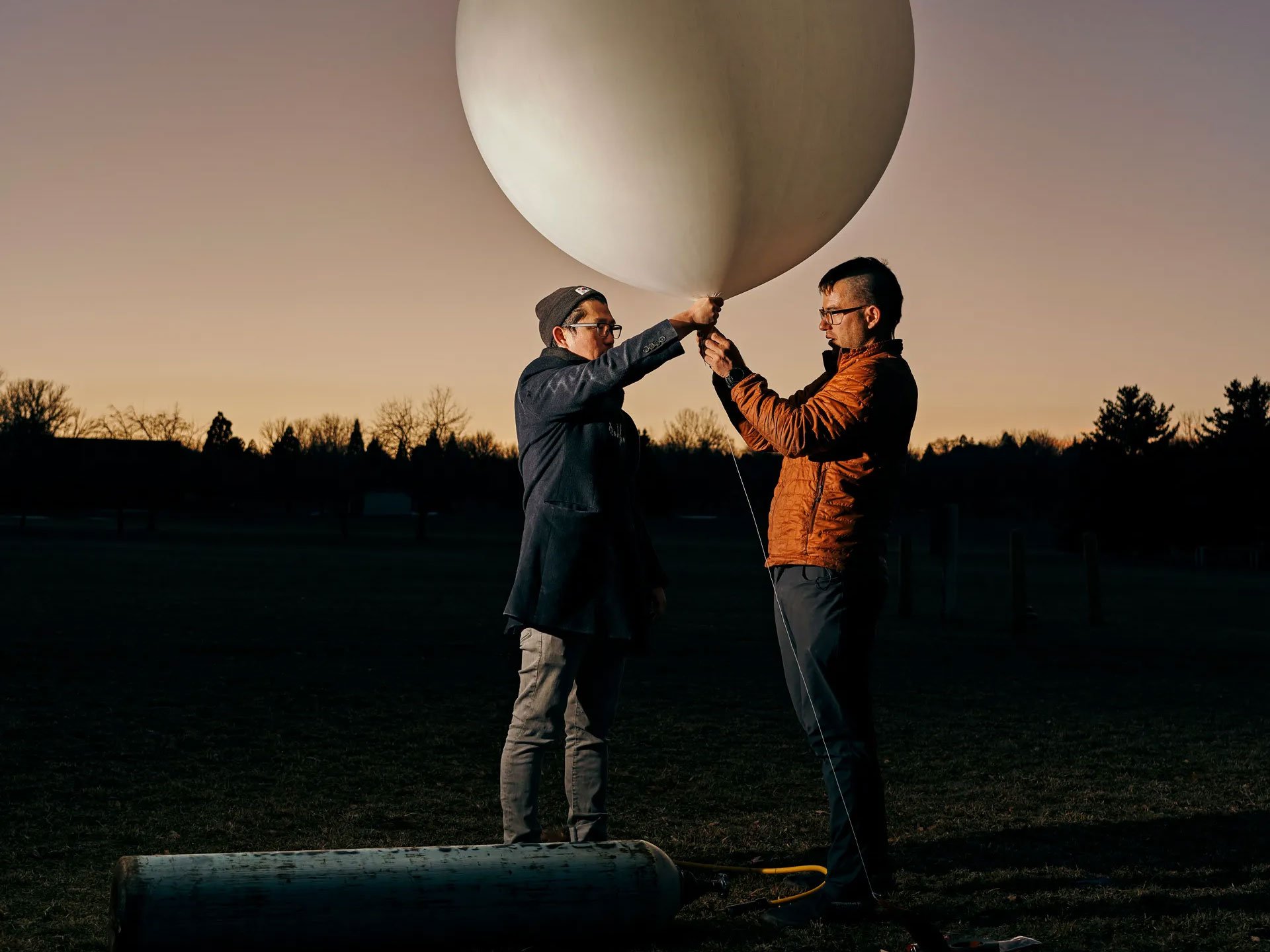
Make Sunsets founders

Their ethos? Act now, ask forgiveness later.

Make Sunsets, a geoengineering startup based in South Dakota, continues to attract both controversy and attention as it pushes ahead with its mission to “Make Earth Cool Again”—literally. The company, founded by Andrew Song and Luke Iseman, has been releasing sulfur dioxide into the stratosphere using high-altitude balloons, an experimental (and deeply polarizing) method of solar geoengineering designed to reflect sunlight and reduce global temperatures.

In a recent newsletter from 10 days ago, Make Sunsets revealed that it had responded to inquiries from the US Environmental Protection Agency (EPA), guided by two former EPA lawyers. Their cheeky tone remains unchanged: “Let’s ensure American energy dominance as well as a safe and healthy environment by Making Earth Cool Again,” they wrote.
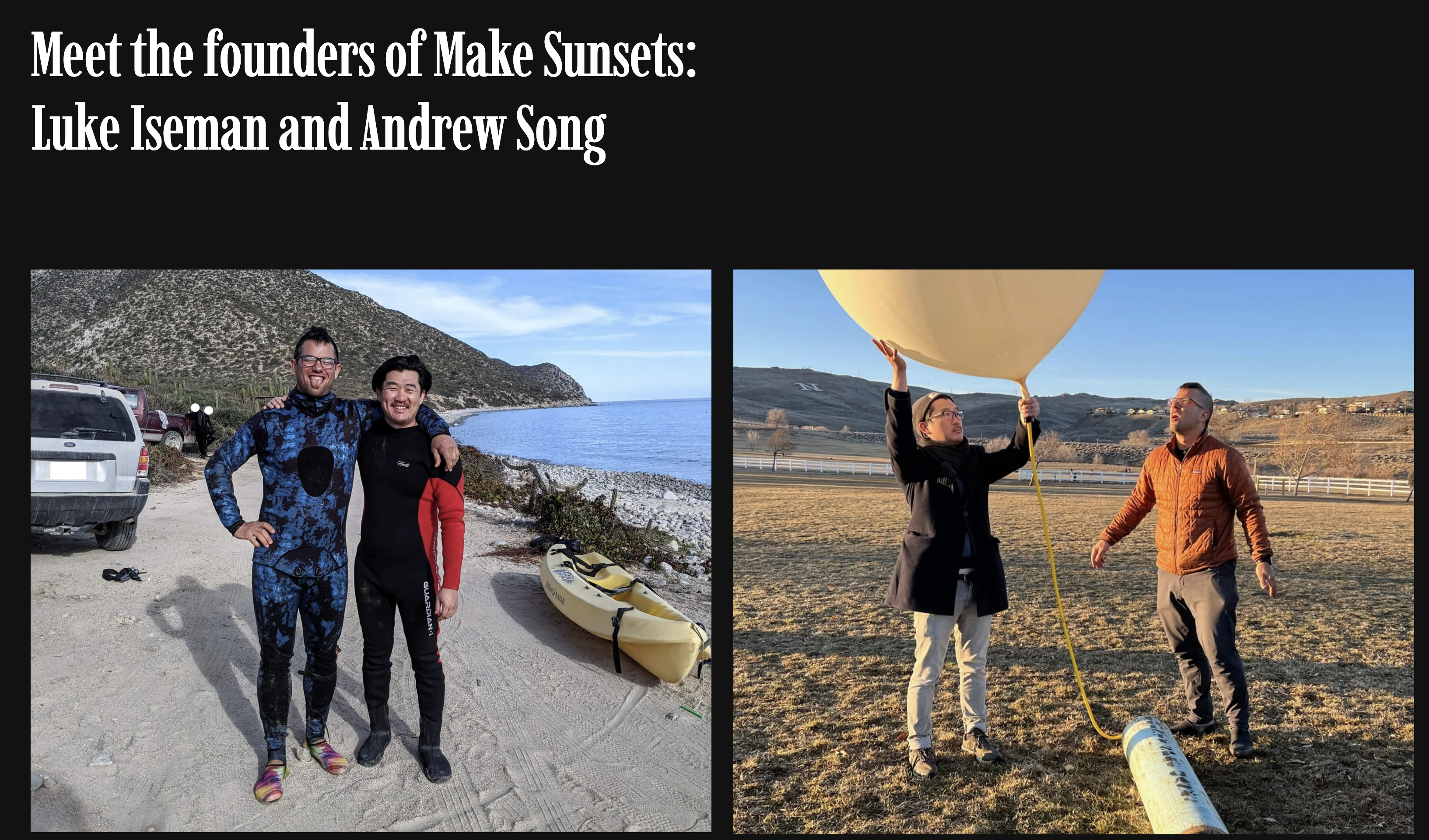
Make Sunsets founders

Despite the EPA referring to their activities as “unregulated,” the founders are confident the agency doesn’t have a solid legal basis to shut them down. “We predict they’ll stay out of our way,” they wrote. And they aren’t slowing down—this month, they launched five new balloons carrying 5,895 “Cooling Credits” worth of sulfur dioxide to altitudes of 30 km, with two of three payloads successfully recovered.

Critics Say “Wait,” They Say “Why?”

The company’s critics, including many climate scientists, argue that Make Sunsets is moving too fast with a technology whose global impacts are uncertain. Solar geoengineering could potentially reduce global temperatures, but it also poses major ethical, geopolitical, and ecological questions—who decides when and where to deploy it? What are the long-term risks?

“The existence of companies like Make Sunsets is precisely why CCAN supports public-funded research and opposes private money in both solar geoengineering testing and deployment. Research must be held to the highest bar, conducted with full transparency, and developed in a way that explicitly benefits the public good – not corporate profit margins,” says Quentin Scott, Federal Policy Director for the Chesapeake Climate Action Network (CCAN) said.

“CCAN is speaking out in strong opposition to the work of this renegade firm because it is a dangerous distraction from the serious scientific research that needs to be done.

“However, the Environmental Protection Agency (EPA) opposition to Make Sunsets is hypocritical and factually inaccurate. EPA says that Make Sunsets may be adversely impacting air quality, but the truth is that the sulfur dioxide that this company releases is dispersed too high in the atmosphere to impact the air we breathe.

“Additionally, the EPA’s pretense of using the Clean Air Act to threaten Make Sunsets is absurd when the administration is repeatedly attacking that same landmark legislation in the courts, Congress, and public discourse. If the EPA truly stood for the principle of protecting pristine air for all Americans, they would enforce the Clean Air Act provisions that they are Congressionally mandated to enforce instead of making up new ones.”

Make Sunsets, on the other hand, is openly skeptical of the academic establishment. They vented their frustration after attending the recent Degrees Global Forum in South Africa, the largest solar geoengineering gathering to date. Their takeaway: “many get paid to talk, not act,” calling out scientists who “live in a fantasy land” for believing in the feasibility of global net-zero emissions by 2100.

Potential Emergency Climate Tool: If global warming accelerates to dangerous levels and mitigation efforts fall short, solar geoengineering could serve as a temporary emergency measure. Make Sunsets contributes early real-world data and experimentation that could prove valuable in understanding the viability of such options in the future.
Potential Emergency Climate Tool:
If global warming accelerates to dangerous levels and mitigation efforts fall short, solar geoengineering could serve as a temporary emergency measure. Make Sunsets contributes early real-world data and experimentation that could prove valuable in understanding the viability of such options in the future.

The newsletter was especially pointed in its critique: “Do we really need another study on the potential impact to maize yield in Ecuador? You know what else hurts maize yields? Record-breaking temperatures, continent-sweeping fires, and longest-recorded droughts.”

Related: Climate change Greta Thunberg sails to Gaza on Freedom Flotilla 

Their core argument: we’ve run out of time for endless modeling—climate interventions are needed now.

Business Model: Selling “Cooling Credits”
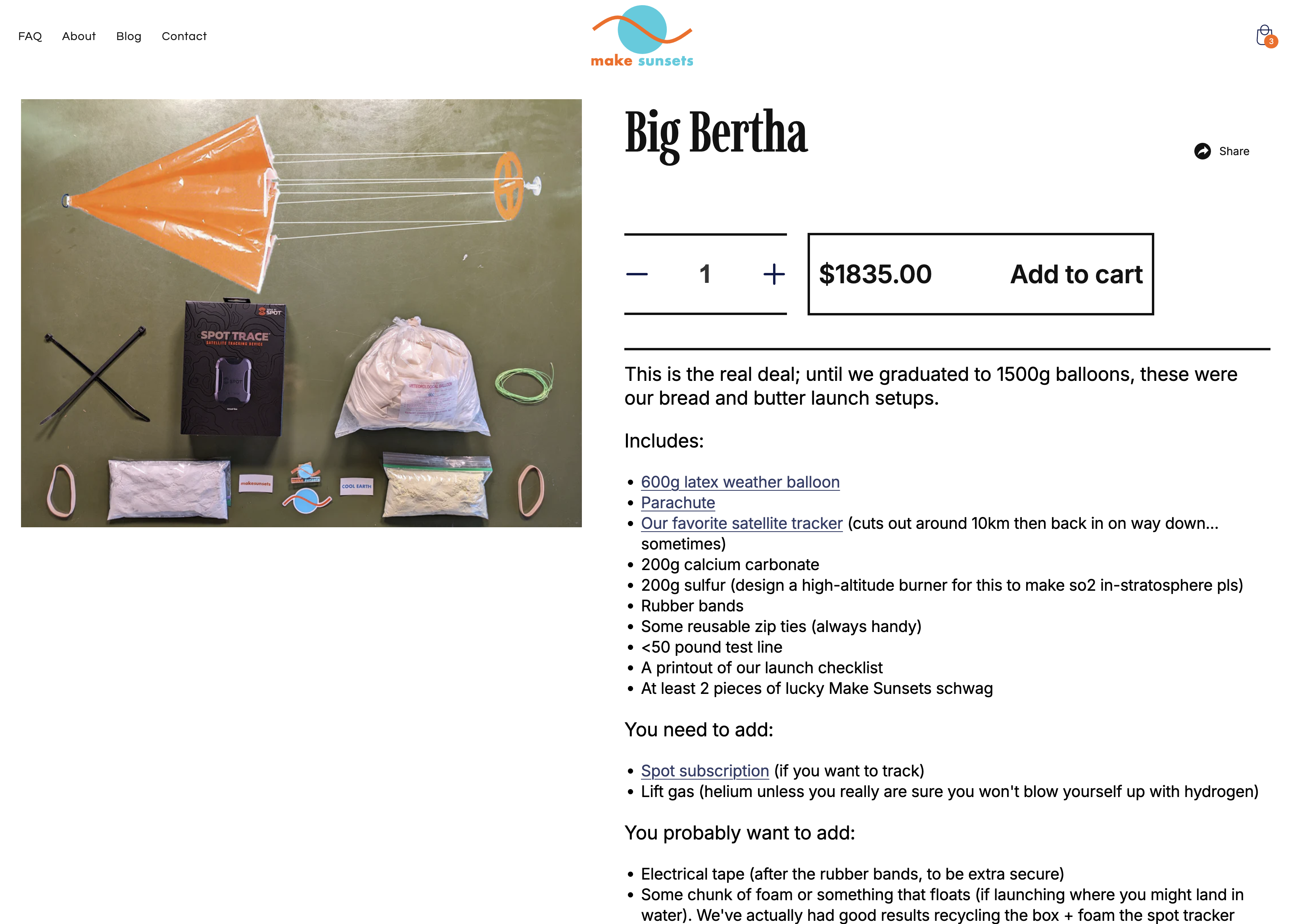
Make Sunsets generates revenue by selling “Cooling Credits”—units purchased by individuals or companies who want to fund solar geoengineering as a form of carbon offset. With a revenue of $9,414 in the last month (May) and expenses (“burn”) of $40,135, they are burning cash but still have a healthy runway of 20 months, supported by a reported cash balance of $969,009.

They’ve recently added a fiscal sponsor, allowing tax-deductible donations to the effort—another controversial move that may signal their intent to operate partly in the nonprofit space.

The company has ambitious plans:

$14K in sales for May

First paid “return-to-home” balloon flight

Signing a client for localized cooling—a move that could mark the beginning of geoengineering-as-a-service

Despite the scientific and regulatory uncertainty, Make Sunsets continues to scale what many consider a rogue climate experiment. Their ethos? Act now, ask forgiveness later.

Whether they represent a radical new frontier in climate action or a reckless gamble remains deeply contested. But one thing is clear—they’re not waiting for permission.

Karin Kloosterman
Karin Kloostermanhttp://www.greenprophet.com
Karin Kloosterman is an award-winning journalist, innovation strategist, and founder of Green Prophet, one of the Middle East’s pioneering sustainability platforms. She has ranked in the Top 10 of Verizon innovation competitions, participated in NASA-linked challenges, and spoken worldwide on climate, food security, and future resilience. With an IoT technology patent, features in Canada’s National Post, and leadership inside teams building next-generation agricultural and planetary systems — including Mars-farming concepts — Karin operates at the intersection of storytelling, science, and systems change. She doesn’t report on the future – she helps design it. Reach out directly to [email protected]

LEAVE A REPLY

Please enter your comment!
Please enter your name here

TRENDING

Leading Through a Dual-Energy Transition: Balancing Decarbonisation with Energy Security

Experience in one area of the energy industry isn't enough to guarantee readiness across all the others. That's where a structured program like an MBA in energy can come in. Today's advanced curricula explore energy economics, finance, policy, and strategic management alongside the technical subjects. And when pursuing an energy MBA online, professionals can skill up and retrain without having to step out of the labor market -- an important perk at a time when skilled professionals are already in short supply.

Can biochar reduce ‘Forever Chemicals’ in food if it’s used in farms?

Biochar is produced by heating organic material in a low-oxygen environment so it does not burn. This process, known as pyrolysis, transforms plant matter into a stable, carbon-rich material.

Huge Fish Nursery Discovered Under Freezing Arctic Seas

In 2019, an underwater robot camera exploring the seabed...

Remilk makes cloned milk so cows don’t need to suffer and it’s hormone-free

This week, Israel’s precision-fermentation milk from Remilk is finally appearing on supermarket shelves. Staff members have been posting photos in Hebrew, smiling, tasting, and clearly enjoying the moment — not because it’s science fiction, but because it tastes like the real thing.

The US leaves 66 United Nations organizations to “put America first”

The world needs a reset and to restart well intentioned cooperation projects from start. Because right now the UN and EU projects look like software built on code from the 80s, rickety, patched, slow to adapt, and prone to crashing under the weight of outdated assumptions.

Qatar’s climate hypocrisy rides the London Underground

Qatar remains a master of doublethink—burning gas by the megaton while selling “sustainability” to a world desperate for clean air. Wake up from your slumber people.

How Quality of Hire Shapes Modern Recruitment

A 2024 survey by Deloitte found that 76% of talent leaders now consider long-term retention and workforce contribution among their most important hiring success metrics—far surpassing time-to-fill or cost-per-hire. As the expectations for new hires deepen, companies must also confront the inherent challenges in redefining and accurately measuring hiring quality.

8 Team-Building Exercises to Start the Week Off 

Team building to change the world! The best renewable energy companies are ones that function.

Thank you, LinkedIn — and what your Jobs on the Rise report means for sustainable careers

While “green jobs” aren’t always labeled as such, many of the fastest-growing roles are directly enabling the energy transition, climate resilience, and lower-carbon systems: Number one on their list is Artificial Intelligence engineers. But what does that mean? Vibe coding Claude? 

Somali pirates steal oil tankers

The pirates often stage their heists out of Somalia, a lawless country, with a weak central government that is grappling with a violent Islamist insurgency. Using speedboats that swarm the targets, the machine-gun-toting pirates take control of merchant ships and then hold the vessels, crew and cargo for ransom.

Leopoldo Alejandro Betancourt López Turned Ocean Plastic Into Profitable Sunglasses

Few fashion accessories carry the environmental burden of sunglasses. Most frames are constructed from petroleum-based plastics and acrylic polymers that linger in landfills for centuries, shedding microplastics into soil and waterways long after they've been discarded. Leopoldo Alejandro Betancourt López, president of the Spanish eyewear brand Hawkers, saw this problem differently than most industry executives.

Why Dr. Tony Jacob Sees Texas Business Egos as Warning Signs

Everything's bigger in Texas. Except business egos.  Dr. Tony Jacob figured...

Israel and America Sign Renewable Energy Cooperation Deal

Other announcements made at the conference include the Timna Renewable Energy Park, which will be a center for R&D, and the AORA Solar Thermal Module at Kibbutz Samar, the world's first commercial hybrid solar gas-turbine power plant that is already nearing completion. Solel Solar Systems announced it was beginning construction of a 50 MW solar field in Lebrija, Spain, and Brightsource Energy made a pre-conference announcement that it had inked the world's largest solar deal to date with Southern California Edison (SCE).

Related Articles

Popular Categories