
Inside the Kaaba: Islam’s Hidden Heart

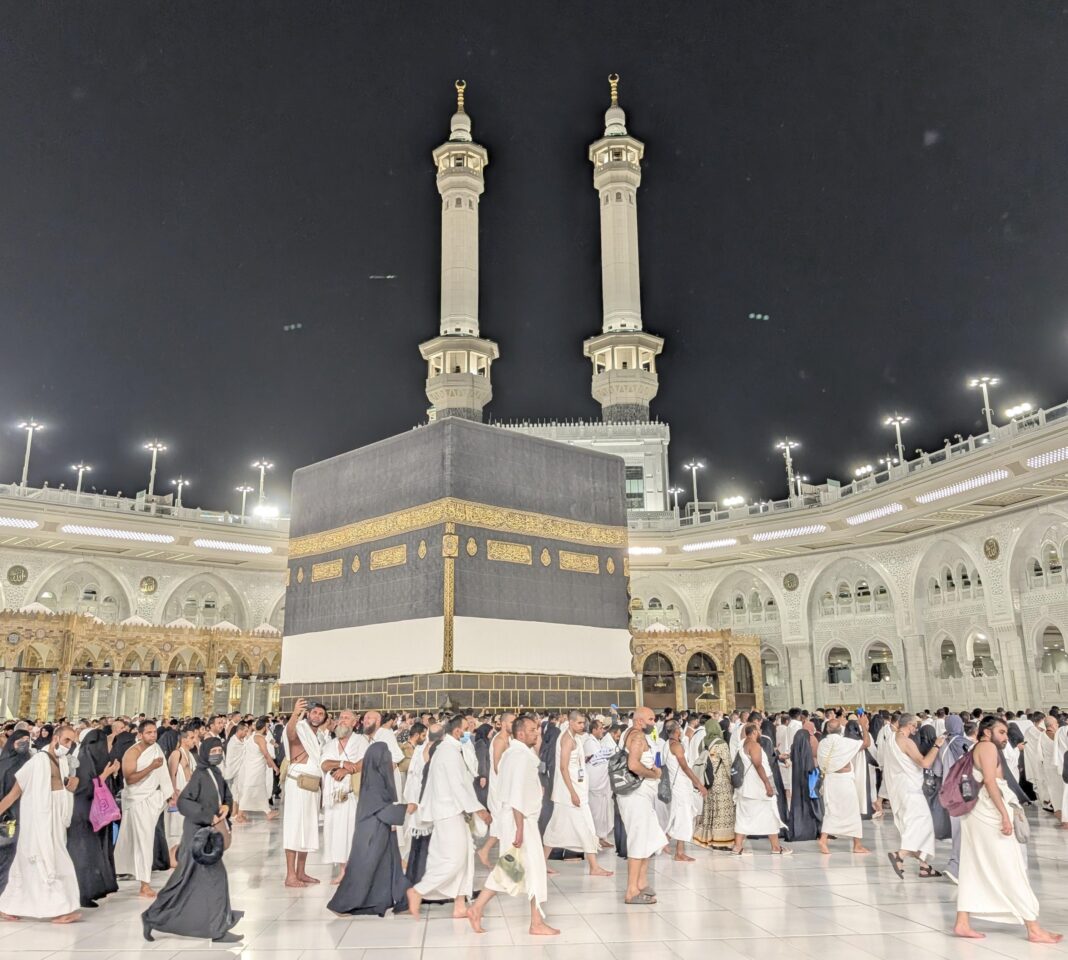
At the very center of the Islamic world stands a cube. Modest in shape yet immense in meaning, the Kaaba anchors the faith of over a billion Muslims, who turn toward it five times a day in prayer. Located within the Grand Mosque in Mecca, Saudi Arabia, this black-clad structure is the direction of prayer, the spiritual axis of Islam, and the focal point of the annual Hajj pilgrimage.

Yet despite its global significance, the Kaaba remains one of the most mysterious buildings on Earth. Few have seen inside it, and fewer still know what lies beyond its heavy door.

Inside the kaaba
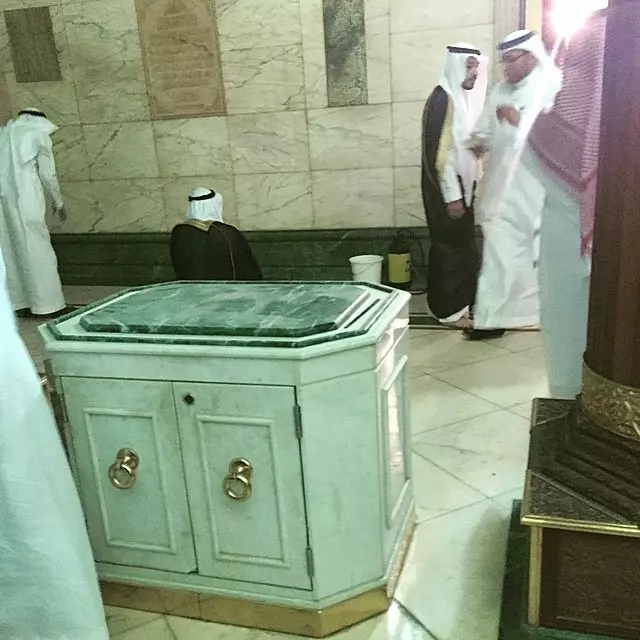
Inside the Kaaba via Islamic Landmarks

The interior of the Kaaba is striking in its simplicity. Step inside, and you enter a quiet, rectangular chamber lined with smooth white marble. Three ancient wooden pillars rise from the floor, holding up a flat wooden ceiling. From this ceiling hang delicate silver and gold lamps, some inscribed with calligraphy from bygone Islamic dynasties. The scent of oud lingers in the air—applied regularly with sacred oils stored in a modest wooden cabinet tucked along one wall.

The floor itself is made of cool, polished marble. There are no decorations, no paintings, no thrones or altars—only space, light, and stillness. The room is empty of ornament but full of spiritual weight.

Kaaba, kabaa interior Kaaba, kabaa interior Kaaba, kabaa interior Kaaba, kabaa interior

This is not a place of tourism or spectacle. The Kaaba is closed to the general public. Entry is reserved for rare ceremonial occasions, most notably when it is cleaned twice a year in a ritual carried out with immense care and reverence. This responsibility belongs to a distinguished Meccan family, the Al-Shaibi clan, who have been the traditional caretakers of the Kaaba for generations—since the time of the Prophet Muhammad himself.

It is a hereditary role, passed down with deep honor. During the cleaning, the interior is washed with Zamzam water and rosewater, wiped down with white cloths, and anointed with perfumes. Only a small group of religious leaders, heads of state, or invited dignitaries are present.

The cloth that wraps the Kaaba—the Kiswa—is replaced once a year during Hajj. Woven from silk and embroidered with Quranic verses in gold thread, the Kiswa is produced by a dedicated team of artisans in a specialized factory in Mecca. It is raised slightly each year to prevent wear from the crowds of pilgrims, then lowered again after Hajj concludes.

While the Kaaba we see today has undergone many reconstructions, its spiritual essence remains unchanged. Tradition holds that it was originally built by Abraham and his son Ishmael as a house of monotheistic worship. Over the centuries, it has been rebuilt several times due to floods, fires, and the passage of time. The current structure dates largely to a 17th-century reconstruction, with its foundations going back even further.

No appointment needed to kiss the stone

Security officers stand guard next to "Al-Hajar al-Aswad", or the Black Stone, as the first group of Muslims perform Tawaf around Kaaba at the Grand Mosque during the annual Haj pilgrimage, in the holy city of Mecca, Saudi Arabia, July 17, 2021. Saudi Ministry of Media/Handout
Security officers stand guard next to “Al-Hajar al-Aswad”, or the Black Stone, as the first group of Muslims perform Tawaf around Kaaba at the Grand Mosque during the annual Haj pilgrimage, in the holy city of Mecca, Saudi Arabia, July 17, 2021. Saudi Ministry of Media/Handout
The Black Stone on the Kaaba

Just outside the eastern corner of the Kaaba lies the Black Stone, a revered object kissed or touched by pilgrims performing the circumambulation ritual. But the sanctity of the Kaaba is not contained in any one object or wall. It lies in the unity it creates. Across continents and cultures, from mud mosques in Mali to prayer rooms in Jakarta, millions face the same direction each day, bound together by the unseen geometry of faith.

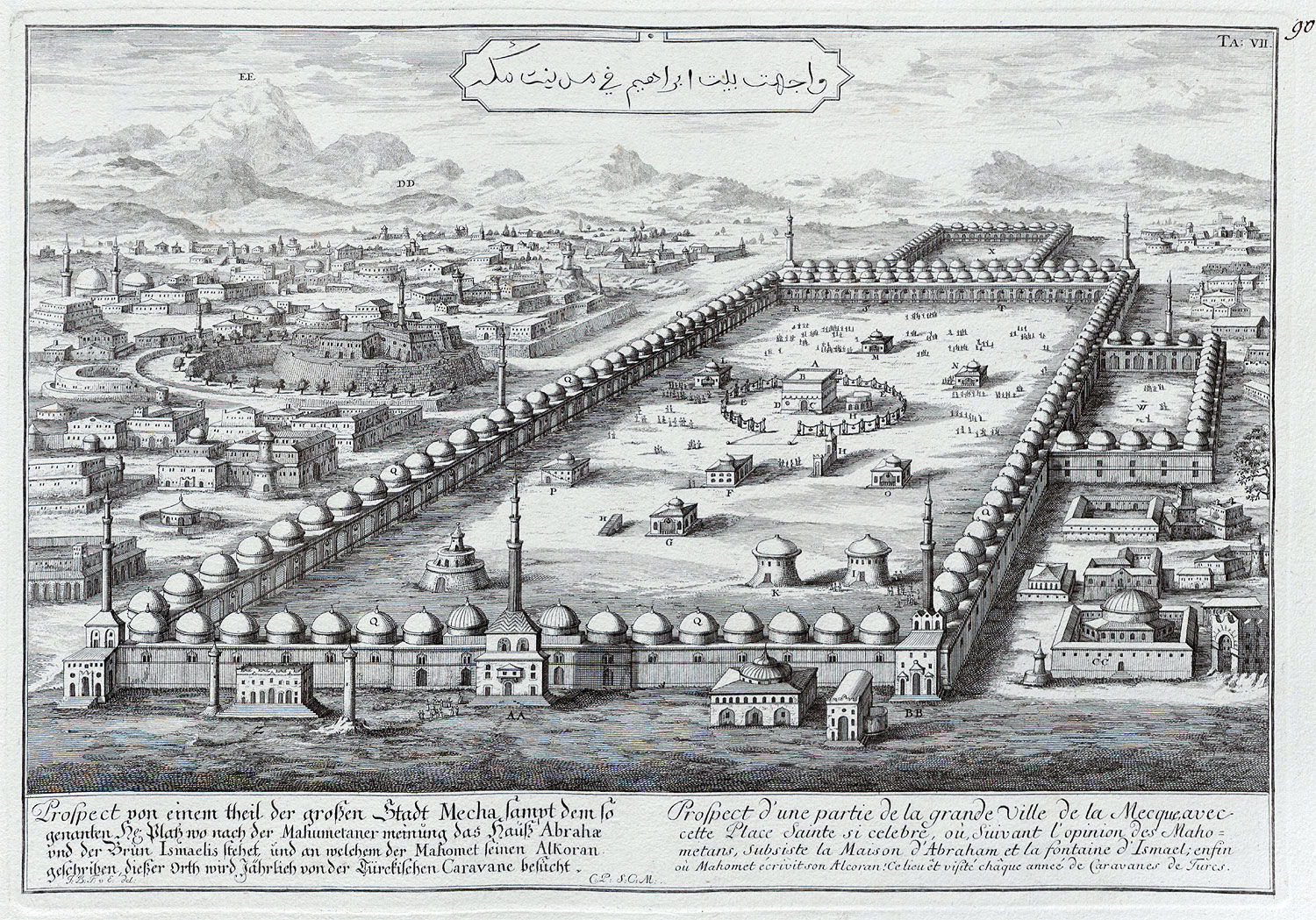
Vintage, undated images of the Kaaba

Vintage, undated images of the Kaaba

The Kaaba does not boast grandeur in the way palaces or cathedrals might. Its power is in its restraint. It is a place beyond spectacle, where emptiness becomes presence, and silence becomes prayer.

Hot this week

Fishermen sue tire manufacturers on behalf of the salmon

A federal trial in San Francisco has brought US tire manufacturers, fishing groups, and environmental scientists into court over a chemical most drivers have never heard of — but which scientists say may be silently reshaping aquatic ecosystems.

Listening to Water: Tarek Atoui’s Next Work for Tate Modern

Born in Beirut, Lebanon in 1980 and now living in Paris, Atoui has spent years building instruments that don’t sit comfortably in concert halls. Many of them involve water, glass, and ceramics — materials that react to sound instead of simply producing it.

Leading Through a Dual-Energy Transition: Balancing Decarbonisation with Energy Security

Experience in one area of the energy industry isn't enough to guarantee readiness across all the others. That's where a structured program like an MBA in energy can come in. Today's advanced curricula explore energy economics, finance, policy, and strategic management alongside the technical subjects. And when pursuing an energy MBA online, professionals can skill up and retrain without having to step out of the labor market -- an important perk at a time when skilled professionals are already in short supply.

From Green Energy to Healthy Societies: Why old systems thinking is becoming relevant again

Across the Middle East and North Africa, large investments are being made in green hydrogen, renewable energy, water infrastructure and sustainability. Most of these efforts are discussed in the context of climate change, decarbonization and economic diversification. That framing is important, but it may not capture their full value.

We saw peace – an interreligious encounter deep in our eyes

They came from Israel, Palestine, Jordan, Iraq, Yemen, Morocco, Tunisia, Lebanon, Egypt… There are Sunni Muslims, Shiite Muslims, Jews (Orthodox and Reform), Orthodox Christians, Coptic Christians, Protestant Christians, Druze, Baha'is, a Scientologist.

Topics

Fishermen sue tire manufacturers on behalf of the salmon

A federal trial in San Francisco has brought US tire manufacturers, fishing groups, and environmental scientists into court over a chemical most drivers have never heard of — but which scientists say may be silently reshaping aquatic ecosystems.

Listening to Water: Tarek Atoui’s Next Work for Tate Modern

Born in Beirut, Lebanon in 1980 and now living in Paris, Atoui has spent years building instruments that don’t sit comfortably in concert halls. Many of them involve water, glass, and ceramics — materials that react to sound instead of simply producing it.

Leading Through a Dual-Energy Transition: Balancing Decarbonisation with Energy Security

Experience in one area of the energy industry isn't enough to guarantee readiness across all the others. That's where a structured program like an MBA in energy can come in. Today's advanced curricula explore energy economics, finance, policy, and strategic management alongside the technical subjects. And when pursuing an energy MBA online, professionals can skill up and retrain without having to step out of the labor market -- an important perk at a time when skilled professionals are already in short supply.

From Green Energy to Healthy Societies: Why old systems thinking is becoming relevant again

Across the Middle East and North Africa, large investments are being made in green hydrogen, renewable energy, water infrastructure and sustainability. Most of these efforts are discussed in the context of climate change, decarbonization and economic diversification. That framing is important, but it may not capture their full value.

We saw peace – an interreligious encounter deep in our eyes

They came from Israel, Palestine, Jordan, Iraq, Yemen, Morocco, Tunisia, Lebanon, Egypt… There are Sunni Muslims, Shiite Muslims, Jews (Orthodox and Reform), Orthodox Christians, Coptic Christians, Protestant Christians, Druze, Baha'is, a Scientologist.

Can biochar reduce ‘Forever Chemicals’ in food if it’s used in farms?

Biochar is produced by heating organic material in a low-oxygen environment so it does not burn. This process, known as pyrolysis, transforms plant matter into a stable, carbon-rich material.

In The Dark Review – An Immersive Music Experience in Total Darkness at St Andrew Holborn

In complete darkness, inside the holy space of St Andrew Holborn, listening begins to feel like a form of prayer. With no light and no distraction, sound fills the church and holds the room. For an hour, attention itself becomes the shared act.

How Quality of Hire Shapes Modern Recruitment

A 2024 survey by Deloitte found that 76% of talent leaders now consider long-term retention and workforce contribution among their most important hiring success metrics—far surpassing time-to-fill or cost-per-hire. As the expectations for new hires deepen, companies must also confront the inherent challenges in redefining and accurately measuring hiring quality.

Related Articles

Popular Categories