

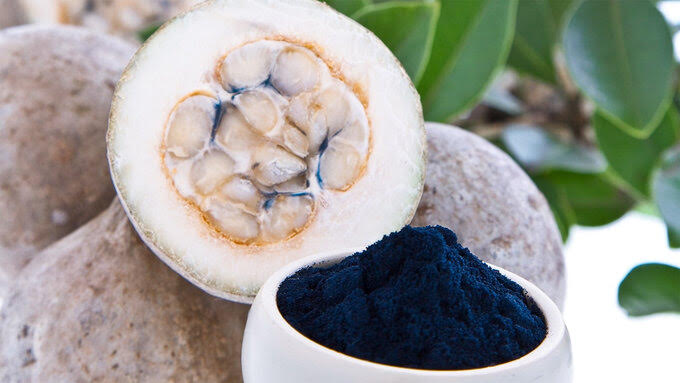
Synthetic food dyes should be avoided in everything we eat. But a true blue natural food dye was missing –– until now. It comes from a fruit about the size of a kiwi or a guava, growing on a semi-deciduous tree called the Genipa americana in the forests of Colombia. Opening a new chapter in the chronicle of food safety, it’s a “holy grail” in the food industry, the first ever blue food colouring to be natural in origin and resistant to acids. Let’s hope new interest in it will help protect forests, not cut them down.
When the pulp of the unripe jagua fruit is exposed to air, it turns dark blue in colour. The pigment has been widely used by various Indigenous Peoples in South America to paint their skin and dye their clothes, ceramics and some foods.
Now it’s been hailed by the food industry as the one remaining natural food colour needed to complete the entire spectrum. It was recently included in the Codex Alimentarius, or “Food Code”, a collection of standards, guidelines and codes of practices.
The jagua blue food colouring was developed in Colombia by a private company that set about creating and collecting the data needed for the scientific assessment of the safety of this food additive.
After a thorough scientific evaluation and confirmation that it was a product for which there was a need, jagua blue has been permitted for use under the Codex standard governing food additives, which covers everything from confectionery to breakfast cereals.
For Colombia, the jagua blue standard is a big deal. Officials there predict that the inclusion of jagua blue in the Codex Alimentarius can help improve the economic wellbeing of Indigenous Peoples who have used the colorant for generations. Particularly hoping to benefit are the Emberá Indigenous Peoples, many of whom have traditionally lived on the riverbanks of the densely forested northwestern Chocó region.
Whatever the production model, Colombia hopes the safety standard can open up new markets and opportunities as well as drive biodiversity conservation and the adoption of sustainable agricultural practices.
internationally has grown exponentially.


