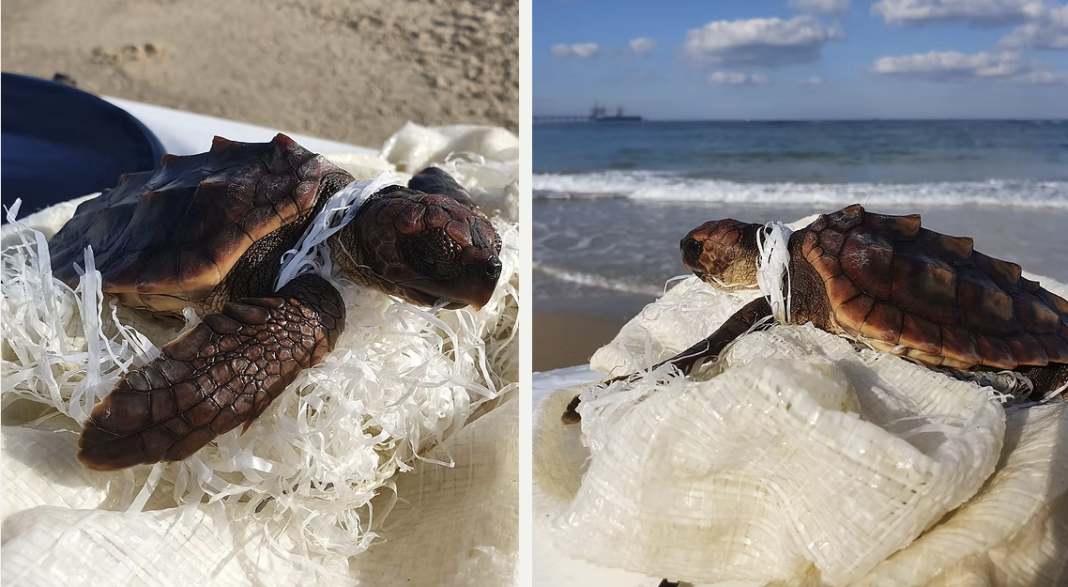


Sea turtle caught in a plastic feed sack, by Yaniv Levi
Commonly used for livestock feed—woven sacks act like floating death traps, snaring turtles by the neck or limbs
In a groundbreaking study published in Marine Science, researchers from Israel’s Sea Turtle Rescue Center (ISTRC), the University of Haifa, and Ruppin Academic Center present the first high-resolution monthly growth data for sea turtles in the eastern Mediterranean—and uncover a deadly new threat: entanglement in polypropylene (PP) sacks.
This study, authored by Shir Sassoon, Yair Suari, and Dr. Yaniv Levy, focuses on the “epipelagic phase”—the early life stage of sea turtles when hatchlings drift passively in open water. While most conservation efforts target nesting beaches, this study shifts attention offshore, where plastic pollution silently kills juvenile turtles long before they reach maturity.
Turtle ‘Lost Years’ Finally Found
Sea turtles spend up to a decade adrift in the open sea, a period known to scientists as the “lost years” due to limited data. Using over two decades of rescue records (1999–2020), the team compiled length data from 577 young turtles—both loggerhead (Caretta caretta) and green (Chelonia mydas)—to track monthly growth for the first time in this region.
Findings show that loggerhead turtles grow at an average of 0.76 cm per month during their first 19 months of life, while green turtles grow faster—0.92 cm per month over the first 11 months. These growth rates mirror those found in other parts of the Mediterranean but fill critical knowledge gaps, particularly for green turtles during this early life stage.
Seasonal fluctuations in growth were also observed, with reduced rates in winter months, highlighting the sensitivity of juvenile turtles to environmental conditions.
Polypropylene: A Lethal Trap

But the most shocking discovery wasn’t about how turtles grow—it was about how they’re dying.
Out of 324 injured epipelagic phase turtles treated at the ISTRC, nearly half (48%) were entangled in woven polypropylene sacks. These sacks—commonly used for livestock feed—act like floating death traps, snaring turtles by the neck or limbs. Many were so severely injured that they required amputations; 12% died from their injuries.
Loggerhead turtles were most affected, particularly during the summer months. Between 2008 and 2020, PP sack entanglements surged from just 20% to 75% of all epipelagic injury cases. The number of incidents jumped significantly after 2017, suggesting a new pattern in maritime waste disposal.
These sacks are strong, lightweight, and slow to degrade—perfect for transport, devastating for marine life. When researchers traced the logos on the sacks, they found origins from as far as Romania, Russia, and Greece, mostly linked to livestock shipping.
“The threads unravel and act like tourniquets,” says Dr. Yaniv Levy, director of ISTRC. “We see turtles arrive unable to swim, starved, and in pain. Many suffer limb loss or systemic infections.”
Floating sacks may mimic natural cover like Sargassum seaweed, attracting juvenile turtles who use them as shelter. Once entangled, turtles often cannot free themselves.
ISTRC is uniquely positioned to collect long-term health and injury data. Their clinical records have helped transform the hospital into a research center that informs both policy and turtle care. Turtles are triaged with CT scans, blood tests, and X-rays, and their rehabilitation includes custom slings, IVs, and even prosthetics.
Rehabilitated turtles are typically released after two months of care, but the team notes that many never reach land for rescue. The actual impact is likely far greater than reported.
Policy Implications

The study urges international regulation on maritime waste, especially from livestock carriers. The team tracked suspect ships using Automatic Identification Systems (AIS), identifying several that sail regularly through Israeli waters but do not dock—making legal accountability difficult. There is a natural current that causes plastic sacks tossed illegally off the ship into the sea, to end up on the Levantine shores where they entangle juvenile turtles. Some plastics are believed to be dumped close to show where they blow into the sea.
A proposed bill in the Israeli Knesset calls for an end to live animal shipments, which would reduce sack and marine waste dramatically. It would also reduce undue animal suffering while being shipped for slaughter while alive at sea. Meanwhile, the study suggests declaring protected marine zones and enhancing multinational enforcement to curb this specific pollutant.
The epipelagic phase is one of the most vulnerable life stages for sea turtles. And while global conservation has made strides in nesting beach protection, this study shows that the open sea remains a lawless frontier.
If you live near a marine environment and find a turtle entangled in plastics, it’s important not to remove it without a veterinarian, says Levy. The plastic can cause reduced blood flow and necrotic tissue and removing it puts poisoned blood into the turtle. The turtle above explains what a vet needs to do to treat the turtle. First a round of antibiotics.
The problem with turtles is feed sacks, not plastic straws, Levy emphasizes.
“Plastic pollution regulations must be extended to pelagic zones,” the authors write in the paper. “We need international collaboration and enforcement—not just for turtles, but for the oceans.”
As Dr. Levy notes, these early-stage turtles are not just victims—they’re indicators. “They’re telling us where our waste ends up, and how fast we need to act.”