
Tonka Bean Trees Attract Lightning to Win the Rainforest Arms Race—And Science Thinks That’s Electrifying

Tonka bean and lightning

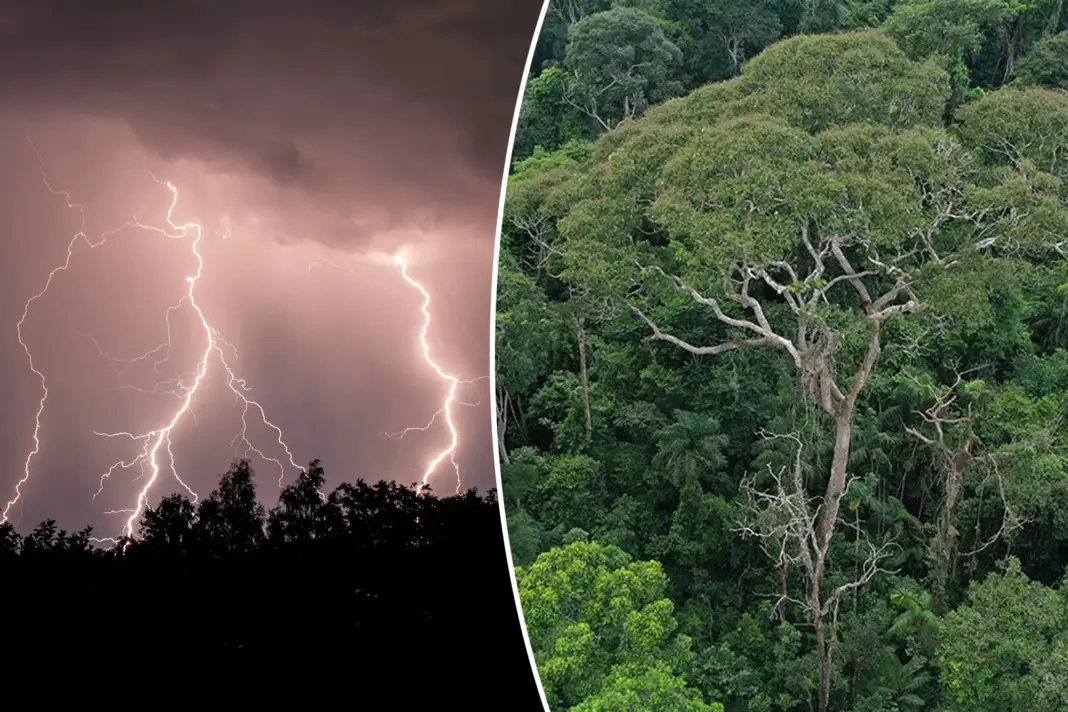
In the dense, storm-soaked rainforests of Panama, a new ecological mystery has been cracked open by lightning—and it’s pointing straight to the tonka bean tree (Dipteryx oleifera). A recent study reveals that these tall, unassuming trees might be using lightning as a secret weapon to wipe out nearby competition.

Evan Gora
Evan Gora

“Seeing that there are trees that get struck by lightning and they’re fine was just mind blowing,” Evan Gora recalled. Over time, the team encountered other D. oleifera trees thriving after getting hit, so they decided to take a closer look.

Published in New Phytologist, the research led by forest ecologist Gora of the Cary Institute of Ecosystem Studies shows that tonka trees can survive lightning strikes that kill surrounding trees and vines, giving them a competitive boost in the long game of forest survival. “There’s a quantifiable, detectable hazard of living next to Dipteryx oleifera,” said Gora in an interview with Science News.

How Does a Tree Survive Lightning?

Dipteryx odorata also called "cumaru" the pea family, Fabaceae. The tree is native to Central America and northern South America. Its seed is known mostly for its fragrance, which is reminiscent of vanilla, almonds, cinnamon, and cloves. It is also sometimes used in perfume and was commonly used in tobacco before being banned.
Dipteryx odorata also called “cumaru” the pea family, Fabaceae. The tree is native to Central America and northern South America. Its seed is known mostly for its fragrance, which is reminiscent of vanilla, almonds, cinnamon, and cloves. It is also sometimes used in perfume and was commonly used in tobacco before being banned. Via Wikipedia.

Lightning is one of the leading natural causes of tree death in tropical forests. The raw voltage and heat from a strike can instantly boil sap, splinter wood, and reduce a once-living organism to charcoal. But not tonka trees.

Using a custom-built system of sensors and cameras, Gora and his team recorded 18 confirmed lightning strikes over a three-year period. Not only did D. oleifera often take the brunt of the strikes, it consistently survived, while neighboring trees and parasitic vines wrapped around its trunk perished.

This self-sacrificial behavior isn’t just a fluke—it appears to be a strategic evolutionary edge. Over a tonka tree’s lifetime, researchers estimate that its ability to outlive competitors via lightning could lead to a 14-fold increase in seed production. Read the full study in New Phytologist

Why This Is So Cool (And So Important to Science)

Also known as the eboe, choibá, tonka bean or almendro, Dipteryx oleifera is native to Honduras, Nicaragua, Costa Rica, Panama, Colombia, and Ecuador. Its hard wood is used in construction, and it produces almond-flavored seeds that are edible and sold in local markets. A keystone species of Panamanian forests, D. oleifera fruits and seeds are a crucial food source for rainforest mammals such as agouti during the dry season.
Also known as the eboe, choibá, tonka bean or almendro, Dipteryx oleifera is native to Honduras, Nicaragua, Costa Rica, Panama, Colombia, and Ecuador. Its hard wood is used in construction, and it produces almond-flavored seeds that are edible and sold in local markets. A keystone species of Panamanian forests, D. oleifera fruits and seeds are a crucial food source for rainforest mammals such as agouti during the dry season. Via Evan Gora.

Evolutionary Ingenuity: This could be one of the first documented cases of an organism using a natural destructive force to its advantage, like an ecological superpower. It’s akin to a fire-adapted species, but with lightning as the fire.

New View on Forest Dynamics: Lightning is often overlooked in forest ecology. Gora’s work adds a new dimension to understanding tree mortality and regeneration in tropical ecosystems, where every inch of canopy matters.

Potential Applications in Climate Modeling: As lightning strikes are expected to increase with global warming (NASA study), understanding how trees respond could help model how rainforests may change—especially regarding species composition and carbon storage. Colin Price does this with lightning as well, using cell phones.

Smart Tree Strategy: While other trees avoid becoming conductors, the tonka might actually attract lightning by growing taller or modifying their structure to be more conductive—though more research is needed to confirm this behavior.

“This is a reminder that survival in the rainforest is about more than just growing fast or tall. It’s about playing the long game—even if that game includes dancing with lightning,” said Gora.

Tonka Beans: Vanilla Alternative with a Toxic Twist

Tonka beans, the seeds of the Dipteryx odorata tree native to South America, have long fascinated chefs and perfumers for their sweet, complex aroma. Rich in coumarin, a natural compound that smells like vanilla with hints of almond, cinnamon, and clove, tonka beans have often been used as a cost-effective substitute for vanilla, especially when vanilla prices soar. In culinary settings, just a small amount of grated tonka bean can flavor desserts, chocolates, and cocktails with an intoxicating scent.

However, the story of tonka beans carries a darker note. Coumarin, while naturally occurring, is toxic in high doses. Consuming large amounts can lead to liver damage and, in extreme cases, death. As a result, the United States banned the use of tonka beans in food back in 1954.

Despite this, tonka beans remain legal for use in perfumery and are still prized in gourmet circles elsewhere in the world, particularly in European fine dining, where Michelin star chefs use them carefully in small, regulated quantities.

Interestingly, the amount of coumarin one would need to consume to risk serious harm is far greater than what is typically found in a single dish. Still, because coumarin toxicity is cumulative and unpredictable among individuals, the FDA has maintained its strict stance.

Today, tonka beans occupy a curious niche: a forbidden ingredient that has gained a cult following among adventurous cooks, symbolizing both the allure and danger of natural flavors.

If the idea of trees using lightning to kill the competition blew your mind, check out these other wild, science-backed nature stories from Green Prophet:

Why Wombats Have Cube-Shaped Poop: Scientists finally figured out how wombats shape their poop into perfect cubes — it’s all in their intestines. Read it on Green Prophet

Plants Can Scream When They’re Stressed: researchers found that tomato and tobacco plants emit ultrasonic sounds when under stress. Read it on Green Prophet


Karin Kloosterman
Karin Kloostermanhttp://www.greenprophet.com
Karin Kloosterman is an award-winning journalist, innovation strategist, and founder of Green Prophet, one of the Middle East’s pioneering sustainability platforms. She has ranked in the Top 10 of Verizon innovation competitions, participated in NASA-linked challenges, and spoken worldwide on climate, food security, and future resilience. With an IoT technology patent, features in Canada’s National Post, and leadership inside teams building next-generation agricultural and planetary systems — including Mars-farming concepts — Karin operates at the intersection of storytelling, science, and systems change. She doesn’t report on the future – she helps design it. Reach out directly to [email protected]

TRENDING

Plant trees in cities, for your heart

It seems like a no-brainer, but sometimes you need to give evidence to city councillors: A new multi-institutional study led by UC Davis Health suggests that not all green space is created equal. Living in urban neighborhoods with more visible trees is associated with a 4% lower incidence of cardiovascular disease, while areas dominated by grass or low shrubs may be linked to higher cardiovascular risk.

Funeral for a Tree plays birdsong from tree rings of beloved oak

When a 65-year-old oak tree in Steve Parker’s yard died from fungal disease, he did not cut it into firewood or haul it away. He did not erase it. He cut the tree into disks and then turned them into records that play birdsong –– a touching tribute to the years that the tree was house and home to birds and all manners of creatures. 

Dubai developer uproots ancient Italian olive trees, $270,000 USD each for “eco” project

Flying centuries-old trees across continents via specialized cargo burns enormous fossil fuels. Replanting them in a desert climate—no matter how advanced the irrigation or “heritage preservation techniques”—places immense stress on organisms that evolved for Mediterranean seasons, soils, and rainfall patterns. And we've seen that the UAE is not capable of taking care of trees so survival rates are uncertain.

The benefits of a real Christmas tree

Every year, Americans purchase 25–30 million Real Christmas Trees (according to the National Christmas Tree Association), directly supporting rural economies and preserving open green space, around 350,000 acres of it. Buying real means investing in American agriculture instead of overseas manufacturing.

Rent a living Christmas tree in California

You can go to a site or go online, order the tree and pick it up or if if possible have it delivered. A live tree doesn't shed needles after a few weeks and it's obviously the ecological choice to cutting down millions of 7 to 15 year old trees every year.

Should You Invest in the Private Market?

startustartup Unlike public stock exchanges, which offer daily trading, strict...

How to build a 100-year-company

Kongō Gumi is a Japanese construction company, purportedly founded in 578 A.D., making it the world's oldest documented company. What can we learn about building sustainable businesses from them?

From Pilot Plant to Global Stage: How Aduro Clean Technologies’ 2026 Expansion Signals a Turning Point for Chemical Recycling Investors Like Yazan Al Homsi

The company's Next Generation Process (NGP) Pilot Plant in London, Ontario, has officially moved into initial operating campaigns, generating the kind of structured, repeatable data that separates laboratory promise from commercial viability.

How AI Helps SaaS Companies Reduce Repetitive Customer Support Work

SaaS products are designed for large numbers of users with different levels of experience, and also in renewable energy.

Pulling Water from the Air

Faced with water shortage in Amman, Laurie digs up...

Turning Your Energy Consultancy into an LLC: 4 Legal Steps for Founders in Texas

If you are starting a renewable energy business in Texas, learn how to start an LLC by the books.

Tracking the Impacts of a Hydroelectric Dam Along the Tigris River

For the next two months, I'll be taking a break from my usual Green Prophet posts to report on a transnational environmental issue: the Ilısu Dam currently under construction in Turkey, and the ways it will transform life along the Tigris River.

6 Payment Processors With the Fastest Onboarding for SMBs

Get your SMB up and running fast with these 6 payment processors. Compare the quickest onboarding options to start accepting customer payments without delay.

Related Articles

Popular Categories