New advances on making aquaponics a valid business

Farmed Here builds high-tech hydroponic farms run by software

Climate change poses a severe threat to food production, making it imperative to find sustainable methods that complement natural, regenerative, soil based farming. One such method is aquaponics, which grows fish and vegetables together using a water substrate with no added minerals. The fish poop supplies all that the plants need to grow. It’s been hard for dreamers and doers to find that sweet spot that balances several ecosystems at the same time: the fish in the pond, the food in the hydroponics beds, and both those parts together.

Researchers from a desert country, where food growing is limited due to lack of water, offer a new proof of concept for a new closed loop system called aquaponics that produces more fish and vegetables while using less energy than conventional systems.

Their findings were published in the journal Resources, Conservation & Recycling.

Amit Gross
Amit Gross, aquaponics expert

Prof. Amit Gross, at Ben-Gurion University has been working with his students and collaborators for the last decade on aquaponic systems. His system uses brackish, or salty water and combines farming with growing fish farms.

As we mentioned above, aquaponic systems grow fish while using the fish waste to grow vegetables hydroponically. Hydroponics was invented by NASA decades ago and later perfected by stealth cannabis growers in Canada who could run grow-ops between walls in their apartment throughout the winter. Now that cannabis is legal in Canada and the US and hydroponics a great method for controlled growing of high value crops, advances are needed to make it even more sustainable.

Attractive woman in hat with hydroponics

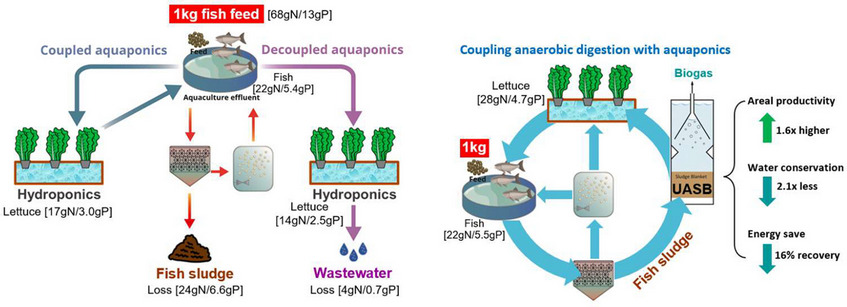
That’s where this new research steps in: coupled aquaponics are closed loop systems that recycle much of the fish effluent rather than reusing it outside of the aquaponic system. Where typically the fish solid waste is disposed of, Gross managed to treat it by anaerobic digestion and recover energy and nutrients into the system to form a near zero waste unit. This is the path to resolving the ups and downs and headaches of balancing the nutrient load in the system and what the plants need as they grow.

After more than two years of testing, Gross’s system demonstrated 1.6 times higher plant areal productivity, 2.1 times lower water usage and 16% less energy consumption per kilogram of feed than conventional systems.

Karin Kloosterman, hydroponics expert
Hydroponics plastic tubes

His calculations suggest that upscaling to about one ton of fish will allow operation of the system with no need for external energy, less than 1% water exchange, negligible waste production as well as significant carbon sequestration.

Net zero, here we come? The next grow system for the spaceship to Mars and the first Mars colony? Sustainable food that can be grown in Antarctica?
Aquaponics
Aquaponics innovation – how they do it

“Feeding the more than 8 billion people on the planet while reducing greenhouse gas emissions will require innovative technologies. Those that combine two functions in one are obviously preferable. Fish are a sustainable high-quality source of protein with a far smaller carbon footprint than most other sources. Combining fish growth with vegetable production and preventing waste is a win-win-win,” says Gross who worked with Ze Zhu and Uri Yogev from Ben-Gurion University and Prof. Karel Keesman from Wageningen University and Research in the Netherlands.

? Hydroponics, Aquaponics, and Cannabis: Growing Greener with Smart Agriculture

As the world looks for sustainable ways to grow food and medicine, modern farming methods like hydroponics, aquaponics, and even cannabis cultivation are leading a quiet revolution—especially in regions facing water scarcity, like the Middle East and North Africa.

Hydroponics uses nutrient-rich water instead of soil, saving up to 90% of water compared to traditional farming. Aquaponics adds fish into the mix, creating a closed-loop system where fish waste feeds the plants, and the plants clean the water. These systems can be set up in homes, urban rooftops, or greenhouses, making them ideal for future food security.

And yes, cannabis—the once-taboo plant—is gaining ground as a medicinal crop. Grown sustainably in hydro or aquaponic systems, cannabis can provide medical benefits without the environmental damage associated with traditional farming.

This green trifecta—hydroponics, aquaponics, cannabis—is not just a trend; it’s a glimpse into the future of ethical, sustainable agriculture.

? Learn More

Here are 5 useful links to deepen your understanding:

  1. Hydroponic Farming in the Middle East

  2. What is Aquaponics and Why is it Eco-Friendly?

  3. Israel’s Medical Cannabis Revolution

  4. Rooftop Farming in the Middle East

  5. Smart Agriculture Innovations in MENA

Karin Kloosterman
Karin Kloostermanhttp://www.greenprophet.com
Karin Kloosterman is an award-winning journalist, innovation strategist, and founder of Green Prophet, one of the Middle East’s pioneering sustainability platforms. She has ranked in the Top 10 of Verizon innovation competitions, participated in NASA-linked challenges, and spoken worldwide on climate, food security, and future resilience. With an IoT technology patent, features in Canada’s National Post, and leadership inside teams building next-generation agricultural and planetary systems — including Mars-farming concepts — Karin operates at the intersection of storytelling, science, and systems change. She doesn’t report on the future – she helps design it. Reach out directly to [email protected]

TRENDING

Why New York Climate Week Isn’t Boring — and 5 Fun Things You Can Do to Make It Yours

Climate Week isn’t just for CEOs and policymakers. It’s a chance for anyone to plug in, whether you’re attending an official showcase or just biking to work with a few friends. Fun and climate action aren’t opposites — they feed each other. And when you connect with community, food, music, or nature, you realize: this is what the future can look like.

EU’s CAP reform continues trend of supporting small farmers in hour of need

Despite mounting political opposition, growing scientific criticism and even the retreat of many former industrial supporters like Nestlé and Danone, certain member-states and supermarket chains continue to prop up Nutri-Score. The Commission must therefore remain vigilant to ensure these attempts do not undermine farmers, distort fair competition or compromise the integrity of the single market – particularly as other pressing threats loom on the horizon.

The hidden chatter beneath our feet – how trees, mushrooms, and microbes speak

Mushrooms, microbes, and machine learning? Why does this matter? The underground networks built by fungi and bacteria are essential for healthy ecosystems—and for our ability to grow resilient crops in a changing climate. Fungi, in particular, act as “middlemen”, connecting roots across distances and helping move nutrients, water, and even chemical signals between plants.

The Satellite That Sees Earth Breathe: How NISAR Could Transform Sustainability From Space

Critically, NISAR’s data will be publicly available. That means not only scientists and governments, but also nonprofits, local planners, and startups can build tools and services using the data.

Mantle8 uses AI to pinpoint natural hydrogen in French mountain

In the misty folds of the French Pyrenees, something quietly extraordinary is happening. At a remote site called Comminges in France, Mantle8, a pioneering natural hydrogen exploration company, has unearthed a breakthrough that could shift the balance of Europe’s energy landscape.

Turning Your Energy Consultancy into an LLC: 4 Legal Steps for Founders in Texas

If you are starting a renewable energy business in Texas, learn how to start an LLC by the books.

Tracking the Impacts of a Hydroelectric Dam Along the Tigris River

For the next two months, I'll be taking a break from my usual Green Prophet posts to report on a transnational environmental issue: the Ilısu Dam currently under construction in Turkey, and the ways it will transform life along the Tigris River.

6 Payment Processors With the Fastest Onboarding for SMBs

Get your SMB up and running fast with these 6 payment processors. Compare the quickest onboarding options to start accepting customer payments without delay.

Qatar’s climate hypocrisy rides the London Underground

Qatar remains a master of doublethink—burning gas by the megaton while selling “sustainability” to a world desperate for clean air. Wake up from your slumber people.

How Quality of Hire Shapes Modern Recruitment

A 2024 survey by Deloitte found that 76% of talent leaders now consider long-term retention and workforce contribution among their most important hiring success metrics—far surpassing time-to-fill or cost-per-hire. As the expectations for new hires deepen, companies must also confront the inherent challenges in redefining and accurately measuring hiring quality.

8 Team-Building Exercises to Start the Week Off 

Team building to change the world! The best renewable energy companies are ones that function.

Thank you, LinkedIn — and what your Jobs on the Rise report means for sustainable careers

While “green jobs” aren’t always labeled as such, many of the fastest-growing roles are directly enabling the energy transition, climate resilience, and lower-carbon systems: Number one on their list is Artificial Intelligence engineers. But what does that mean? Vibe coding Claude? 

Somali pirates steal oil tankers

The pirates often stage their heists out of Somalia, a lawless country, with a weak central government that is grappling with a violent Islamist insurgency. Using speedboats that swarm the targets, the machine-gun-toting pirates take control of merchant ships and then hold the vessels, crew and cargo for ransom.

Related Articles

Popular Categories