


According to Jewish tradition, all spiritual journeys begin by using our minds to keep their bodies healthy. As Maimonides explains, we become genuine people whenever we consciously focus our bodies’ actions toward a constructive purpose, such that no action is “an act of nothingness” (Introduction to Avos Chapter 5).
Once we’ve left nothingness and joined purposefulness, we’re card-carrying members of humankind: only then can we direct our actions toward wellness and wholeness of body, mind, and spirit. Then we progress to the purpose of all the purposes: knowing and emulating God.
It’s Always in the Body
Even when we’re busy with spiritual work, the body remains at the center of all the action:
- When we’re immersed in Torah study, our brain holds our thoughts.
- We pray with our mouths.
- With our body’s actions, we emulate God’s ways and live according to His instructions: “All my bones will say: ‘No one is like You, God.’” (Psalms 35:10)
- When we live according to God’s will, He blesses us with material prosperity: “I will give the rain of your land in its time… You will gather your grain, grapes, and olives.”(Deuteronomy 11:14)
Our path to God isn’t through the perfect wisdom of the soul but rather through striving to become better in our imperfect bodies.
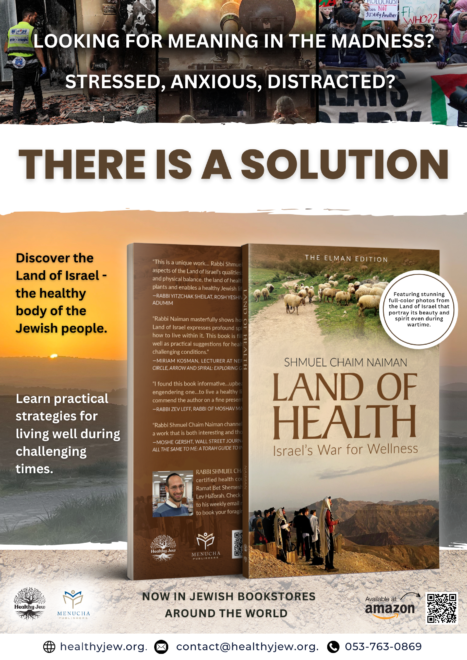
This path takes us through the Land of Israel, the area of the world that Jewish tradition teaches is the body of the Jewish nation, as I explain in my new book, Land of Health: Israel’s War for Wellness.
As individuals, we find God when we are inside our individual physical bodies.
As a nation, we find God inside our collective body.
Comparing Lives
Let’s explore the parallels between these two lives: individual and national.
Individual Life
We become genuine people when our minds guide our actions toward health and wellness.
Once we’re purposeful people, we progress to seeking spiritual growth.
National Life
Israel’s national mission begins with caring for the Land of Israel: its earth, water, plants, and animals. Listen to King David’s prayer (quoted in the closing line of the Kuzari):
“Get up, have compassion on Zion… Because your servants want its stones, and its earth they seek.”(Psalms 102:14)
Then we find God in Israel by living here with His Torah:
“From Zion, Torah will go out and the word of God [will go out] from Jerusalem.” (Isaiah 2:3)
We appreciate and value our bodies, because they hold our personal “form of God.” We also appreciate and value the Land of Israel, because it holds the spirit of our nation.

How to Care for Israel
Am I suggesting that Jewish national life begins with environmental advocacy for this corner of the Middle East?
Exactly!
But only as the first step of a larger mission.
Cherishing and supporting Israel’s land and stopping there is like caring for our physical health as the final purpose of life.
Again, let’s look at the parallels between individual and national life:
Individual Life
Maimonides notes that living healthily in order to get more pleasure and prestige for more years isn’t very different from mindlessly chasing after unhealthy pleasures and prestige — it’s all the same selfishness. (Introduction to Avos 5; Laws of Character 3)
Therefore, healthy Jewish living aims to achieve a more meaningful purpose: enabling us to know and emulate God’s ways.
National Life
Caring for Israel’s land only to protect its beauty — or to escape antisemitism — isn’t very different from mindlessly building skyscrapers while ignoring their environmental imprint. It’s all the same materialism.
Therefore, the Land of Israel aims to achieve a more meaningful purpose: finding God’s Presence and living in the Land of Israel by God’s word. This is where the Jewish people have observed the Torah for millennia. Their stories are told in its beautiful hills, valleys, rivers, plants, and animals.
A healthy Jewish yearning for the Land of Israel begins with cherishing it — not only because he likes pretty views and interesting history but also because God dwells in those views and history.
This article is an excerpt from the author’s new book, Land of Health: Israel’s War for Wellness, which is now available here on Amazon and in Jewish bookstores all over the world.
About the Author:


)