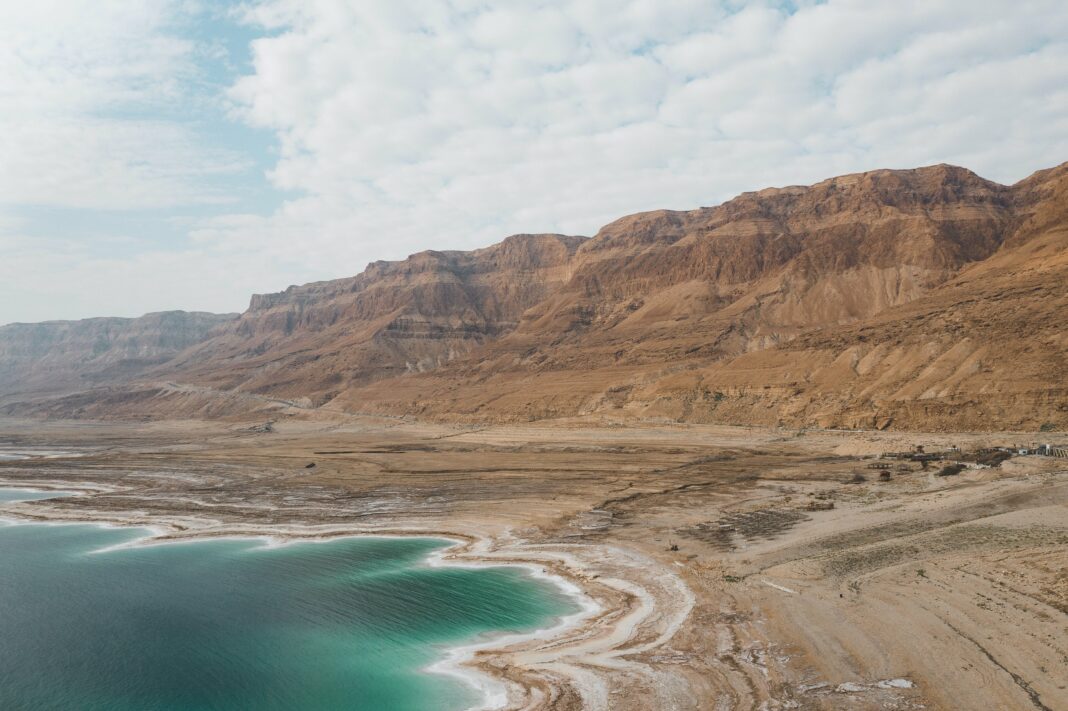


While I was on my 10-day Taglit Birthright Israel trip, I had the opportunity to go to the Dead Sea, and it was one of my favorite places I have ever been to. It was like no other place I’d ever seen. It was so beautiful, it felt like I was in a dream. Floating in the Dead Sea was magical, and the color of the water with the mountains in the background was unreal. This gem of Israel is by far the highlight of any trip to Israel and I hope to return again soon.
The Dead Sea is the lowest point on Earth. It is the saltiest water body on the planet, with a salt concentration of 36 percent, so salty that no life can live in this sea except for some rare form of bacteria. When you go swimming in the sea, you float entirely. It borders Jordan and Israel and is the world’s most unique and extraordinary phenomenon, holding great historical and religious significance.

Unfortunately, the Dead Sea is shrinking, and at an alarming rate. According to EcoPeace, a trilateral water protection org working between Israel, the Palestinian Authority and Jordan, the Dead Sea is dropping by more than one meter every year. This catastrophic event is in need of urgent matters as the disappearance of the Dead Sea would cause a multitude of problems. Already of which is the issue of sinkholes, which is caused by the salt deposits that dissolve underground and cause massive craters in the earth’s surface.
There are two significant reasons why the Dead Sea is shrinking, and it’s entirely man-made that has little to do with climate change. Water flows from the north, into the Sea of Galilee, down the Jordan River, and eventually makes its way into the Dead Sea. However, this process is being disrupted.
First off, no freshwater is coming from the Jordan River. This is because tributaries are being blocked and Jordan and Israel are diverting the water between the two of them. Oded Rahav, an expert on the Dead Sea and the founder and CEO of the Dead Sea Guardians organization, said only 8 percent of the water flows down the Jordan River to the Dead Sea. The rest of the water is getting pulled out so it never reaches the Dead Sea. This diversion of water from the Jordan River began in the 1960s when surrounding countries learned they can access freshwater from this flow. However, this process now is entirely unsustainable and urgently needs to be discontinued.
The second reason is due to dead sea factories extracting minerals. Both Israeli and Jordanian mineral factories are contributing to this problem (I wrote about the issue of resource management between countries in my article about why international environmental law is an important career). Companies like the ICL, for example, mine the dead sea for minerals because the Dead Sea is rich in minerals such as potash, bromine, sodium chloride (salt), magnesia, magnesium chloride, and metal magnesium.
Another company, The Dead Sea Works, is vastly contributing to mineral extraction from the Dead Sea, which people like Gidon Bromberg from EcoPeace are working to stop. These detrimental human activities are profitable yet unsustainable. This mineral extraction is largely intensifying the rate of evaporation in the Dead Sea and therefore contributing to its shrinking.
Other contributors to the Dead Sea shrinking include evaporation in the summertime and increased temperatures due to climate change, but as I mentioned before, diversion and mineral extraction are the most significant reasons for the Dead Sea shrinking.
These losses are causing great damage to the landscape around the Dead Sea. “Every three days we are losing one centimeter,” Rahav told Green Prophet. These losses from the Dead Sea are risking the formation of sinkholes. Sinkholes are vast and expansive, roads are falling through, and people’s livelihoods are at risk.
Alison Ron of the Ein Gedi Kibbutz feels saddened as she watches the Dead Sea shrink away each and every day. “The Dead Sea has character” she vocalized. “It’s hard watching something you grew up with sink away”. As sinkholes continue to pop up as the years go on, it is no longer an issue that can be ignored. This is the world’s greatest, most present issue to date that will be the first thing to go. Sinkholes are now forming rapidly. Over the past 40 years, there have been more than 8,000 sinkholes have formed and they are dangerous.
Luckily, there is hope. Organizations such as EcoPeace and The Dead Sea Guardians are rising up to come up with solutions. “So much of the rest of the Middle East is so unstable for various reasons that the water crisis further feeds that instability and could be the spark for a further internal uprising,” say’s Gidon Bromberg of EcoPeace, while he deals with a number of climate crises in Israel and the Middle East.
Some actions that EcoPeace is taking in regards to the Dead Sea is registering the Dead Sea as a UNESCO World Heritage Site. This way, the Dead Sea would enlist requirements for sustainable practice and promotes regional cooperation in surrounding countries. Another EcoPeace plan of action is to rehabilitate the water that was lost and divert it back to the Jordan River. EcoPeace also aims to grant a public trust obligation to any company that wants to extract minerals from the Dead Sea. This would regulate mineral extraction in order to best preserve the sea.
Similarly, The Dead Sea Guardians is working to revive the Dead Sea through the Israeli government. The Dead Sea Guardians is trying to get the Israeli government to implement policies that would one, return water back to the Sea of Galilee and the lower Jordan River, and two, provide a framework to mineral extracting companies that would limit their volume of evaporated water that is done in their production methods.
While there are extraordinary companies working long and hard to stabilize the Dead Sea and return it to its original state, it is important that we continue to urge attention to this critical issue. There is no time to wait and this issue will not fix itself. The Dead Sea is remarkable and needs to be preserved for the rest of time.