Tiny house built from diapers and concrete

Indonesia house concrete diapers, nappies
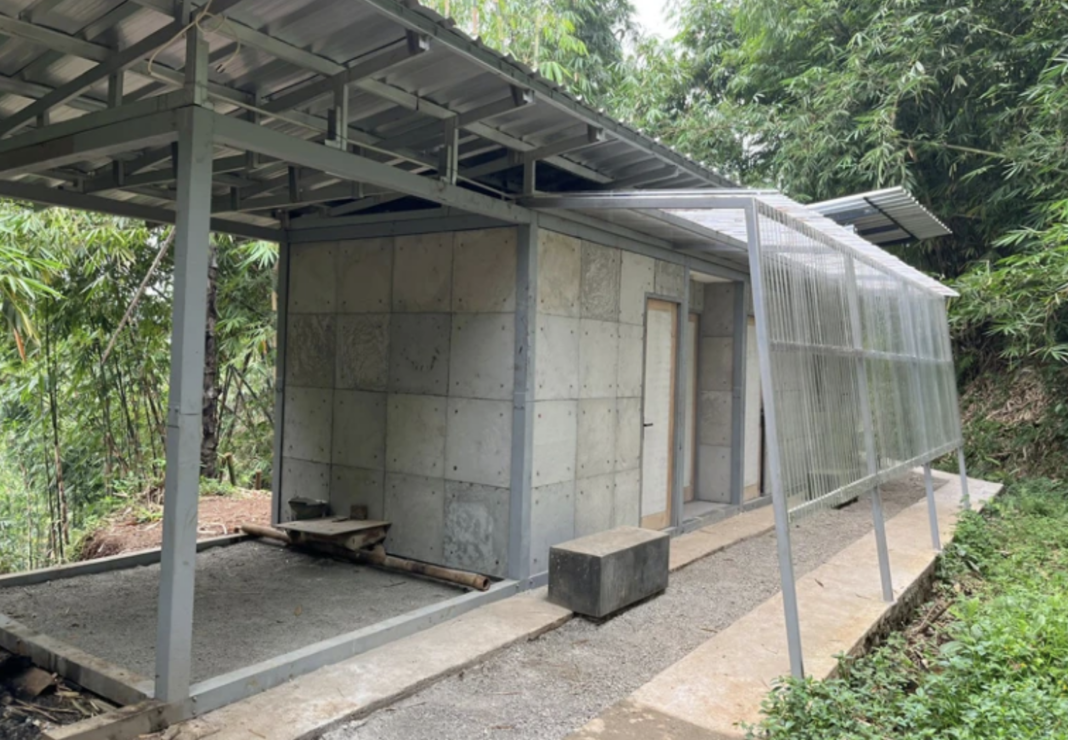
A house in Indonesia is made with a mix of concrete and used diapers.

A tiny house was built using recycled baby diapers and concrete showing this novel recycled material mix can replace up to 40% of the sand used in concrete without reducing its strength, according to a new study by researchers at the University of Kitakyushu in Japan.

The team published a study in Scientific Reports about their findings and say that it could be used to create low-cost housing for low-income countries.

A small, tiny house was built in Indonesia to demonstrate how the material works, using a concrete mix which diverts 1.7 cubic metres of diaper waste from going to landfill. Plastic bottles, tires, essentially Earthships (how to build one here) made from waste –– are all ways to divert garbage from going to landfill. This latest idea integrates a common household nuisance – diapers.

The downside to the new building material is that diapers decrease compressive strength in the building, so columns and beams would require a smaller proportion of the diaper waste than do architectural elements, such as walls.

diapers cooking in the oven
Baking the diapers to a new composite material to add to concrete

As for being a practical solution, unfortunately, “there’s no supporting system in the municipal waste management to separate diapers”, notes civil engineer Siswanti Zuraida, who led the project in Indonesia.

A Huggies home? Scientists have built a house with old diapers

Municipalities in countries like Canada have the ability to separate diaper waste from compost and other household waste so trying further pilots in Canada might be worthwhile.  

diaper concrete home indonesia
A diaper concrete home Indonesia

The Japanese researchers in this study were trying to solve two environmental problems together: disposable diapers used both for babies and an increasing elderly population in countries like Japan are a growing source of non-recyclable waste, and cement production is responsible for almost 7% of global greenhouse-gas emissions, while consuming 50 billion tonnes of sand each year.

The diaper-concrete house in Indonesia demonstrates how this type of waste could be used for building housing in lower and middle-income communities. But better ideas using vernacular building techniques are out there: trailblazers like Bill and Athena Steen in Arizona have shown in an endless number of projects in Mexico that local, vernacular architecture can replace concrete altogether, and provide passive air conditioning and heating. Their solution uses natural strawbale building, adobe and earthen plaster that breathes.

The late and alternative builder Nader Khalili from Iran used superadobe methods (basically sand in bags, skipping concrete altogether), to build homes that nurture the human psyche, with caverns made to be soft and organic (like people), without modern sharp, square edges.

And Egypt’s Hassan Fathy nurtured the vernacular with his development of New Gourna for Egypt’s poor. As we see in Saudi Arabia it wasn’t that long ago when kings lived in mud houses – see the House of Saud’s ancestral mud house

But modern architects love concrete; they are addicted to it, despite its toll on the planet. Indonesia, home to creative bamboo architects that gave birth to the Bali Green School, can surely come up with a better idea than more concrete. 

IBUKA green bamboo Balu, Green School
Ibuku at the Green School in Bali

Siswanti Zuraida, a civil engineer at the University of Kitakyushu, began putting the project together while lecturing at the Bandung Science Technology Institute near Jakarta. Populations in Indonesia’s low- and middle-income brackets are growing, along with more babies, more diapers and more demands for low-cost housing.

“It’s all about the resource availability,” says Zuraida. “With the growth of the population, the diaper waste will also grow. It’s challenging, so we thought that this would be a part of our contribution to recycling this waste.”

Single-use diapers are made from wood pulp, cotton and super-absorbent polymers, small amounts of which have been shown to improve the mechanical properties of concrete. With funding from a Jakarta-based waste-management company called Awina, Zuraida set out to determine how much sand could be swapped for shredded nappies to create useful concrete and mortar.


 

Karin Kloosterman
Karin Kloostermanhttp://www.greenprophet.com
Karin Kloosterman is an award-winning journalist, innovation strategist, and founder of Green Prophet, one of the Middle East’s pioneering sustainability platforms. She has ranked in the Top 10 of Verizon innovation competitions, participated in NASA-linked challenges, and spoken worldwide on climate, food security, and future resilience. With an IoT technology patent, features in Canada’s National Post, and leadership inside teams building next-generation agricultural and planetary systems — including Mars-farming concepts — Karin operates at the intersection of storytelling, science, and systems change. She doesn’t report on the future – she helps design it. Reach out directly to [email protected]

TRENDING

Play spogomi the garbage picking sport and win a World Cup

If the future of environmental action looks less like a lecture and more like a pickup game, that might not be a bad thing at all.

Mud bricks are not just for Minecraft – they can solve real-world refugee housing

Unconfirmed photos are circulating on the internet that a Gazan family has started to rebuild their home using mud bricks. And just a few days ago we reported on a Saudi Arabian designer and his plans for using mud bricks as a solution to the refugee crisis. 

Urban miner Sortera raises $45 million USD to pull aluminum from the scrap pile

Sortera Technologies, founded in 2020 by Nalin Kumar and Manuel Garcia, is emerging as a major U.S. circular-industry player. Led by CEO Michael Siemer, the company uses AI and advanced sensors to turn scrap metal into high-value aluminum alloys. Its new ~$45 million funding round signals investor appetite for industrial decarbonisation—where emissions cuts come not from PR-friendly solar installs, but from upgrading the materials that power EVs, solar frames, and construction.

How flat windows work on round and dome-shaped rooms

Round homes ask us to rethink building conventions. Their curves offer comfort, efficiency, and surprising strength—but they require intentional window design. Whether you’re building in the desert, forest, or city fringe, one of these solutions will fit your climate, materials, and aesthetic.

Ski Japan and skip the cherry blossoms

apan’s winters reveal a quieter magic far from the cherry blossoms — a landscape of deep snow, mountain silence, and steaming hot springs. From Niseko’s legendary powder in Hokkaido to the Olympic slopes of Hakuba and the ancient baths of Nozawa Onsen, Japan offers some of the world’s most sustainable and culturally rich ski experiences. With efficient bullet-train access, renewable-powered resorts, and geothermal onsens under falling snow, this is how to ski Japan responsibly — where tradition, technology, and climate awareness meet on the same mountain.

Qatar’s climate hypocrisy rides the London Underground

Qatar remains a master of doublethink—burning gas by the megaton while selling “sustainability” to a world desperate for clean air. Wake up from your slumber people.

How Quality of Hire Shapes Modern Recruitment

A 2024 survey by Deloitte found that 76% of talent leaders now consider long-term retention and workforce contribution among their most important hiring success metrics—far surpassing time-to-fill or cost-per-hire. As the expectations for new hires deepen, companies must also confront the inherent challenges in redefining and accurately measuring hiring quality.

8 Team-Building Exercises to Start the Week Off 

Team building to change the world! The best renewable energy companies are ones that function.

Thank you, LinkedIn — and what your Jobs on the Rise report means for sustainable careers

While “green jobs” aren’t always labeled as such, many of the fastest-growing roles are directly enabling the energy transition, climate resilience, and lower-carbon systems: Number one on their list is Artificial Intelligence engineers. But what does that mean? Vibe coding Claude? 

Somali pirates steal oil tankers

The pirates often stage their heists out of Somalia, a lawless country, with a weak central government that is grappling with a violent Islamist insurgency. Using speedboats that swarm the targets, the machine-gun-toting pirates take control of merchant ships and then hold the vessels, crew and cargo for ransom.

Leopoldo Alejandro Betancourt López Turned Ocean Plastic Into Profitable Sunglasses

Few fashion accessories carry the environmental burden of sunglasses. Most frames are constructed from petroleum-based plastics and acrylic polymers that linger in landfills for centuries, shedding microplastics into soil and waterways long after they've been discarded. Leopoldo Alejandro Betancourt López, president of the Spanish eyewear brand Hawkers, saw this problem differently than most industry executives.

Why Dr. Tony Jacob Sees Texas Business Egos as Warning Signs

Everything's bigger in Texas. Except business egos.  Dr. Tony Jacob figured...

Israel and America Sign Renewable Energy Cooperation Deal

Other announcements made at the conference include the Timna Renewable Energy Park, which will be a center for R&D, and the AORA Solar Thermal Module at Kibbutz Samar, the world's first commercial hybrid solar gas-turbine power plant that is already nearing completion. Solel Solar Systems announced it was beginning construction of a 50 MW solar field in Lebrija, Spain, and Brightsource Energy made a pre-conference announcement that it had inked the world's largest solar deal to date with Southern California Edison (SCE).

Related Articles

Popular Categories