House of Saud palaces built from mud

At-Turaif, mud vernacular building, earth architecture, Saudi Arabia, House of Saud, UNESCO heritage site, mud palace, greenprophet

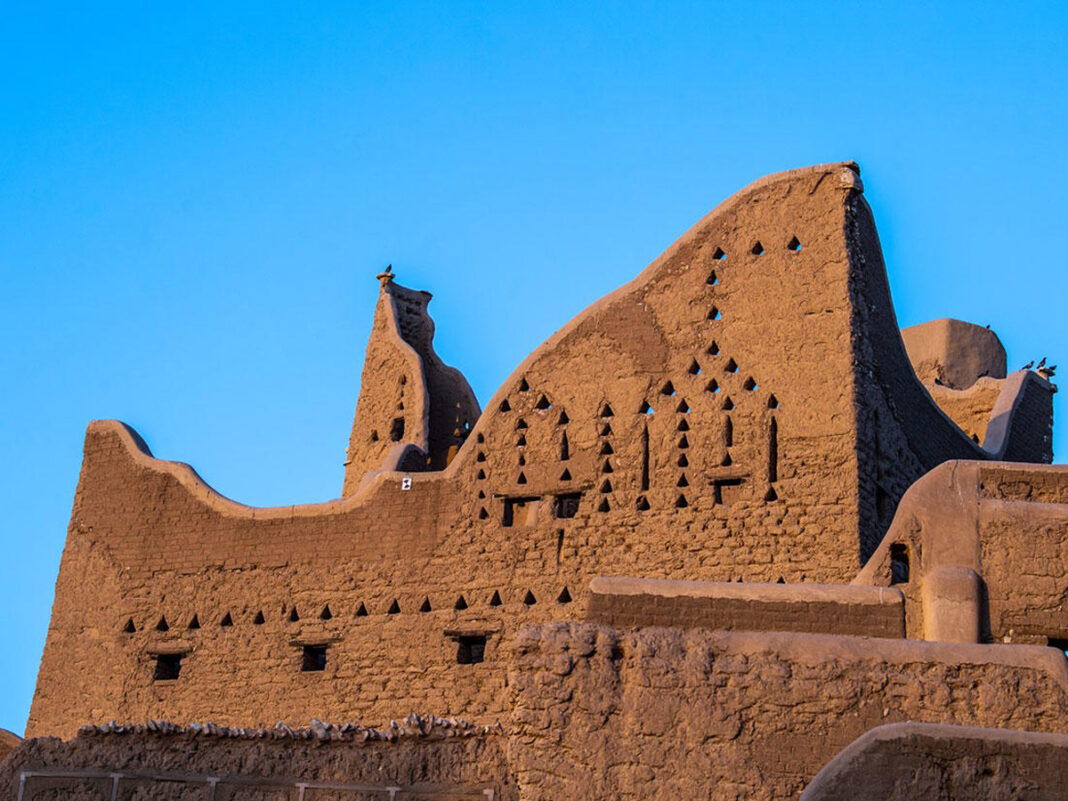
At-Turaif, or simply, Turaif, a Saudi Arabian town in the Northern Borders Province, which lies close to the border with Jordan, is now open to the public. The UNESCO-recognized site has cultural significance as the original home to the ruling Saudi Dynasty, the House of Saud. It is the birthplace of the austere form of Islam found in Saudi Arabia today. The mud and earth buildings and palaces of Turaif, was closed to tourists, until now. 

At-Turaif, mud vernacular building, earth architecture, Saudi Arabia, House of Saud, UNESCO heritage site, mud palace, greenprophet

The vernacular buildings of Taraif are a living monument to traditional building from the region, and a statement that respectable buildings, palaces even, can be built from mud. The site has special significance because it is the original home to the current ruling Saudi dynasty whose family lived there in the 1800s. 

What is Najdi Architecture?

At-Turaif, mud vernacular building, earth architecture, Saudi Arabia, House of Saud, UNESCO heritage site, mud palace, greenprophet

Najdi architecture is an approach from the central Arabian Gulf region that combines three main factors –– from the people who lived there over the years including Bedouin tribes. Najdi is built in harmony with nature and 1) works in hot desert climates; 2) it provides privacy in residential buildings as Muslims guard their privacy (see mashrabiya), and 3) uses locally available materials such as mud brick, stone and wood.

At-Turaif, mud vernacular building, earth architecture, Saudi Arabia, House of Saud, UNESCO heritage site, mud palace, greenprophet

Founded in the 15th century, Turaif is built in the Najdi architectural style, which is specific type of vernacular architecture from the Central Arabia.

At-Turaif, mud vernacular building, earth architecture, Saudi Arabia, House of Saud, UNESCO heritage site, mud palace, greenprophet 

In the 18th and early 19th centuries, the political and religious role of Turaif increased in importance and the citadel at at-Turaif became the center of power for the House of Saud and the spread of the Salafiyya reform in Islam. The property includes the remains of many palaces and housing units built on the edge of the ad-Dir’iyah oasis.

Modern Turaif is one of the cities that have been established for running the Trans-Arabian Pipeline.

According to UNESCO, the UN body that preserves human and natural heritage sites, the site of at-Turaif District in ad-Dir’iyah illustrates a significant phase in the human settlement of the central Arabian plateau, when in the mid-18th century Ad-Dir’iyah became the capital of an independent Arab State and an important religious centre. At-Turaif is an outstanding example of traditional human settlement in a desert environment. The current Saudi family building out Neom and The Line might look back to their ancestors for some more practical ideas of building the future. 

At-Turaif, mud vernacular building, earth architecture, Saudi Arabia, House of Saud, UNESCO heritage site, mud palace, greenprophet

The at-Turaif District was the first historic centre with a unifying power in the Arabian Peninsula.  Its influence was greatly strengthened by the teachings of Sheikh Mohammad Bin Abdul Wahhab, a  reformer of austere Sunni Islam who lived, preached and died in the city. He started the austere form of Islam called Wahhabism. 

Abd al-Wahhab arrived to Najd in 1744 and preached a return to “pure” Islam. To that extent he sought protection from the local emir, Muhammad ibn Saud, head of the Al Saud tribal family, and they cut a deal.

The Al Saud, now the House of Saud we know today, will endorse al-Wahhab’s austere form of Islam and in return, the Al Saud tribe will get political legitimacy and regular tithes (money) from al-Wahhab’s followers. The religious-political alliance that al-Wahhab and Al Saud forged back then endures to this day in Saudi Arabia, according to a PBS history special.

By the 19th century, the House of Saud spread its influence across the Arabian Peninsula, stretching from the Red Sea to the Persian Gulf and including the Two Holy Cities of Mecca and Medina. But in 1818, forces of the Ottoman Empire sacked Riyadh, and executed many of the religious and political leaders. Over the next eighty years the Al Saud attempt to reestablish their rule on the Arabian Peninsula without success.

Wahhabism, a fundamentalist approach to Islam had already spread throughout the Arabian Peninsula and the Muslim world.

At-Turaif, mud vernacular building, earth architecture, Saudi Arabia, House of Saud, UNESCO heritage site, mud palace, greenprophet

Today, most of the ancient part of Turaif is in ruins. If you visit it today what you will see has not been altered or reconstructed during 20th century reemployments or restorations. A major programme of restoration work is in place, which respects the original locations, plans and techniques. It must take particular care to preserve the attributes of the authenticity of its buildings and the road network.  

Turaif, now open to tourism, is located at a bend in Highway 85 as it turns west to Jordan. It is located at around 31°40′39″N 38°39′11″E. In 2010, it had a population of 48,929.

All images above via UNESCO.


Have an edit or correction to make on this story? Want to share your travel experiences? Send us an email [email protected].

Karin Kloosterman
Karin Kloostermanhttp://www.greenprophet.com
Karin Kloosterman is an award-winning journalist, innovation strategist, and founder of Green Prophet, one of the Middle East’s pioneering sustainability platforms. She has ranked in the Top 10 of Verizon innovation competitions, participated in NASA-linked challenges, and spoken worldwide on climate, food security, and future resilience. With an IoT technology patent, features in Canada’s National Post, and leadership inside teams building next-generation agricultural and planetary systems — including Mars-farming concepts — Karin operates at the intersection of storytelling, science, and systems change. She doesn’t report on the future – she helps design it. Reach out directly to [email protected]

TRENDING

Australian camels fly on a plane to Saudi Arabia

Australia has the largest population of feral camels in the world. Some get repatriated to Saudi Arabia.

Seaweed fashion brands can source from Saudi Arabian sea

From Red Sea seaweed to runway-ready fabric, Saudi Arabia is quietly reshaping fashion’s material future. KAUST scientists, designers, and textile innovators are proving that sustainability can begin in local ecosystems. As seaweed becomes wearable, fashion is learning to grow not from fields — but from tides.

The Line’s 15 minute city failure and the limits of green futurism

The failure of The Line is not a failure of imagination. It is a failure of restraint by western architects and planners who go along with the charade. Who is holding these firms accountable? This is actually a reasonable kind of project for the UN to take on and challenge. 

Musk’s Saudi Mega-Data Center Signals a Desert Arms Race for AI

For now, Musk’s partnership signals a deepening alignment between Silicon Valley and Riyadh — and a new chapter in the Middle East’s data-powered future. The satellites and robots may come later. The energy footprint, however, is already here.

Turning Your Energy Consultancy into an LLC: 4 Legal Steps for Founders in Texas

If you are starting a renewable energy business in Texas, learn how to start an LLC by the books.

Tracking the Impacts of a Hydroelectric Dam Along the Tigris River

For the next two months, I'll be taking a break from my usual Green Prophet posts to report on a transnational environmental issue: the Ilısu Dam currently under construction in Turkey, and the ways it will transform life along the Tigris River.

6 Payment Processors With the Fastest Onboarding for SMBs

Get your SMB up and running fast with these 6 payment processors. Compare the quickest onboarding options to start accepting customer payments without delay.

Qatar’s climate hypocrisy rides the London Underground

Qatar remains a master of doublethink—burning gas by the megaton while selling “sustainability” to a world desperate for clean air. Wake up from your slumber people.

How Quality of Hire Shapes Modern Recruitment

A 2024 survey by Deloitte found that 76% of talent leaders now consider long-term retention and workforce contribution among their most important hiring success metrics—far surpassing time-to-fill or cost-per-hire. As the expectations for new hires deepen, companies must also confront the inherent challenges in redefining and accurately measuring hiring quality.

8 Team-Building Exercises to Start the Week Off 

Team building to change the world! The best renewable energy companies are ones that function.

Thank you, LinkedIn — and what your Jobs on the Rise report means for sustainable careers

While “green jobs” aren’t always labeled as such, many of the fastest-growing roles are directly enabling the energy transition, climate resilience, and lower-carbon systems: Number one on their list is Artificial Intelligence engineers. But what does that mean? Vibe coding Claude? 

Somali pirates steal oil tankers

The pirates often stage their heists out of Somalia, a lawless country, with a weak central government that is grappling with a violent Islamist insurgency. Using speedboats that swarm the targets, the machine-gun-toting pirates take control of merchant ships and then hold the vessels, crew and cargo for ransom.

Related Articles

Popular Categories