
A cross between a sci-fi post-apocalyptic city and a Moshe Safdie rendition of Expo 67, the Line becomes Saudi Arabia’s crown prince Mohammed bin Salman’s vision to modernize Saudi Arabia.
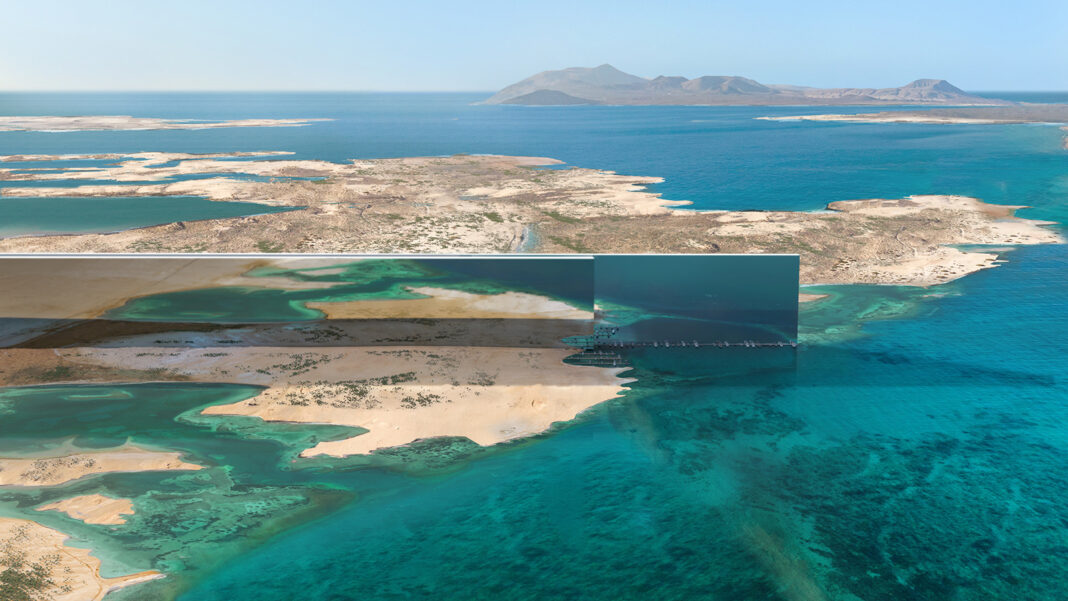
The Line is a 150-mile long belt of futuristic “living” in the middle of the desert, jutting out into the Red Sea. The new city will be part of the Saudi ruler’s vision for a modern Saudi Arabia in order to subvert decades of the nation’s intolerance for western society and its repression of women.
 Of course bin Salman, on the board of directors for The Line didn’t design it, but has pledged billions of oil money for a non-local architecture firm to “dream” up the future. It’s the pattern in the Middle East where “starchitect” firms are happy to take on indulgent projects even foregoing eco or low-carbon policies.
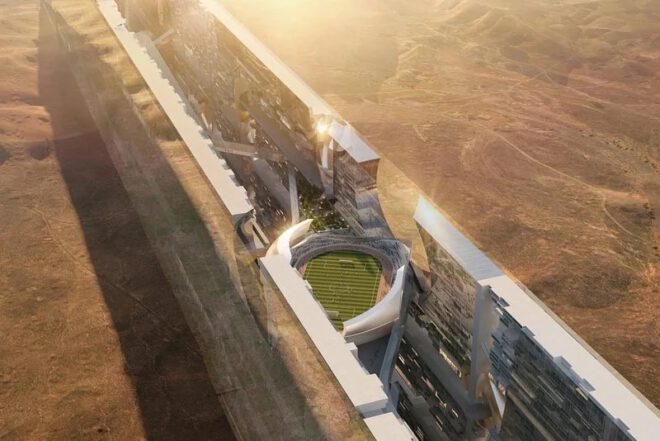

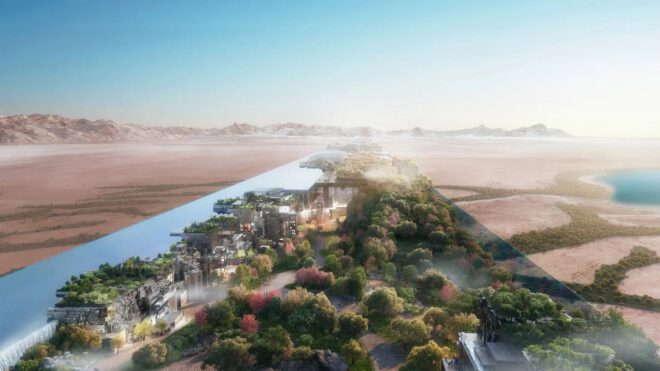

And of course if you are making endless millions off of Saudi Arabia’s oil money, you will never disappoint, especially when it comes to marketing terms you can also throw to techs doing the Photoshop graphics: Net gravity! Net zero! Carless! but without any consideration of local wildlife, the Huwaitat indigenous tribespeople already living there, local building materials, 115 degree summers and a pristine marine environment of the Red Sea, already at risk.
Want to see some more excess? How about the Four Seasons Riyadh and its hotel built on stilts?
Whenever I see a new idea released from Saudi Arabia, it’s like the hired architecture firm in England (often Fosters + Partners) is playing a joke on the Saudis to see how bombastic they can build the next dream. Does no one in England’s architecture world have common sense any more? Activists are already set to re-wild England, Scotland and Ireland after several millennia of England clearcutting forests – at home and elsewhere. It’s the same colonising spirit breaking ground and ruining the environment today in pristine ecosystems of Saudi Arabia: The Line! Neom! Four Seasons!

As for the press materials released, the architect firm is not mentioned.
What’s on The Line?
So what’s The Line? Back in 2021 Saudi Arabia announced its plan for The Line, a car-less belt of built habitat. To be built in the Tabuk Province in northwestern Saudi Arabia, this proposed “smart city” will be a little over 200 yards wide and at some parts 550 yards above sea level.
“I never seen something more dystopian,” one commenter wrote in reply to a video of The Line posted by the Saudi Press Agency.
You can read our past coverage of Neom starting here: it’s another new planned megacity hosting visions of grandiose cities and towns for work and play in Saudi Arabia. Take into consideration that local Saudis don’t work or play like Westerners so these cities are being built for …
us. These dystopian cities are being built for westerners.
So far any attempts to encourage Middle East locals to live in such modern “net-zero” developments have failed –– see our coverage of Masdar in the United Arab Emirates –– and the foreigners that stay at such residences are banned from speaking publicly about the experience.
The Middle East can build ideas that might mention the future and look like the future, but in practice foreigners are usually only living in the Gulf’s golden cage because they are lured with wealth and large homes, cars and status.
Saudi Arabia’s Mohammed bin Salman proudly boasts that he’s “committed to a civilizational revolution that puts humans first based on a radical change in urban planning. The designs revealed today for the city’s vertically layered communities will challenge the traditional flat, horizontal cities and create a model for nature preservation and enhanced human livability. The Line will tackle the challenges facing humanity in urban life today and will shine a light on alternative ways to live,” he said.
The project is bankrolled by the government’s public investment fund.
Remember Disney palaces in ruin in Turkey?
So how did great ideas like The High Line in New York City get so muddled into the nightmare of The Line of Saudi Arabia? Set to accommodate 9 million people, and about 30 square miles in size, The Line (says it marketing material) will promise to run on renewable energy, with amenities within a 5-minute walk, or end to end transport to visit your friends at the other end of the line within 20 minutes. It will “prioritize people’s health and well-being over transportation and infrastructure.”
A vertical city called Zero Gravity
In 1967 Israeli architect Moshe Safdie created Habitat ‘67 as a model for modest city. It housed participants of the Olympics that year and it’s returned to citygoers. It remains a historic site in the city near the water and people live in it today. The cubed structure with each block the same but somewhat different, offers a concept for modular living in the city, but it’s in human scale with nature outside every window, privacy a priority.
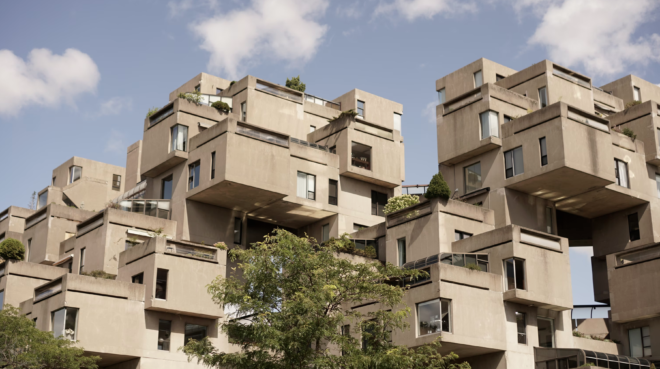
The Line however has taken that idea and crossed it with the Borg’s Cube (from Star Trek) and thrown in some renderings of cities after an apocalypse, and calls it Zero Gravity Urbanism.
The Line’s public parks and pedestrian areas, schools, homes and places for work, they say, are layered vertically, allowing citizens to move effortlessly and reach all daily needs within five minutes. The city’s exterior will be one giant mirror facade (something Saudi Arabia has done well in this mirror museum Maraya in the desert) to allow The Line to “blend” with nature for “magical moments”.
Environmental artist Pablo Solomon, from Texas, comments: “While the billionaires can do what they choose to do with their money [the solution is]: planting trees, conserving water, developing ways to clean emissions from reliable fossil fuels, desalinating water, developing hydroelectric and small nuclear reactors, finding ways to effectively/efficiently store electricity, etc.
“I have to give the Saudis an A for creativity—but a D for practicality. However, it will be fun to watch the sand pile up on either side of their 21st Century Hadrian’s wall,” Solomon adds.
Touted as a smart city that will be digitized and cost hundreds of billions to build, there is no mention of the real future, the future of a decentralized city where people own access to their own data and financial freedom. A future will people will be able to have a small plot of land, grow their own food, barter, and live with prosperity of their own making. The Line will just make you a soldier for capitalists.
But Saudi Arabia’s not always wrong. See the reforestation of mangroves and Saudi’s investing in hydrogen fuel.