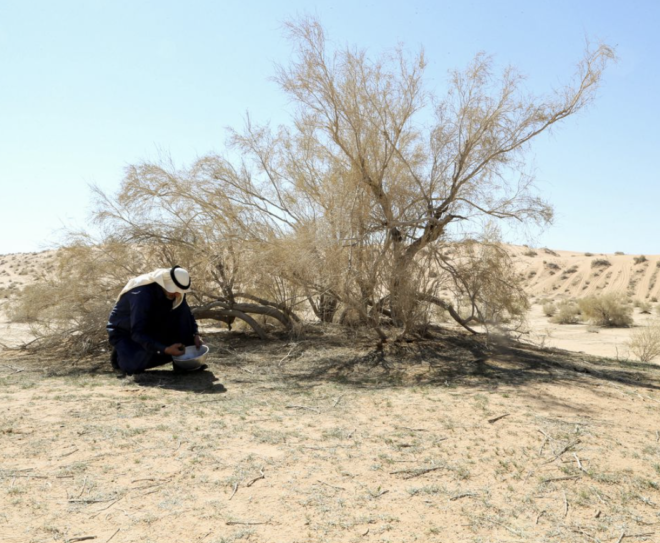
Holding back the deserts with a saxaul tree

saxual tree bedouins, saudi arabia
Bedouins collecting saxaul seeds: Reuters

Africa is getting its Great Green Wall, meanwhile Saudi Arabia is also suffering from climate change-induced draught and is starting to do something about it by planting more local trees that love the desert. The country is looking to a traditional tree used by the Bedouins to stop desertification. It’s called the saxaul tree and what’s great about it is that like how pine tree seeds open by fire, the saxaul tree seeds open when it’s extra hot and dry. 

Environmental activist Abdullah Abduljabar sees these trees as silver lining for deserts, as reported in Reuters.  And beyond slowing desertification by holding back the sand, the saxaul trees, (known in Arabic as Al-Ghadha or Etsion Parsi in Hebrew), provides firewood, food for animals plus shade and medicine for Bedouins who still live in the wild deserts of Saudi Arabia, Jordan, Israel, and Sinai. 

Saudi Arabian mangrove forests
Saudi Arabian mangrove forests can help mitigate climate change

Our writer Saeb in Jordan wrote in depth here on the wisdom inside Bedouin folk medicine and traditions.

desert daughter bedouin, bedoin miriam aborkeek israel
Bedouin medicine by the Desert Daughter.

Abduljabar, vice-president of the Al-Ghadha environmental association, will plant 250,000 of these trees in Saudi Arabia as a way to improve environmental stability in Saudi Arabia. The Saudi government will provide the funds for the trees.

It’s all part of mangrove reforestation and an ambitious plan to plant 10 billion trees in the next few decades. Back in 2014 we reported how one woman was pioneering the idea of saving mangroves in Saudi Arabia. Give it a read

The country also plans to work with other Arab states to plant an additional 40 billion trees across the Middle East, the Reuters report explores: 

“Many Middle Eastern countries are suffering from rising temperatures and longer and more frequent droughts, placing pressure on water supplies and food production.   The saxaul can survive for months without a drop of water and thrives in particularly harsh environments where temperatures can soar to 58 degrees Celsius (136 F).”

“The Gulf is one of the hottest places on earth.  The Unaizah park last year was recognised by Guinness World Records as the world’s largest saxaul botanic garden, stretching over 172 sq km (66.41 sq miles).   On a recent visit, an expanse of saxaul trees stretched to the horizon, enlivening the desert as wind blew through their needle-like leaves.  

“The saxaul tree has many qualities, one of the most important ones is that it doesn’t need a lot of water,” said Al-Ghadha association president Majed Alsolaim, as he walked in the park while holding the Guinness certificate in his hands.   “That’s why people in Unaizah have taken care of it (in order for it) to become an environmental symbol for this region.” 

Saxaul trees typically grow one to four metres high and are indigenous to the deserts of Saudi Arabia, especially in places where the sand is thicker. The wood from these trees can be used to make both furniture and glue, and the tree itself has medicinal uses.

Its latin name is Haloxylon persicum, the white saxaul, is a small tree belonging to the family Amaranthaceae. Its range is Western Asia, including Israel, Egypt, Sinai,  Iraq, Saudi Arabia, Iran, Oman, UAE, Afghanistan, and Pakistan, to Central Asia.

To sum up, we like the approach Saudi Arabia is taking (they could reverse the destruction seen in this Atlas of the Arab world), but take note: if you cut a tree in the Kingdom: it could land you 10 years in jail

Karin Kloosterman
Karin Kloostermanhttp://www.greenprophet.com
Karin Kloosterman is an award-winning journalist, innovation strategist, and founder of Green Prophet, one of the Middle East’s pioneering sustainability platforms. She has ranked in the Top 10 of Verizon innovation competitions, participated in NASA-linked challenges, and spoken worldwide on climate, food security, and future resilience. With an IoT technology patent, features in Canada’s National Post, and leadership inside teams building next-generation agricultural and planetary systems — including Mars-farming concepts — Karin operates at the intersection of storytelling, science, and systems change. She doesn’t report on the future – she helps design it. Reach out directly to [email protected]

Hot this week

How Renewable Energy is Revolutionizing the Way We Power Our World

Solar has become the star of the transition thanks to modular hardware and straightforward installation. It fits dense cities and remote towns alike. Many companies are turning to rooftop arrays and carport systems - and exploring commercial solar installation as a practical way to lock in future savings.

How does one start prepping?

Faced with an extreme winter storm this year, Americans wonder how to be prepared for catastrophe. Miriam has lived through wars in the Middle East - so she's prepared on giving you a guide to prepping.

Fishermen sue tire manufacturers on behalf of the salmon

A federal trial in San Francisco has brought US tire manufacturers, fishing groups, and environmental scientists into court over a chemical most drivers have never heard of — but which scientists say may be silently reshaping aquatic ecosystems.

Listening to Water: Tarek Atoui’s Next Work for Tate Modern

Born in Beirut, Lebanon in 1980 and now living in Paris, Atoui has spent years building instruments that don’t sit comfortably in concert halls. Many of them involve water, glass, and ceramics — materials that react to sound instead of simply producing it.

Leading Through a Dual-Energy Transition: Balancing Decarbonisation with Energy Security

Experience in one area of the energy industry isn't enough to guarantee readiness across all the others. That's where a structured program like an MBA in energy can come in. Today's advanced curricula explore energy economics, finance, policy, and strategic management alongside the technical subjects. And when pursuing an energy MBA online, professionals can skill up and retrain without having to step out of the labor market -- an important perk at a time when skilled professionals are already in short supply.

Topics

How Renewable Energy is Revolutionizing the Way We Power Our World

Solar has become the star of the transition thanks to modular hardware and straightforward installation. It fits dense cities and remote towns alike. Many companies are turning to rooftop arrays and carport systems - and exploring commercial solar installation as a practical way to lock in future savings.

How does one start prepping?

Faced with an extreme winter storm this year, Americans wonder how to be prepared for catastrophe. Miriam has lived through wars in the Middle East - so she's prepared on giving you a guide to prepping.

Fishermen sue tire manufacturers on behalf of the salmon

A federal trial in San Francisco has brought US tire manufacturers, fishing groups, and environmental scientists into court over a chemical most drivers have never heard of — but which scientists say may be silently reshaping aquatic ecosystems.

Listening to Water: Tarek Atoui’s Next Work for Tate Modern

Born in Beirut, Lebanon in 1980 and now living in Paris, Atoui has spent years building instruments that don’t sit comfortably in concert halls. Many of them involve water, glass, and ceramics — materials that react to sound instead of simply producing it.

Leading Through a Dual-Energy Transition: Balancing Decarbonisation with Energy Security

Experience in one area of the energy industry isn't enough to guarantee readiness across all the others. That's where a structured program like an MBA in energy can come in. Today's advanced curricula explore energy economics, finance, policy, and strategic management alongside the technical subjects. And when pursuing an energy MBA online, professionals can skill up and retrain without having to step out of the labor market -- an important perk at a time when skilled professionals are already in short supply.

From Green Energy to Healthy Societies: Why old systems thinking is becoming relevant again

Across the Middle East and North Africa, large investments are being made in green hydrogen, renewable energy, water infrastructure and sustainability. Most of these efforts are discussed in the context of climate change, decarbonization and economic diversification. That framing is important, but it may not capture their full value.

We saw peace – an interreligious encounter deep in our eyes

They came from Israel, Palestine, Jordan, Iraq, Yemen, Morocco, Tunisia, Lebanon, Egypt… There are Sunni Muslims, Shiite Muslims, Jews (Orthodox and Reform), Orthodox Christians, Coptic Christians, Protestant Christians, Druze, Baha'is, a Scientologist.

Can biochar reduce ‘Forever Chemicals’ in food if it’s used in farms?

Biochar is produced by heating organic material in a low-oxygen environment so it does not burn. This process, known as pyrolysis, transforms plant matter into a stable, carbon-rich material.

Related Articles

Popular Categories