Crab legs overturn fishing industry pest into new export

blue crab

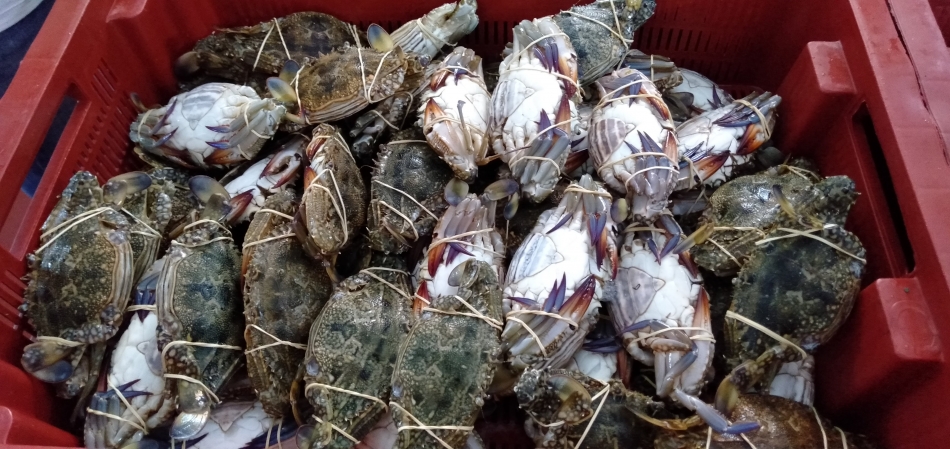
“It eats everything, leaves nothing and reproduces very quickly,” laments Mouradh, a fisherman from the Tunisian islands of Kerkennah. For the country’s fishers, the blue crabs that were being hauled out of the water, tangled up in their broken nets, were a disaster.

An invasive species introduced into the Mediterranean through the Suez Canal, the blue crab threatened the artisanal fishing techniques used along the Tunisian coastline, specifically damaging the gillnets and traps used in the Charfia (a traditional, fixed fishery system that blocks the path of fish and leads them to traps). With their sharp shells and claws, blue crabs ruin these fishing nets and feed on other fish species also caught in the nets or traps.

fishing nets tunisia
Tunisia has developed a complete value chain for blue crab so that fishers and food producers in Tunisia can tap into this income source.

Blue crabs were first found off the Tunisian coast in 1993. By 2014, they began proliferating massively, causing significant damage to the coastal artisanal fishing sector, especially in the Gulf of Gabès in southeast Tunisia, where, during the high season, the blue crab represented more than 70 percent of the catch off this Mediterranean gulf.

These predatory crabs compete with indigenous species for space and food. They feed on all other species of fish, and its only natural predator, the octopus, is not enough to limit its spread. By disturbing the natural ecosystems, the blue crab has also negatively affected the yields of Tunisian women clam collectors, who were supported by FAO to improve their household incomes

At the same time, this blue crab is the fifth most popular crab in the world market. It is especially sought out in the Asian, United States and Australian markets where it is featured on the menus of many restaurants.

Seeing the potential of turning this foe into a friend, FAO and the Tunisian government launched training sessions for the fishers in this region. Through the “Strengthening Governance and Development of Fisheries in Tunisia” project, FAO trained 90 fishers in Djerba, Gabès and Kerkennah.

Fishers received information sessions on the benefits of the blue crab and 1 500 multipurpose traps to allow them to catch the crab more easily. During FAO’s practical, hands-on training sessions, the fishers were able to compare the effectiveness of these large, mesh net traps against the traditional cylindrical crab pots.
fishing-tunisia

In collaboration with Tunisian marine research center, the National Institute of Science and Technology of the Sea, FAO also produced a practical manual in French on  blue crab fishing with multipurpose traps. It specifically addresses small-scale fishers, teaching them best practices in catching blue crabs.

Beyond the advancement of fishing techniques in Tunisia, FAO has assisted the government in developing a complete value chain within this niche market. Good governance of fishing, that allows fishers to catch crabs of good quality while respecting the environment, has facilitated the marketing of the blue crab locally and internationally.

The first blue crab processing and marketing plant for the Asian market, created by the government in 2019 in the Kerkennah islands, triggered a mini economic boom in the area with 50 new jobs for plant technicians.

Valerio Crespi, FAO Fisheries and Aquaculture Officer explains, “This successful plant not only allowed fishers to diversify their sources of income, it also added value to an invasive species.”

The exports of blue crab during the month of May 2021 rose significantly, reaching 2 090.9 tons with a value of USD 7.2 million (about 19.6 million Tunisian dinars), while exports for the same period in 2020 was 796.1 tons with a value of USD 3.1 million (or 8.6 million dinars).

Private sector investments in blue crab processing plants have gone from simple packaging and freezing raw crabs to preparing cooked products in order to expand to markets in Asia, Italy, Spain and the Americas. Some food manufacturing plants in Zarzis are considering including cooked crab as one of their products to enter other markets. In fact, even in Tunisia where crab has never been a traditional dish or ingredient in cooking, this product is starting to appear on local menus due to its new availability in markets.


Photos: Left/top: The blue crab was initially a disaster for fishers, ruining nets and traditional fishing techniques. ©FAO/Valerio Crespi Right/bottom: FAO offered training and better traps to Tunisian fishers to take advantage of this new type of catch. Though not well-known locally, blue crab is very popular in other markets. ©FAO/Valerio Crespi
Karin Kloosterman
Karin Kloostermanhttp://www.greenprophet.com
Karin Kloosterman is an award-winning journalist, innovation strategist, and founder of Green Prophet, one of the Middle East’s pioneering sustainability platforms. She has ranked in the Top 10 of Verizon innovation competitions, participated in NASA-linked challenges, and spoken worldwide on climate, food security, and future resilience. With an IoT technology patent, features in Canada’s National Post, and leadership inside teams building next-generation agricultural and planetary systems — including Mars-farming concepts — Karin operates at the intersection of storytelling, science, and systems change. She doesn’t report on the future – she helps design it. Reach out directly to [email protected]

TRENDING

Fishermen sue tire manufacturers on behalf of the salmon

A federal trial in San Francisco has brought US tire manufacturers, fishing groups, and environmental scientists into court over a chemical most drivers have never heard of — but which scientists say may be silently reshaping aquatic ecosystems.

Yaniv Levy’s Lifelong Quest to Protect Sea Turtles in a Time of War and Greed

This is the story of Dr. Yaniv Levy, founder of Israel’s Sea Turtle Rescue Center—the world’s only government-supported turtle hospital and breeding center unlike any in the world. But to understand why his work matters, you have to go back nearly 30 years, to another coastline altogether: Aldabra Atoll, part of the Seychelles, one of the last untouched Edens left on Earth.

How to help Gaza fishermen

The destruction of Gaza's two main aquaculture farms, along with the hatchery facility, has also left the sector unable to produce alternative aquatic foods through aquaculture. 

Invasive species of the Mediterranean Sea

The Med region is changing as hundreds of new species invade. Can you imagine floating in Cefalu with killer jellyfish?

Turning Your Energy Consultancy into an LLC: 4 Legal Steps for Founders in Texas

If you are starting a renewable energy business in Texas, learn how to start an LLC by the books.

Tracking the Impacts of a Hydroelectric Dam Along the Tigris River

For the next two months, I'll be taking a break from my usual Green Prophet posts to report on a transnational environmental issue: the Ilısu Dam currently under construction in Turkey, and the ways it will transform life along the Tigris River.

6 Payment Processors With the Fastest Onboarding for SMBs

Get your SMB up and running fast with these 6 payment processors. Compare the quickest onboarding options to start accepting customer payments without delay.

Qatar’s climate hypocrisy rides the London Underground

Qatar remains a master of doublethink—burning gas by the megaton while selling “sustainability” to a world desperate for clean air. Wake up from your slumber people.

How Quality of Hire Shapes Modern Recruitment

A 2024 survey by Deloitte found that 76% of talent leaders now consider long-term retention and workforce contribution among their most important hiring success metrics—far surpassing time-to-fill or cost-per-hire. As the expectations for new hires deepen, companies must also confront the inherent challenges in redefining and accurately measuring hiring quality.

8 Team-Building Exercises to Start the Week Off 

Team building to change the world! The best renewable energy companies are ones that function.

Thank you, LinkedIn — and what your Jobs on the Rise report means for sustainable careers

While “green jobs” aren’t always labeled as such, many of the fastest-growing roles are directly enabling the energy transition, climate resilience, and lower-carbon systems: Number one on their list is Artificial Intelligence engineers. But what does that mean? Vibe coding Claude? 

Somali pirates steal oil tankers

The pirates often stage their heists out of Somalia, a lawless country, with a weak central government that is grappling with a violent Islamist insurgency. Using speedboats that swarm the targets, the machine-gun-toting pirates take control of merchant ships and then hold the vessels, crew and cargo for ransom.

Related Articles

Popular Categories