
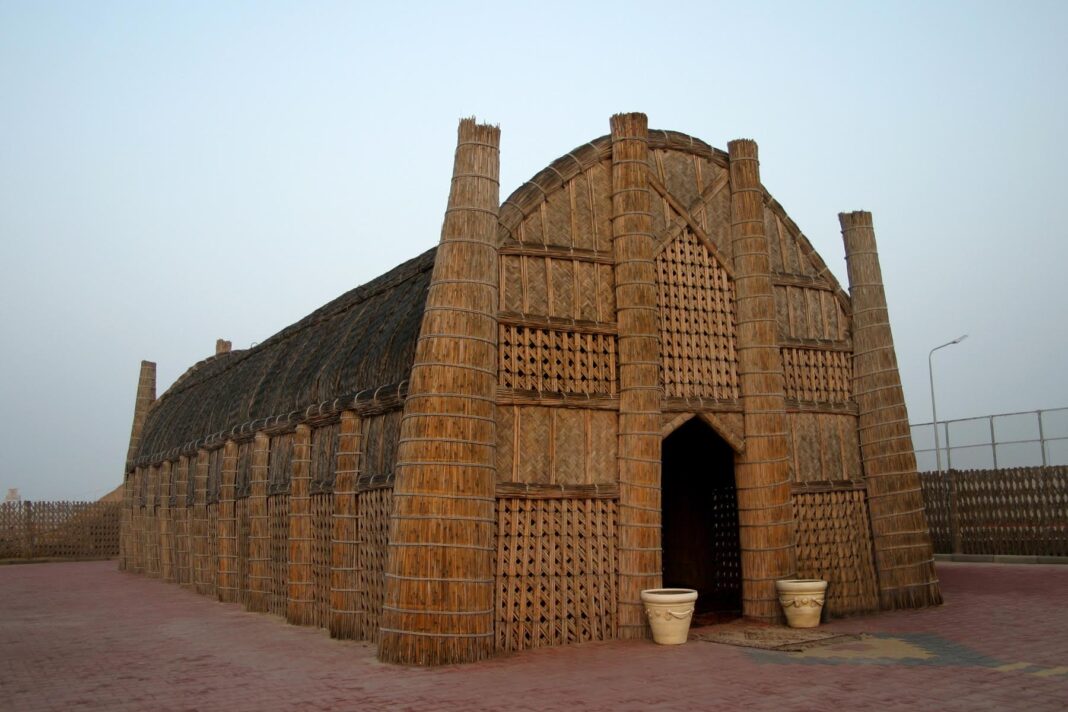
Mudhif, an Iraqi guesthouse, from reed grass connects American veterans to their trauma

Mudhif reed house iraq

Building with invasive plants; Healing through shared war stories

U.S. Veterans, Iraqi refugees and the public will join environmental artist Sarah Kavage and Iraqi designer Yaroub Al-Obaidi in constructing an Iraqi guest house, called a mudhif. Constructed of phragmites, an invasive reed grass, this traditional Iraqi marshland structure will be built on the grounds of the Schuylkill Center for Environmental Education in Northwest Philadelphia. 

Mudhifs have traditionally been used for town meetings and ceremonies. At the Roxborough site, it will serve as a gathering place to share experiences of war through storytelling, healing and recovery among U.S. Veterans, Iraqi immigrant communities and the public.

The construction of the cutting-edge art installation Al-Mudhif will kick off on Memorial Day, Monday, May 31, with a dedication ceremony. The building process involves tying bundles of reeds into 20-foot-long columns, and then shaping them into huge parabolic arches. Hand-woven mats are then tied over and between the columns, forming a roof. Finally, crafted lattice panels are attached to the sides, allowing for both sunlight and airflow into the interior and enclosing the entire hut.

mudhif Iraq
The Ahwar of Southern Iraq: Refuge of Biodiversity and the Relict Landscape of the Mesopotamian Cities: A view of the method of construction of the reed houses. Jasim Al-Asady

Connecting with Iraqi communities in nature through the building process of this sanctuary offers a significant memorable and cultural space for U.S. Veterans who were deployed in Iraq to connect with local Iraqi communities and culture.

“It is not often that Veterans are able to heal and connect with residents from areas that were engaged in conflict,” said RADM Karen Flaherty-Oxler, Director of the Corporal Michael J. Crescenz (Philadelphia) VA Medical Center. “Opportunities such as this help bring their experience full circle, often providing closure, healing and building bridges across cultures.”

South Philadelphian Marine Corps Veteran Leroy Anthony Enck says, ”For some veterans and military members, our time in Iraq was marked with loss and destruction: losing fellow service-members in body or spirit, witnessing a similar loss among indigenous communities in Iraq, and observing—despite our best efforts—the environmental destruction our presence and operations facilitated. 

“Some of us have struggled with the larger moral implications of this impact, and after participating in the difficult work of moral engagement, have decided to dedicate ourselves to this work as atonement. Now, we have an opportunity to engage in the hefty work of building: constructing the first mudhif outside of Iraq, building new community with our brethren among the former Iraqis who now call Philadelphia home, and giving—rather than taking—an opportunity for generations young and old to experience greater understanding of people and flora displaced through no choice of their own.”

The involvement of Iraq War Veterans in the project was facilitated by Reverend Chris Antal, a Staff Chaplain at CMCVAMC. Antal had this to say, “Some Veterans who served in Iraq are often burdened by difficult memories and painful emotions. Collaborations such as this help build trust, foster reconciliation and create a sanctuary amidst the calming presence of nature.”

The project is part of a larger art initiative Lenapehoking~Watershed with the Alliance for Watershed Education (AWE) for which Sarah will create multiple site-specific, temporary installations along the Delaware River circuit trail, exclusively using natural materials such as meadow grasses and invasive phragmites. We will activate the installation of the Al-Mudhif with an accompanying exhibition and extended programming around the exchange of war experiences, healing, and intercultural encounters from June to October 2021.


Karin Kloosterman
Karin Kloostermanhttp://www.greenprophet.com
Karin Kloosterman is an award-winning journalist, innovation strategist, and founder of Green Prophet, one of the Middle East’s pioneering sustainability platforms. She has ranked in the Top 10 of Verizon innovation competitions, participated in NASA-linked challenges, and spoken worldwide on climate, food security, and future resilience. With an IoT technology patent, features in Canada’s National Post, and leadership inside teams building next-generation agricultural and planetary systems — including Mars-farming concepts — Karin operates at the intersection of storytelling, science, and systems change. She doesn’t report on the future – she helps design it. Reach out directly to [email protected]

TRENDING

The US leaves 66 United Nations organizations to “put America first”

The world needs a reset and to restart well intentioned cooperation projects from start. Because right now the UN and EU projects look like software built on code from the 80s, rickety, patched, slow to adapt, and prone to crashing under the weight of outdated assumptions.

Musk’s Saudi Mega-Data Center Signals a Desert Arms Race for AI

For now, Musk’s partnership signals a deepening alignment between Silicon Valley and Riyadh — and a new chapter in the Middle East’s data-powered future. The satellites and robots may come later. The energy footprint, however, is already here.

Medical cannabis Syqe lays off 30% of its workforce

This backing gave Syqe financial muscle and strategic reach—but also raises reputational and strategic risks, given tobacco’s fraught public perception in the health space. Imagine if McDonald’s bought into a regenerative kale farm. The cash infusion could scale production, but people would always wonder if the lettuce was being served with a side of fries. 

Egyptian locust appears at English beach town signaling climate change

So why should a single locust in Cornwall matter? Because it might be a harbinger of climate change and shifting weather patterns. Warmer, drier extremes and stronger winds can help migratory insects push further north. A recent study links increased locust outbreaks to climate anomalies like heavier rainfall and wind patterns.

How Israel’s Strikes Avert Iran’s Environmental Threat

The strikes on Iran have sparked fierce debate, but from Israel’s perspective, the choice was easy: either accept the risks of a nuclear Iran or act decisively to stop it.

Turning Your Energy Consultancy into an LLC: 4 Legal Steps for Founders in Texas

If you are starting a renewable energy business in Texas, learn how to start an LLC by the books.

Tracking the Impacts of a Hydroelectric Dam Along the Tigris River

For the next two months, I'll be taking a break from my usual Green Prophet posts to report on a transnational environmental issue: the Ilısu Dam currently under construction in Turkey, and the ways it will transform life along the Tigris River.

6 Payment Processors With the Fastest Onboarding for SMBs

Get your SMB up and running fast with these 6 payment processors. Compare the quickest onboarding options to start accepting customer payments without delay.

Qatar’s climate hypocrisy rides the London Underground

Qatar remains a master of doublethink—burning gas by the megaton while selling “sustainability” to a world desperate for clean air. Wake up from your slumber people.

How Quality of Hire Shapes Modern Recruitment

A 2024 survey by Deloitte found that 76% of talent leaders now consider long-term retention and workforce contribution among their most important hiring success metrics—far surpassing time-to-fill or cost-per-hire. As the expectations for new hires deepen, companies must also confront the inherent challenges in redefining and accurately measuring hiring quality.

8 Team-Building Exercises to Start the Week Off 

Team building to change the world! The best renewable energy companies are ones that function.

Thank you, LinkedIn — and what your Jobs on the Rise report means for sustainable careers

While “green jobs” aren’t always labeled as such, many of the fastest-growing roles are directly enabling the energy transition, climate resilience, and lower-carbon systems: Number one on their list is Artificial Intelligence engineers. But what does that mean? Vibe coding Claude? 

Somali pirates steal oil tankers

The pirates often stage their heists out of Somalia, a lawless country, with a weak central government that is grappling with a violent Islamist insurgency. Using speedboats that swarm the targets, the machine-gun-toting pirates take control of merchant ships and then hold the vessels, crew and cargo for ransom.

Related Articles

Popular Categories