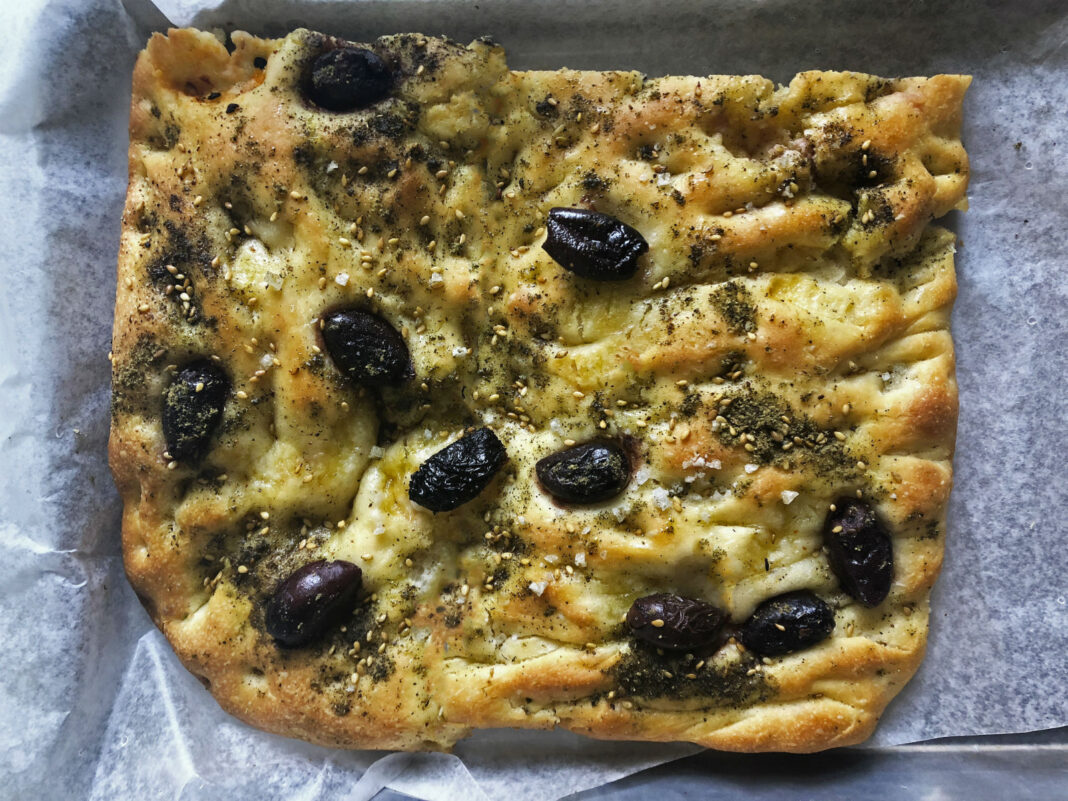

Recipe: Olive and Za’atar-Topped Focaccia

Focaccia with olives and za'atar

An Italian flatbread featuring a Middle-Eastern herb? Why not?

Italy and much of the Middle East have a lot in common. They share the Mediterranean climate. Both love olive oil. In both regions, people bake a variety of flatbreads. And za’atar’s flavor is closely related to oregano, the spice dusted over those iconic Italian dishes, pizza and lasagna. Here in Israel, most pizzerias leave big shakers of both oregano and za’atar out on the counter for customers to flavor their pizzas as they wish.

We liked this easy recipe for olive and za’atar-topped focaccia very much. My family couldn’t wait to tear into it as soon as I took it out of the oven. Use your preferred olives, just make sure they’re pitted. In spite of olives’ saltiness, don’t forgo the final sprinkling of flaky salt for the delicious crunch it gives.

Olive and Za’atar-Topped Focaccia

Ingredients

2¼ teaspoon (1 packet) active dry yeast; or 50 grams (2 oz) fresh yeast
1 teaspoon sugar
1¾ cups warm water
5 cups (600 grams) bread flour plus more as needed
2 teaspoons kosher salt
5 tablespoons extra virgin olive oil plus more as needed
½ cup pitted black or green olives
1 tablespoon za’atar, or to taste
Flaky salt, to taste

Dissolve the yeast with sugar in the warm water.


Put the flour and salt into the bowl of a stand mixer fitted with a dough hook. Alternatively, you can make this dough by hand. Note that the dough will be tacky. Add the water and yeast mixture and 2 tablespoons of the olive oil to the flour mixture.

Turn the mixer to stir, and allow it to mix until a shaggy dough is just formed, 5-6 minutes. If the dough is too moist to cohere, add flour, a tablespoon at a time, while mixing, until a smooth, elastic dough forms.

Remove the dough from the mixer, gently form into a ball, and transfer to a well-oiled bowl. Turn the dough in the bowl to cover it with a film of oil.

Cover the dough with a recycled plastic bag or plastic wrap.

Place the covered dough in a warm part of the kitchen and allow the dough to rise until doubled in size, 1½-2 hours.

Spread 3 tablespoons of olive oil over a rimmed baking sheet.

Punch the dough down, then transfer it to the baking sheet. Gently press the dough, spreading it into the edges of the baking sheet to form a rectangle. Flip it over to cover both sides with the olive oil.

Poke dimples all over the dough with your fingers. Cut open a plastic bag to cover the dough, or use plastic wrap. In either case, brush the inner surface with oil so it won’t stick to the dough. Let the dough rise again for 45 minutes to an hour.

While the dough is rising again, preheat the oven to 425°F. – 220°C.

Scatter the olives over the dough and push them in lightly. Sprinkle za’atar and flaky salt over all.

Bake for 25-30 minutes or until golden brown with a crisp crust. Dribble a little more olive oil over the hot focaccia and allow it to cool slightly before serving.

Want another cool recipe? We have one for za’atar-topped pita, another variation on the bread/za’atar combination.

Adapted recipe and photo from The Nosher.

Miriam Kresh
Miriam Kreshhttps://www.greenprophet.com/
Miriam Kresh is an American ex-pat living in Israel. Her love of Middle Eastern food evolved from close friendships with enthusiastic Moroccan, Tunisian and Turkish home cooks. She owns too many cookbooks and is always planning the next meal. Miriam can be reached at miriam (at) greenprophet (dot) com.

TRENDING

Make nettle dumplings, also known as nettles malfatti

Springtime foraging yields a harvest of wild greens to cook at home, like nettles. Make delicious nettles malfatti dumplings with this recipe.

Lion’s Mane Mushroom Recipe

Eyeing the mushrooms for sale in the local supermarket,...

Mandi, Fragrant Yemenite Chicken With Golden Rice

This is a luxurious recipe that requires a taste...

Simple Qatayef recipe makes fabulous nut-filled pancakes

Qatayef - also spelled katayif or qatya’if - is traditionally eaten at Ramadan (get our Ramadan vegetarian ideas here), but it’s a treat anytime. In fact, it’s a treat that’s gone through history. A recipe for qatayif appears in a tenth century Arabic cookbook by the writer Ibn Sayyar al-Warraq, who compiled recipes going back to the eighth and ninth centuries. People have been eating qatayif for a very long time.

Feta and Brie Cooked in Grapevine Leaves

For an easy, luscious appetizer, wrap a semi-firm white...

Turning Your Energy Consultancy into an LLC: 4 Legal Steps for Founders in Texas

If you are starting a renewable energy business in Texas, learn how to start an LLC by the books.

Tracking the Impacts of a Hydroelectric Dam Along the Tigris River

For the next two months, I'll be taking a break from my usual Green Prophet posts to report on a transnational environmental issue: the Ilısu Dam currently under construction in Turkey, and the ways it will transform life along the Tigris River.

6 Payment Processors With the Fastest Onboarding for SMBs

Get your SMB up and running fast with these 6 payment processors. Compare the quickest onboarding options to start accepting customer payments without delay.

Qatar’s climate hypocrisy rides the London Underground

Qatar remains a master of doublethink—burning gas by the megaton while selling “sustainability” to a world desperate for clean air. Wake up from your slumber people.

How Quality of Hire Shapes Modern Recruitment

A 2024 survey by Deloitte found that 76% of talent leaders now consider long-term retention and workforce contribution among their most important hiring success metrics—far surpassing time-to-fill or cost-per-hire. As the expectations for new hires deepen, companies must also confront the inherent challenges in redefining and accurately measuring hiring quality.

8 Team-Building Exercises to Start the Week Off 

Team building to change the world! The best renewable energy companies are ones that function.

Thank you, LinkedIn — and what your Jobs on the Rise report means for sustainable careers

While “green jobs” aren’t always labeled as such, many of the fastest-growing roles are directly enabling the energy transition, climate resilience, and lower-carbon systems: Number one on their list is Artificial Intelligence engineers. But what does that mean? Vibe coding Claude? 

Somali pirates steal oil tankers

The pirates often stage their heists out of Somalia, a lawless country, with a weak central government that is grappling with a violent Islamist insurgency. Using speedboats that swarm the targets, the machine-gun-toting pirates take control of merchant ships and then hold the vessels, crew and cargo for ransom.

Related Articles

Popular Categories