
Eco-anxiety affects nearly 70% of all Americans, new survey

eco anxiety from climate change, man in green light

As the effects of climate change become more evident, and more awareness to it is felt, more than half of U.S. adults (56%) say climate change is the most important issue facing society today, yet 4 in 10 have not made any changes in their behavior to reduce their contribution to climate change, according to a new poll by the American Psychological Association. 

This is an important survey to note, because it will implicated how the western east areas of the world, countries like Turkey, Lebanon, Israel, Egypt, Jordan, Syria will follow. There is about a 10 year lag, but we hope the writing is on the wall and enough people will wake up to the real threats that come from fossil fuels and cheap products made in China. 

While 7 in 10 say they wish there were more they could do to combat climate change, 51% of U.S. adults say they don’t know where to start. The survey was conducted online from Dec. 12-16, 2019, by The Harris Poll on behalf of the American Psychological Association. 
APA_Climate_Survey_email-graphics_1.jpg

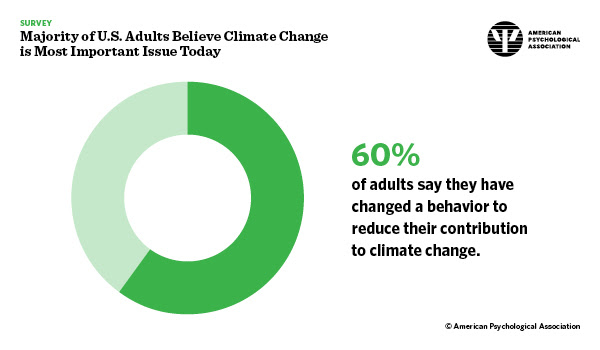
People are taking some steps to combat climate change, with 6 in 10 saying they have changed a behavior to reduce their contribution to climate change.

Nearly three-quarters (72%) say they are very or somewhat motivated to make changes. 

Among those who have already made behavior changes to reduce their contribution to climate change, when asked why they have not done more, 1 in 4 (26%) cite not having the resources, such as time, money or skills, to make changes. Some people are unwilling to make any changes in their behavior to reduce their contribution to climate change.

When those who have not changed their behavior were asked if anything would motivate them to reduce their contribution to climate change, 29% said nothing would motivate them to do so. 

Climate change fears affects mental health, mainly the younger ones

Concern about climate change may be having an impact on mental health, with more than two-thirds of adults (68%) saying that they have at least a little “eco-anxiety,” defined as any anxiety or worry about climate change and its effects.

These effects may be disproportionately having an impact on the country’s youngest adults; nearly half of those age 18-34 (47%) say the stress they feel about climate change affects their daily lives.

Psychological research shows us that when people learn about and experience local climate impacts, their understanding of the effects of climate change increases.

A quarter of those who have not yet made a behavior change to reduce their contribution to climate change say personally experiencing environmental impacts of climate change (e.g., natural disasters, extreme weather conditions) (25%) or seeing environmental impacts of climate change in their community (24%) would make them want to try to reduce their contribution to climate change. 

Take action to relieve the eco-anxiety

The most common behavior changes people have already made or are willing to make include:

  • reducing waste, including recycling (89%);
  • upgrading insulation in their homes (81%)
  • limiting utility use in their homes (79%)
  • using renewable energy sources, such as solar panels or purchasing electricity from a renewable energy supplier (78%)
  • consuming less in general (77%)
  • or limiting air travel (75%)

Public transport, vegans, bike paths, farmer’s markets wanted 

"beirut lebanon bike path"
Bike path in Beirut, more paths wanted please say Americans. What about us western easterners?

Adults are less likely to say they have changed or are willing to change daily transportation habits (e.g., carpool, drive an electric or hybrid vehicle, use public transportation, walk or bike) (67%) or their diet (e.g., eat less red meat or switch to a vegetarian or vegan diet) (62%). 

A majority (70%) also say that they have already or are willing to take action such as working with their community to reduce emissions, for example by installing bike paths, hosting farmers markets, or using community solar panels.

And nearly 6 in 10 (57%) say that they have already or are willing to write or lobby elected officials about climate change action with a similar proportion (57%) saying they already have or are willing to join an organization or committee working on climate change action. 

The most common motivations for behavior changes among those who have taken action to reduce their contribution to climate change are wanting to preserve the planet for future generations (52%), followed by hearing about climate change and its impacts in the news (43%).

This survey was conducted online within the United States by The Harris Poll on behalf of APA from Dec.12 – 16, 2019, among 2,017 U.S. adults ages 18 and older.


Karin Kloosterman
Karin Kloostermanhttp://www.greenprophet.com
Karin Kloosterman is an award-winning journalist, innovation strategist, and founder of Green Prophet, one of the Middle East’s pioneering sustainability platforms. She has ranked in the Top 10 of Verizon innovation competitions, participated in NASA-linked challenges, and spoken worldwide on climate, food security, and future resilience. With an IoT technology patent, features in Canada’s National Post, and leadership inside teams building next-generation agricultural and planetary systems — including Mars-farming concepts — Karin operates at the intersection of storytelling, science, and systems change. She doesn’t report on the future – she helps design it. Reach out directly to [email protected]

LEAVE A REPLY

Please enter your comment!
Please enter your name here

TRENDING

Huge Fish Nursery Discovered Under Freezing Arctic Seas

In 2019, an underwater robot camera exploring the seabed...

Remilk makes cloned milk so cows don’t need to suffer and it’s hormone-free

This week, Israel’s precision-fermentation milk from Remilk is finally appearing on supermarket shelves. Staff members have been posting photos in Hebrew, smiling, tasting, and clearly enjoying the moment — not because it’s science fiction, but because it tastes like the real thing.

The US leaves 66 United Nations organizations to “put America first”

The world needs a reset and to restart well intentioned cooperation projects from start. Because right now the UN and EU projects look like software built on code from the 80s, rickety, patched, slow to adapt, and prone to crashing under the weight of outdated assumptions.

Turkey named as climate change COP31 home in 2026

Murat Kurum as President-Designate of COP31

Ancient air trapped in Canadian salt bubbles foretells climate future

Opening these samples is like cracking open air that existed long before dinosaurs, before forests, before animals of any kind. As lead researcher Justin Park put it: “It’s an incredible feeling to crack open a sample of air that’s a billion years older than the dinosaurs.”

Qatar’s climate hypocrisy rides the London Underground

Qatar remains a master of doublethink—burning gas by the megaton while selling “sustainability” to a world desperate for clean air. Wake up from your slumber people.

How Quality of Hire Shapes Modern Recruitment

A 2024 survey by Deloitte found that 76% of talent leaders now consider long-term retention and workforce contribution among their most important hiring success metrics—far surpassing time-to-fill or cost-per-hire. As the expectations for new hires deepen, companies must also confront the inherent challenges in redefining and accurately measuring hiring quality.

8 Team-Building Exercises to Start the Week Off 

Team building to change the world! The best renewable energy companies are ones that function.

Thank you, LinkedIn — and what your Jobs on the Rise report means for sustainable careers

While “green jobs” aren’t always labeled as such, many of the fastest-growing roles are directly enabling the energy transition, climate resilience, and lower-carbon systems: Number one on their list is Artificial Intelligence engineers. But what does that mean? Vibe coding Claude? 

Somali pirates steal oil tankers

The pirates often stage their heists out of Somalia, a lawless country, with a weak central government that is grappling with a violent Islamist insurgency. Using speedboats that swarm the targets, the machine-gun-toting pirates take control of merchant ships and then hold the vessels, crew and cargo for ransom.

Leopoldo Alejandro Betancourt López Turned Ocean Plastic Into Profitable Sunglasses

Few fashion accessories carry the environmental burden of sunglasses. Most frames are constructed from petroleum-based plastics and acrylic polymers that linger in landfills for centuries, shedding microplastics into soil and waterways long after they've been discarded. Leopoldo Alejandro Betancourt López, president of the Spanish eyewear brand Hawkers, saw this problem differently than most industry executives.

Why Dr. Tony Jacob Sees Texas Business Egos as Warning Signs

Everything's bigger in Texas. Except business egos.  Dr. Tony Jacob figured...

Israel and America Sign Renewable Energy Cooperation Deal

Other announcements made at the conference include the Timna Renewable Energy Park, which will be a center for R&D, and the AORA Solar Thermal Module at Kibbutz Samar, the world's first commercial hybrid solar gas-turbine power plant that is already nearing completion. Solel Solar Systems announced it was beginning construction of a 50 MW solar field in Lebrija, Spain, and Brightsource Energy made a pre-conference announcement that it had inked the world's largest solar deal to date with Southern California Edison (SCE).

Related Articles

Popular Categories