


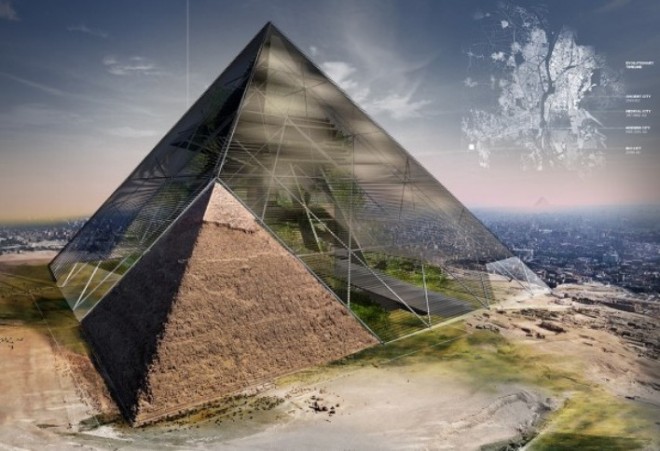
 Seven designers teamed up on a project to transform an ancient Egyptian pyramid into a green skyscraper that works to reverse desertification. Their Bio-Pyramid concept won an honorable mention in the 2015 eVolo Skyscraper Competition, an award that recognizes outstanding ideas that challenge the way architecture relates to both natural and built environments. Could up-cycling the Great Pyramid into a towering biosphere stop the Sahara Desert from advancing?
Oceans cover 71% of earth’s surface leaving less than a third of the planet above salty water. That real estate calculation is unsettling when you consider the resource demands of a world population expected to reach 11 billion by 2100. It’s more worrying still when you factor in constantly expanding deserts which now form over 33% of all landmass.
The Bio-Pyramid designers set their project in Egypt situated on the edge of the Sahara Desert, the largest non-polar desert on earth covering an area about 3.5 million square miles, about as big as the USA. Continual land degradation grows the Sahara by nearly 30 million acres annually, creating new desert that exceeds the size of Jordan!
Ancient Egyptians exploited the Nile River and its seasonal flooding, becoming one of the first ancient cultures to commercially farm on a large-scale. Prior to the Arab Spring, cultural heritage and tourism – not crop production – underpinned Egypt’s economy. The Bio-Pyramid team aimed to transform the traditional approach to historic preservation and sightseeing using a bit of architectural alchemy. They melded the Great Pyramid of Giza with a modern skyscraper and a closed ecosystem, or biosphere, converting the oldest of the Seven Wonders of the Ancient World into a “living machine” with direct ties to its local community.
The 1,280-foot-tall skyscraper would house a university, museum, research labs, tourist attractions, and retail shops set within extensive network of planting beds and food-producing gardens. In essence, it would be a vertical farm, fed by an underground water reservoir constantly replenished by water harvesting systems such as condensation traps and gray water recycling. It’s carefully cultivated micro-climate would purify water, clean the air, moderate the effects of punishing external temperatures on interior spaces, and create clean energy to sustain the facility.
The designers propose that developing sustainable and self-sufficient agricultural ecosystems (also known as permaculture) can immediately benefit surrounding urban communities while reversing desertification in the shadow of the Great Pyramid.
Desertification ranks among today’s greatest environmental challenges. The United Nations defines it as “land degradation in arid, semiarid and dry subhumid areas resulting from various factors, including climatic variations and human activities.” Drylands (degraded land where water scarcity limits production of crops, forage plants, and trees) now occupy 41% of earth’s land area and are home to more than 2 billion people.
Australian permaculture expert Geoff Lawton once claimed, “You can solve all the world’s problems in a garden.” But are hypothetical projects like Bio-Pyramid the best solutions? Ironically, as the pyramid decouples from its role as a magnet for foreign tourism, the biosphere project – if realized – would increase its ability to attract visitors. This could bring sizable economic gains to cities like Giza and Cairo, but with unexplored environmental impacts.
Surely we need to find new ways to manage changing climate, rising world population, and voracious human consumption, but the solutions should work with nature and partner with significant behavioral changes across entire communities. Aspects of this ambitious project are well-intended, but plunking complex manufactured ecosystems into unnatural environments is something best limited to desert-fringed Dubai, where tourists already invest in pricey pilgrimages to artificial alpine ski slopes, energy and water-intensive water parks (that unbelievably manage to be green-certified), and (coming soon!) tropical rainforests.
Image of the Bio-Pyramid from eVola website.



[…] Bio-Pyramid turns Egyptian pyramid into a desert-reversing skyscraper! Bio Pyramid Seven designers teamed up on a project to transform an ancient Egyptian pyramid into a green skyscraper that works to reverse desertification. Their Bio-Pyramid concept won an honorable mention in the 2015 eVolo Skyscraper Competition, … Read more on Green Prophet […]
[…] Bio-Pyramid turns Egyptian pyramid into a desert-reversing skyscraper! Bio Pyramid Seven designers teamed up on a project to transform an ancient Egyptian pyramid into a green skyscraper that works to reverse desertification. Their Bio-Pyramid concept won an honorable mention in the 2015 eVolo Skyscraper Competition, … Read more on Green Prophet […]
When I initially commented I clicked the “Notify me when new comments are added” checkbox Brighton and Hove iva or debt management plan now
each time a comment is added I get three e-mails
with the same comment. Is there any way you can remove people
from that service? Thanks a lot!