


With drought looming in California, but in many regions of the world include Yemen, Green Prophet honors Earth Day by digging into the archives so you can share 10 ways to collect and save fresh, potable water.
1. Seawater cone evaporation
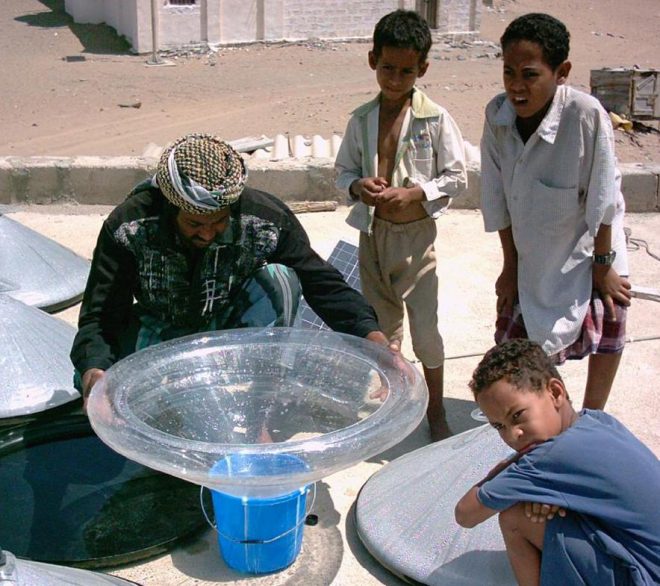
This low-tech method of collecting fresh water in involves placing an inverted plastic “water cone” over a pan of salt water and catching the evaporating fresh water droplets in the rimmed cone edges.
A cone measuring about 1/2 meter in diameter and are about 35 to 40 cm high can produce as much a one liter a day of fresh water. This idea is being tried in water starved countries like Yemen; which are now literally running on empty. The idea is also being used at a large scale to grow organic food in Abu Dhabi in seawater greenhouses.
2. Purifying contaminated water supplies in SODIS plastic bottles

Another “low tech” way of creating potable water supplies involves purifying water in large plastic water bottles, which are normally thrown away after use. Discovered by a Swiss research institute, The Swiss Federal Institute of Aquatic Science and Technology the SODIS method takes stagnant or waste water first made clear by filtering through sand.
The filtered water is then put into the plastic bottles, one side of which has been painted a dark color to help absorb sunlight. The filled bottles are arranged in rows on rooftops to allow the sun’s heat to heat up the water in the bottles to kill harmful bacteria.
This acts like a miniature sun boiler and not only provides safe drinking water but also allows more light into the dwelling. The SODIS method is now being used in countries like India where local freshwater supplies are often contaminated.
3. Water from air conditioning units

This water collecting idea has been around for years and is now being used by US and other armed forces units in desert countries. Water from air conditioning condensation is purified and used for drinking by troops in the field. Water obtained by this method can have a variety of uses; including agriculture and industrial use as well as for drinking.
4. Wastewater treatment
Treatment of wastewater, from sewage as well as “grey water” from households is now being done in countries like Israel, which reclaims as much as 70% of its waste water.
Israel’s success in reclaiming waste water has been so great that its national water company, Mekorot, received UN recognition for its Shafdan water reclamation facility. Much of this treated water is used for agriculture and public parks, which do not need purified fresh water.
5. Defying nature in Wadi Rum
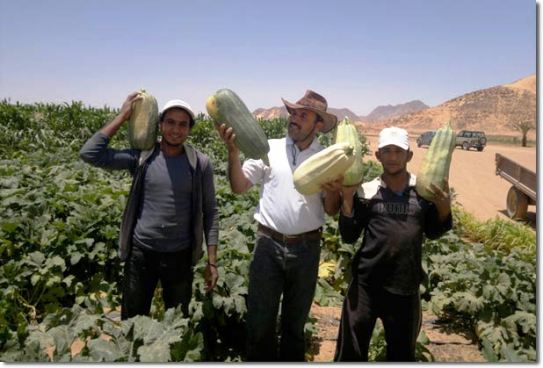
Bedouin farmers in Jordan’s Wadi Rum desert region (photo) are now using permaculture design systems, which date back to the ancient Nabateans who once inhabited the region.
These systems help conserve available water supplies to successfully grow organic vegtables and other crops. Permaculture irrigation involves digging small canals and drip irrigation methods. The systems used have already been in use extensively in the Jordan Valley. Mulching around trees such as pomegranates involves using what is known as a “chopndrop” method that helps conserve water.
6. Fog harvesting
Fog harvesting involves collecting water droplets created in locations where dense fog often blankets areas during certain times of the year. Also known as fog drip, this method of collecting water is now being used in Middle East countries like Yemen, Oman and Saudi Arabia, where annual monsoons create dense fog, known as “Khareefs” which blanket southern coastal regions.
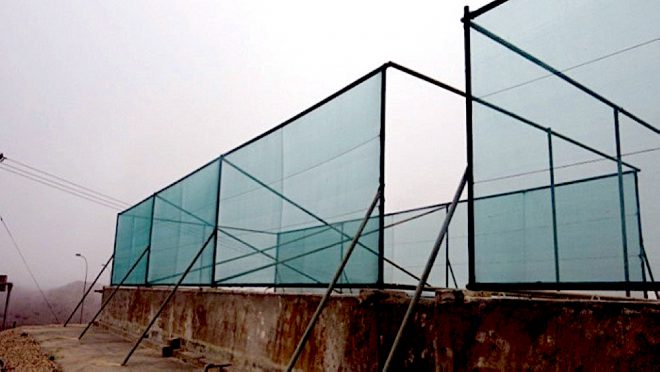
In this method, fog created water droplets are captured on special plastic mesh, which then drips down into a special reservoir located below the mesh. A collector of four 20-m-wide, 3-m-tall nets is placed at opposite ends of a reservoir that is capable of holding 400 cubic meters of water.
7. Bamboo Warkawater Towers
Another low-tech invention for harvesting water from the air is an Italian designed “Warkawater Tower” that is designed to collect water in countries like Ethiopia during cooler evening hours when the air becomes cooler.
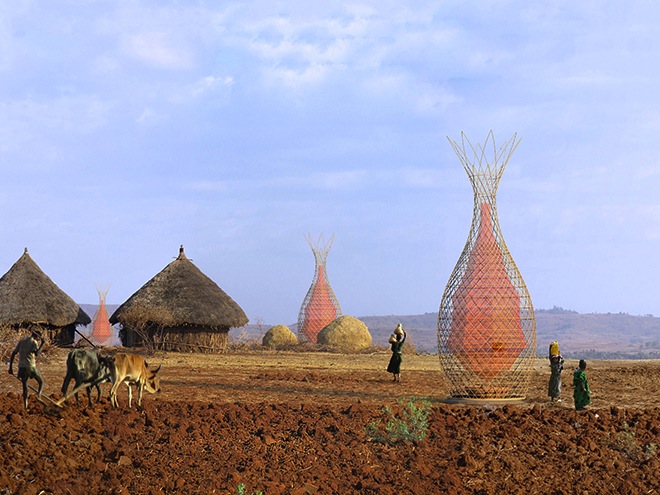
Named after the warka tree, native to Ethiopia, special plastic mesh in bamboo frameworks collect dew, which then drips down to a collecting pan. This method requires no external energy and is well suited for arid countries like Ethiopia where nighttime temperatures are often very cool, allowing due to form.
8. Dome collectors

Also suited for arid countries like Ethiopia, or even California or Arizona in the US, futuristic dome collectors also collect dew in early morning hours. This device involves a dome shaped mini-greenhouse of special plastic sheeting that collects dew which then drips into an inverted funnel shaped cone.
The collector requires no external energy source and is easy to assemble and disassemble. In addition, they can also be used to grow crops, which are located under the plastic “greenhouse”.
9. Underground water reservoirs
Whether natural, like Israel’s Sea of Galilee or man-made, water collecting reservoirs have been prime water storage sources since ancient times. More recently, these sources have become increasingly polluted, as well as severely depleted by periods of less than normal rainfall, or severe drought.
This is especially so in Middle East region countries like Turkey, Syria, Lebanon, Israel and Cyprus.
As more and more water is removed, for drinking or agriculture, the remaining water is more subject to saline pollution and other contamination.
10. Desalination technologies
A last resort :Although more in use today, desalination of sea water by reverse osmosis and other methods is one of the most environmentally damaging as it involves use of oil and other fossil fuels to run the desalination plants.
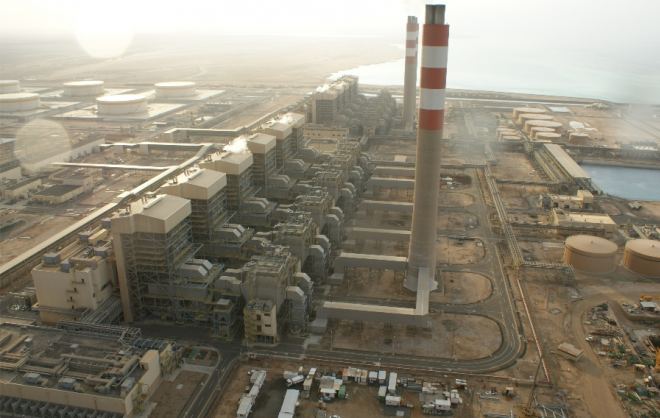
In addition, the heavy saline brine residue is usually allowed to flow back into the sea, making the seawater nearby more saline. Various ME and Mediterranean countries are now heavily dependent on desalination, including Cyprus which is receiving Israeli assistance to build desalination plants, Saudi Arabia, and the UAE.
As fresh water supplies grow even more scarce worldwide, fresh water related issues will undoubtedly receive more attention on future Earth Day events.
More on water collection and conservation:
Futuristic dome collectors collect dew for drinking water and crops
Cyprus gets new desalination plant with Mekorot Israel’s knowhow



I heard a long time ago about catching water in a cup with a cone over it, overnight, from someone at the Unitarian church…..good site, thanks, these ideas kinda overlap, I plan to try it out tonight, using some glass bottles with plastic cones placed in the mouth of the bottle, will report back…I don’t expect a great deal of water, but I am determined to find a “free” system, one that does not require the electricity like the dehumidifier method…..and I have a lot of bottles which my husband has saved from buying Kombucha…..I had considered actually throwing some of them out…bad idea!!!
tank you
i am water engineer from Iran .i want to fallow your note . can you send any note for me?
my email is (([email protected]))