

 Engineers at Lockheed-Martin recently developed and patented a molecular filtration membrane called Perforene which can desalinate seawater using only 1/100th the energy of the best existing desalination systems.
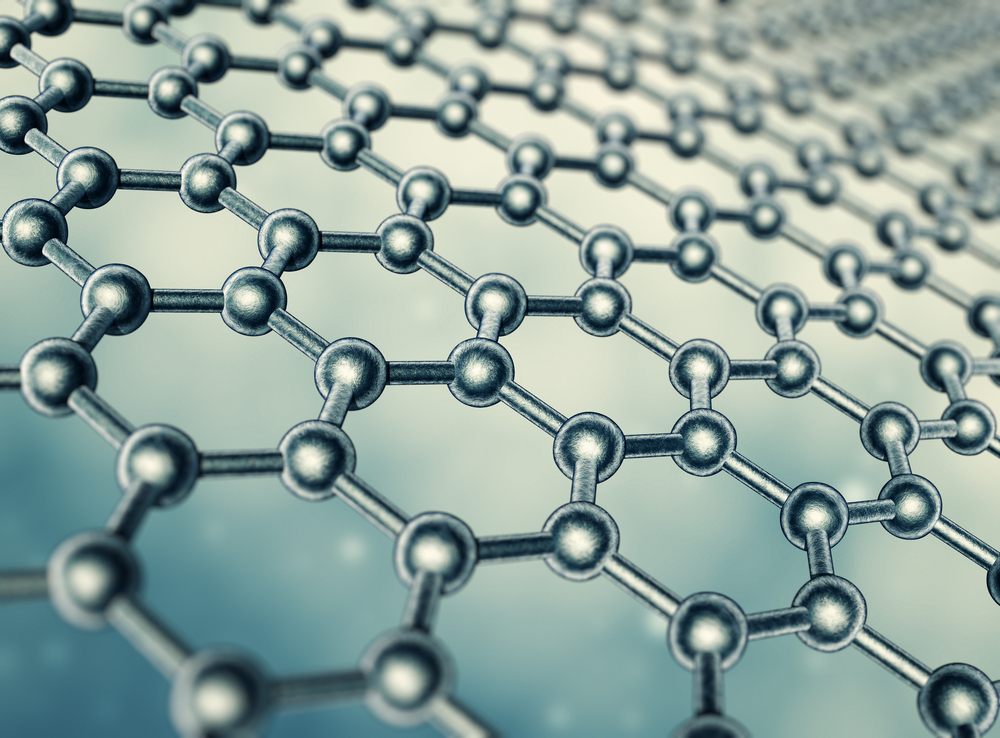
Perforene is made from graphene, the exciting new nanomaterial which comes in the form of one-atom thick sheets of carbon atoms. Like an overzealous nanotechnology, graphene seems to photobomb itself in as the solution to numerous environmental problems such as, storing electricity, removing air pollution, advanced photovoltaics, high strength materials and now desalinating water.
Under a microscope, this material looks like a mesh net with holes as small as one hundred nanometer. These holes are small enough to block the chlorine and sodium ions in salt water but large enough to allow pure water molecules to pass through.
The material was invented by Lockheed engineer. In an interview with Reuters, Stetson said that this new material is 1000 times stronger than steel and 500 times thinner than the best existing reverse osmosis desalination filter.
He said, “The energy that’s required and the pressure that’s required to filter salt is approximately 100 times less.”
Why desalinating water is not energy efficient
Desalination typically uses at least 3 kilowatt-hours per cubic meter. To put this into familiar terms, filling a 2 liter bottle with desalinated water consumes the same amount of energy as running a 15-watt compact fluorescent light for 24 minutes.
The energy required to purify two liters of freshwater would only run the same light for less than two minutes.
This may not seem like a lot of energy, but it adds up.
According to information published by the International Renewable Energy Agency (IRENA), the world’s desalination plants consume approximately 360 million kilowatt-hours each day. Because of their gluttonous energy consumption, desalination plants are nearly always collocated with electrical power generating stations.
Nuclear power is often used. But in a bit of political doublespeak, the desalination plants are said to generate electricity. Electricity “generated” by existing desalination plants is only the excess energy produced by the collocated power plant that hasn’t been consumed.
If unconsumed energy is the same things as producing energy, Lockheed-Martin’s desalination technology might become one of the most important sources of energy and water in the Middle East. The company is seeking commercialization partners and hopes begin manufacturing this amazing new material in 2015.
Image of graphene molecular sheet via shutterstock




[…] nature.com greenprophet.com phys.org […]
[…] “The energy that’s required and the pressure that’s required to filter salt is approximately 100 times less” (source) […]
[…] Perforene was also developed by Lockheed-Martin with the same principle as the porous graphene of National Oak Ridge Laboratory, and the same, with 99% less energy than traditional RO membranes:http://www.greenprophet.com/2014/12/graphene-nanotechnology-makes-desalination-100-times-more-effici… […]
[…] SOLUTIONS EXIST: New water technologies make desalination 100x more efficient. See here, here and here. See also the “free energy” section on this website, here. A […]
James and Ike, thanks for pointing this out. I also wondered where John Stetson found the two orders of magnitude. Was Maxwell’s demon working overtime? It now appears that in the original interview he was speaking of of 100 times better permeability which as James mentioned, is not the same as 100 times better energy efficiency. Thanks for the correction. Perhaps someone at Lockheed Martin would like to comment?
If it works it will keep the west coat form drying up. and alot of other places will;l benefit too.
This is really poor journalism. You have uncritically repeated a company’s claim without making any attempt to balance that against fundamental science. Graphene and Carbon Nano Tubes show substantially better flux rates for water than conventional membrane material, meaning you have an increase in permeability. While superficially that might seem equitable to energy, it is not, because when you are desalinating using reverse osmosis you have to overcome the osmotic pressure in addition to any friction in the membrane structure (the minimum energy required to desalt sea water (33 g/l) is around 1 kwh/m3). Also when you increase permeability, guess what? You decrease salt ion rejection, making a results comparison between these systems inaccurate. These new nanotechnologies show interesting potential in reducing energy, but at more modest rates like 10-15% (which is still a big deal). Here is a much more critical article that appeared in science on the subject: http://www.sciencemag.org/content/333/6043/712.
James,
I was about to add a similar comment when I saw yours. Good to see there are a few folks out there who really understand the physics and won’t fall victim to the snake oil claims like the credulous author of this piece.
The theoretical minimum energy that must be input to reduce the entropy and sort fresh water water molecules from brine at a 50% recovery rate is 1.06 kWh/m3. Factoring in a generous 60% thermal efficiency in converting heat energy into mechanical sorting energy via pumping through a maximally permeable RO membrane would require 1.77 kWh/m3 for that ideal process. The current state of the art for seawater desalination is 3.17 kWh/m3, so there is only about a 44% improvement that can be made regardless of the technological approach, not a factor of 100.
Lockheed Martin is also now claiming to have invented a compact nuclear reactor that will change the world in ten years (http://www.lockheedmartin.com/us/products/compact-fusion.html ). They must have adopted Vinod Khosla or Elon Musk as their press agent. If not careful, L-M is going to become the P.T. Barnum of technology companies.
Thats a really great invention that will change the world. California and the western US are drying up. A lot of farmers might quit next year if the drought continues a fourth year in a row. Vulvox Nanobiotechnology is working on ultra strong nanomaterials that can be used in membrane applications. Stronger membranes can stand higher pressure.
http://vulvox.tripod.com
[…] http://www.greenprophet.com/2014/12/graphene-nanotechnology-makes-desalination-100-times-more-effici… […]
[…] Graphene nanotechnology makes desalination 100 times more efficient […]