

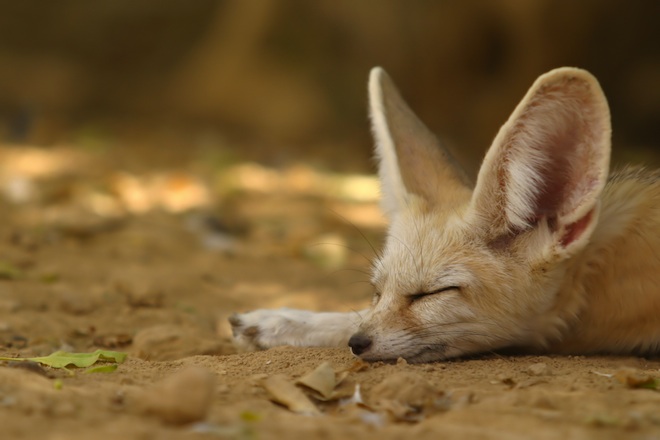
With its oversized ears and soft brown eyes, the world’s smallest canid is also probably the cutest. But being adorable has turned out to be lethal for the Fennec Fox in Tunisia, where both locals and tourists are loving the species to death. 
Life is rough for desert dwellers in North Africa, where the sun beats down on the sand year round, and water and food are scarce. But the Fennec Fox has developed numerous traits over the years that have allowed its populations to flourish throughout the Sahara and on towards Sinai.
Relatively little is known about the nocturnal Fennec’s biology, except that its disproportionately large ears not only allow it to root out food, but also help to regulate body temperature. It also burrows itself in the sand – either to escape from predators or to hide from the Saharan sun.
While the International Union for the Conservation of Nature (IUCN) lists Vulpes zerda as of least concern on their red list of threatened species, photographer Bruno D’Amicis discovered a disturbing trend that threatens the species during the two years he spent photographing the animal in Tunisia with support from National Geographic.
He found that nomadic people frequently capture the fox both as pets and to make a few dinar off tourists. D’Amicis won first prize for a single photograph in the Nature category of the 2014 World Press photography competition for an image of a captive Fennec he discovered that was kept as a pet for a small child.
The image depicts a petrified animal chained to a wheel rim in a sheep pen that appears to be absolutely petrified. Thanks to his efforts, the owners eventually freed the animal, but it is unlikely to have survived.
In the comment section of a blog post that National Geographic published about his work, D’Amicis laments the Fennec’s plight but urges readers to think about the problem’s roots.
Related: Tunisia’s environmental progress slides back 25 years

“The story of this unlucky fox is unfortunately just one among many that suffer from the same conditions, and so many other species are facing a similar situation!” he wrote. “One could surely release all of them, a few perhaps will survive, but the main problem will remain: what should be really done is addressing the primary cause.”
The primary cause, according to him, is lack of education and financial security. In 2009, Maureen McKamey, then a Drake University student, relayed a similar story that suggests that D’Amicis may be right.
She tells the story of a nomadic woman who appeared from behind a dune dragging a small Fennec attached to a chain. The old woman asked Maureen and her team if they would like to photograph the fox for a single dinar. Of course the tourists were mortified, and debated buying the Fennec so that they could release it back into the wild, but the guide cautioned against it, since that is exactly what the old woman was hoping would happen.
D’Amicis says that he refused to pay to photograph the captive fox he photographed and urges other travelers to the region to do the same.
Long aware of the problem, the Tunisian government aired a television program that appealed to the population’s sympathy for the small desert creature. The star was Labib the Fennec Fox. Sadly, they eventually declared the program a failure.




[…] Cuteness is a curse for the adorable Fennec Fox The image depicts a petrified animal chained to a wheel rim in a sheep pen that appears to be absolutely petrified. Thanks to his efforts, the owners eventually freed the animal, but it is unlikely to have survived. In the comment section of a blog … Read more on Green Prophet […]
Bruno D’Amicis is a real pretentious cultural imperialist attempting to force Western nonsense about wildlife down the throats of people who know better.
D’Amicis is also a thief for not paying for the photo of their property regardless of his beliefs.
If he bothered to think about the situation and why this is so common, he’d realize the Fennec is so easy to capture, because it they find living in close proximity to humans far more pleasant than living away from them where starvation is always lurking just a few days away, where should they make a single mistake they are a nice meal for various predators that put the Fennec at the top of their dinner list.
To me the picture portrays a Fennec annoyed at the appearance of the stranger.
Where is the picture of the child who owns the fox.
Where is the picture of the child that should be covered in scratches and bite marks from playing with the captive wild Fennec? If it truly is living in terror as he believes an even better photo to prove his point would have been that photo.
Yet he forgot to take one I guess. Is it perhaps because alone the child interacts fine with the Fennec. Is it perhaps that it is his strange presence that alarms the Fennec.
Where is a photo of the child with the fox with him NOT visible to the fox.
My tiny very domestic dogs (Japanese Chin) will adopt the SAME POSE in the presence of strangers. They relax only if I am around.
What it is proof of is what he think looks like terror, and that he doesn’t know animals very well.
I bet he probably has never had pets he’s had to interact with regularly. If he did, he’d be able to distinguish the looks they have.
Clearly he is trying to push the Western belief that wild animals hate being with humans despite overwhelming proof that is simply a lie.
If he truly were interested in finding out if he were correct, he would have stuck around rather than pretentiously judging anyone in order to see how the animal interacted with the people who held it while he was not visible.
The problem is the refusal to legitimize the practice and therefore develop rules and regulations to protect these animals as they are easily transformed into pets if handled properly.
It’s a lie that foxes cannot be domesticated. A Russian researcher disproved that absolutely when he purposely bred very wild and hostile wild arctic foxes over a period of a few years to produce a completely domestic and docile domesticated version.
A domesticated version of the Fennec therefore would end the pressure of the wild population.
Of course I realize that people who write articles like this hold the Western notion that wild animals love living in the wild and hate civilization as if it were a holy writ, and miss just how absurd it is.
Another soon-to-be-extinct species?
nope not even close. The Fennec is a very successful desert dweller akin to the American Coyote which has spread everywhere and now even lives in urban areas.
The Fennec is so easily captured for the same reason.
It prefers to live among humans where food, shelter and WATER are extremely easy to obtain vs a vs the open desert where escaping death due to starvation or predation is a daily occurrence.
The irony of this article is it is human activity that has made the Fennec become an extremely common animal in no dan, but because the author is trying to foist false Western paradigms used to distinguish wild from domestic they cannot see the obvious.
You may have something of interest to say about these animals, but by painting those with a “Western world view” as if that was the essence of everything evil about your world deflates your argument and makes me sad. Your anger is misplaced, and is like how the right wing of my country blames the boogey man of the president, democrats, educated people, etc., etc., for everything wrong in the world. How silly and flat. What made you this way? Why are so many people like you? People who reify the world? Once you use the words “cultural imperialist”, you no longer have to think. Your thought is made concrete and has much less life. Your words only add weight to the world’s problems. So sad.