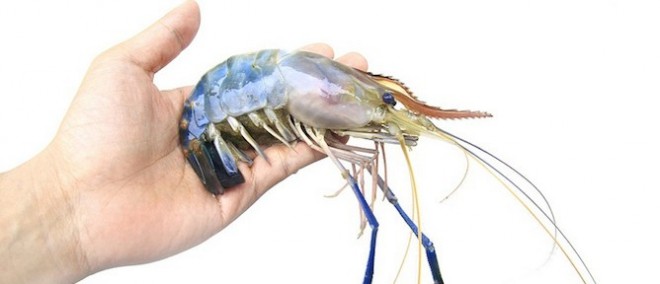


There are evolutionary reasons why Tarzan is bigger than Jane. Most males of any species –– birds, bugs and prawns included –– grow bigger than their female counterparts. The phenomenon is called sexual dimorphism.
A new Israeli-American company, Enzootic, is taking sexual dimorphism and the ability to control it to the dinner table.
Based on research from Ben-Gurion University of the Negev, the company developed a one-time, non-chemical, non-genetic treatment method that allows hatcheries and aquaculture farmers to control and rear these crustaceans by gender.
This has big environmental and commercial payoffs, says Assaf Shechter, the CEO of Enzootic.
“We are directing their energy to growth,” he tells ISRAEL21c.
In some cases, it makes sense to grow males in artificial pools and in others just females, says Shechter.
But in all cases, it makes more sense and cents to grow the males apart from the females. When grown with females, males become more aggressive and the dominant males suppress the growth of the inferior ones. The bottom line is that there is less to harvest come time to go to market.
The technique is based on research by Prof. Amir Sagi, Shechter’s former PhD adviser. He is cofounder and CTO of the company.
Sagi’s team previously produced a cutting-edge biotechnological tool for crustacean sex reversal and mono-sex progeny production that was licensed to the Tiran Group, an Israeli shipping company with aquaculture farms in China. Tiran also signed an agreement to advance aquaculture in Vietnam using Sagi’s technology. This is a completely separate venture from Enzootic.
For the boys
Growing males only could mean a 60 percent increase in income for the prawn farmer, and a 45% increase for biomass producers. There are rewards for the hatcheries, too –– they could fetch heftier prices for the prized immature mono-sex prawn, says Shechter.
Where labor is cheap, like in Southeast Asia where the majority of freshwater prawns are grown and frozen for export, some farmers hand-select the males from the females, but this process is time-consuming and not practical.
Shechter is hoping to take this technology to the United States to provide tastier, fresher, more ethical prawn farming opportunities for a stagnant production market, in a society hungry for seafood.
Only one percent of the seafood harvest is actually produced in the United States and the Caribbean, says Shechter, because fish farmers could not compete with Southeast Asia’s labor and fuel prices.
Freshwater male prawns.
But with a growing awareness of food miles, the importance of knowing what goes into your food, a desire for freshness and buying American –– Shechter hopes to be able to start a new revolution with Enzootic, pronounced en-zoo-tic.
“We are targeting the US, because the United States is such a huge consumer of prawns and shrimps, and we want to encourage farmers in the region to grow locally.”
He believes this biotech solution can make the business of crustacean aquaculture a booming business all over the United States, and especially in states that have mild winters. Shechter is also targeting regions within a one-hour plane ride of the United States.
How the technology works
Just after the Macrobrachium rosenbergii get past their larval stage, when they about the size of sea monkeys, Enzootic specialists inject them with an RNA-based material that allows them to “choose” the sex of future progeny.
Methods using hormones, for instance, are applied for sex selection in fish, but this is the first non-hormone treatment of its kind for freshwater prawns, and it may prove to be the safest for human consumption and to alleviate any fears associated with genetically modified foods.
“We use temporary gene silencing to create a generation of mono-sex freshwater prawns using RNAi,” says Shechter.
One prawn changed this way can lead to 100,000 offspring.
In the long term, the company hopes to use its technology as a biocontrol agent. The “treated” prawns sent out with no available mates could ingest invasive species, without any risk of invading the natural environment themselves.
“Defending the cost-effectiveness of a mono-sex culture isn’t a new idea. But until now there wasn’t a technology that can enable 100% all-male prawns,” says Shechter.
As world leaders scramble to look for more secure sources of protein for our world’s nine billion people and counting, Enzootic may be a logical choice. Freshwater prawns constitute about a $2.5 billion business.
Enzootic is based in both Irvine, California, and in Beersheva, Israel. The company employs six people and was founded in 2012, although it based on at least 30 years of research from Sagi’s lab.
The young company is already partnering with others, including an Israeli company called Vecoy that makes viruses commit suicide. Enzootic hopes to be able to create environmentally friendly treatments against aquaculture viruses with this partnership.
The company is current in a pilot phase, and is partnering with hatcheries in North America to produce mono-sex females for livestock.
::Enzootic
This story first appeared on ISRAEL21c – www.israel21c.org