

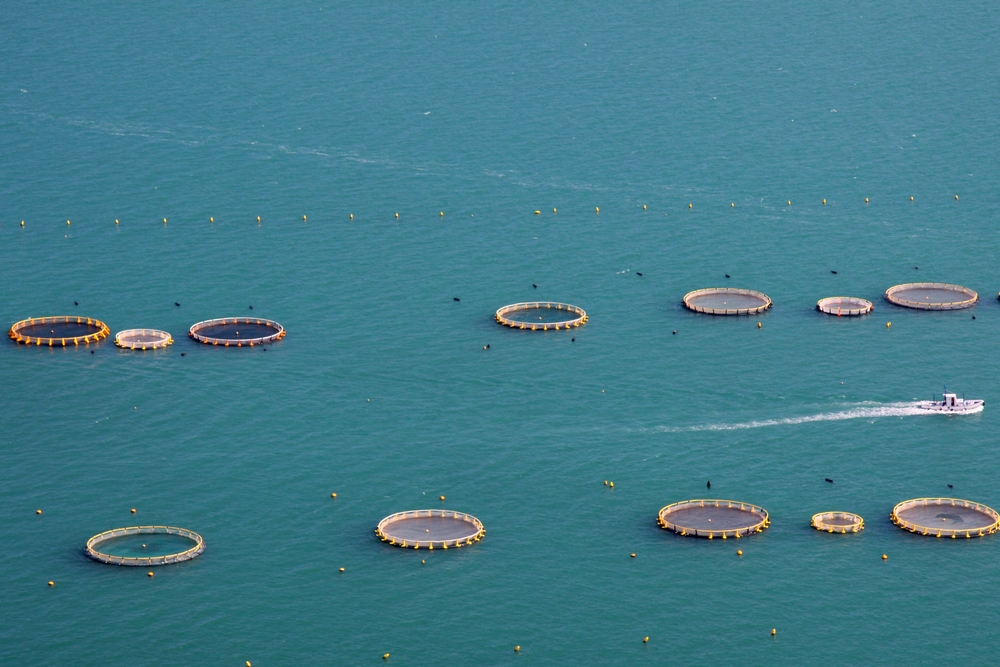
Aquaculture, or fish farming at sea and in land based ponds, has been practiced successfully by Israelis for many years. While most fish farming produces freshwater fish like carp, tilapia and trout in fresh water ponds, salt water aquaculture has also been “successfully” practiced in the Mediterranean Sea.
A new study looks at what happened to the Red Sea marine environment when fish cages were moved to the Mediterranean Sea.
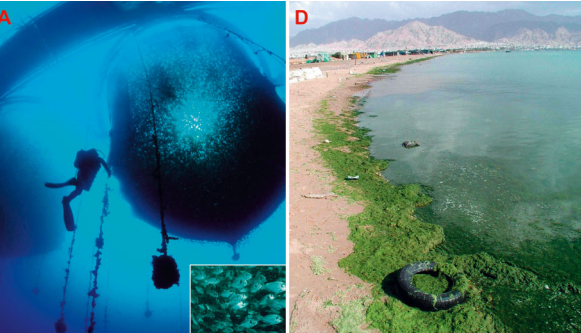
The ecological viability of raising sea bream in underwater fish cages in the Gulf of Aqaba-Eilat at the Red Sea has been a controversial one that ended in the fish farms being removed and relocated to the Mediterranean in 2008.
The Eilat fish farms were located offshore there for more than 20 years, and their removal came after they caused severe damage to natural marine life in the areas where the fish cages had been placed. See the photo above.
In order to determine the long-lasting affects of the Eilat fish farms studies were made by research teams led by Dror Angel, a marine researcher at the Leon H. Charney School of Marine Sciences at the University of Haifa.
In an interview with Green Prophet, Beverly Goodman, a marine life researcher who also lectures at the Leon Charney School of marine Sciences, gave Green Prophet an indication of what has happened to the Red Sea region after the fish cages were removed in 2008.
One of the research project’s tasks involved taking core sediment samples of the sea bed directly underneath the areas where the fish cages were located.
On the subject of “nutrification” from excrement and fish food from the farm the having a greater impact on the marine environment, she said that the presence of the cages was “causing significant changes to the marine environment in the Gulf of Aqaba-Eilat. A marine biology agreement for a monitoring program with data just didn’t exist for two decades while the fish cages were in place,” says Goodman, an underwater archeologist and climate change specialist for the marine environment.
The marine environment of the area where the fish cages had been for so long has been monitored for the past several years since the cages were removed.
The initial studies in which Goodman was involved (she came to Eilat after the decision was been made to relocate the fish farms to Ashdod, she says: “very few life forms were found where the cages had been.”
Initial sediment samples from the fish cage areas found that the sea bottom was “dead” with little life remaining. What life forms there were, were “hanging from above the seabed,” she tells us.
Later studies found that marine life has slowly returned to the area; including species of sea grasses that are important to a number of marine life species. The studies are trying to determine if the area will eventually return to what it was prior to the introduction of the fish farms.
A national monitoring program concluded that a “positive recovery trend” was being made in the area of the fish cages.
Another factor affecting marine life in the Gulf of Aqaba-Eilat was the dumping of raw sewage into the sea, which occurred regularly until the 1990s.
As for the fish farms now located in the Mediterranean near Ashdod Port, Beverly Goodman told Green Prophet that the Mediterranean marine environment is much different as it is a larger body of water with various currents not found in the Gulf of Aqaba-Eilat.
There are also additional environmental factors though, including pollution from Ashdod Port and pollution from very polluted nearby streams that flow into the Mediterranean. She added that as far as she knows, no studies have yet been made on the situation concerning the fish farms near Ashdod.
“We simply need more information on these new fish farms,” she says.
More on fish farming issues affecting Israel and Palestinian Gaza:
Aquaponics is Farming With a Fishing Rod in Israel
Israel eases Distane Limit for Gaza Fishermen; But Need for Fish Farming is Evident
Eilat Fish Cages; Out of the Frying Pan and Into Ashdod Harbor
Fish farming in Eilat by Prof. Yosi Loya; fish cages at sea from Shutterstock




[…] In 2008 Israel relocated its Eilat fish farms to the Mediterranean port of Ashdod to prevent further damage to the Red Sea ecology. Studies have now shown that previously endangered Eilat marine species have recovered and no adverse affects have been reported regarding the Ashdod environment. http://www.greenprophet.com/2014/02/moving-red-sea-fish-farm-cages-shows-positive-eco-results-new-st… […]
Interesting. I’m pretty sure the school in Haifa was funded by Leon Recanati, not Leon Charney.