
Tonight marks the end of the Jewish holiday Tu B’Shevat. The Jewish New Year of the trees. Here is an enlightening article on the spiritual customs surrounding this ecological, Jewish holiday.
Growing up in the Midwest, our Hebrew School celebrated Tu B’shevat (The New Year for the Trees) as a minor holiday. We collected money for the Jewish National Fund to plant trees in Israel and munched on some carob pods and dried pineapple.
I immigrated to Israel in 1983 and soon afterward I moved to Tzfat where Tu B’Shevat is serious business. My Hassidic and Sepharadi neighbors spend a good amount of time planning for the holiday and spend a good amount of money stocking up on every possible type of fresh and dried fruit, nut and wine so that they can create a Tu B’Shevat Seder that comes as close to the Kabbalistic tradition as possible.
Origins of Tu B’shevat
The origins of Tu B’shevat derive from the Talmud where the Rabbis wrote that there are four new year celebrations in the Jewish year. The 15th of the month of Shvat is the New Year of the trees. The day relates to the Biblical mitzvoth of ma’aser (tithing), orlah (refraining from picking a tree’s fruit for the first 3 years) and shmitta (Sabbatical year). For purposes of determining the start and end dates of each year’s agricultural cycle for trees Tu B’Shevat was set as the end of the previous year and the beginning of the new year.
According to the Shulhan Aruch (Code of Jewish Law — written in Safed) fasting and eulogies are forbidden and all penitential prayers are omitted on Tu B’shevat. It’s seen as a day of great joy and is a time to thank God for all of His goodness.
Tu B’shevat, Kabbalah and Safed
Rabbi Isaac Luria — the Ari — lived in Safed between the years 1570 – 1573. The Ari instituted many different Jewish traditions which many Jews, particularly Hassidim and Sepharadim, continue to observe. These include the customs of cutting a little boy’s hair fir the first time when the child turns three, studying all night on Shavouth and the Tu B’Shevat Seder.
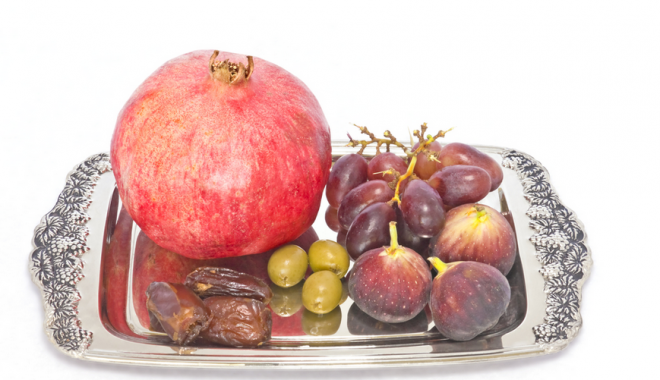
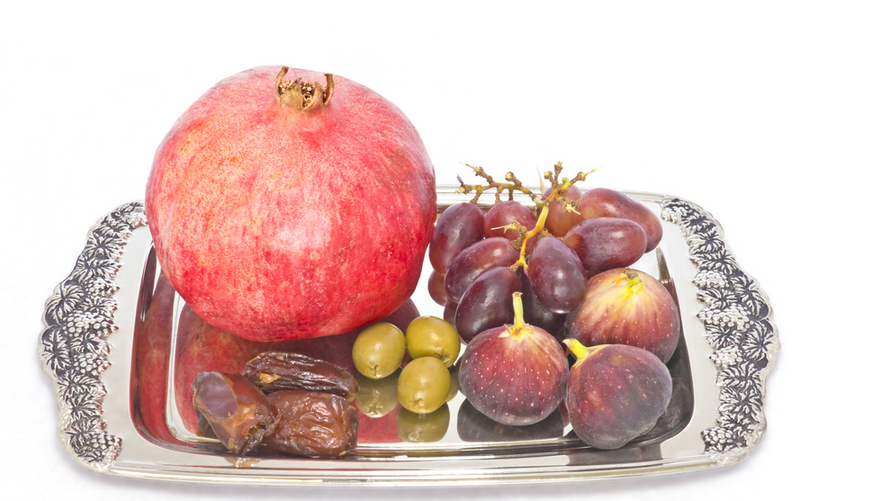
The Ari established a Seder — Order — in which participants eat specific produce in a particular order as they read appropriate mystical passages. The Ari’s Seder was recorded by one of his students in the Pri Etz Hadar booklet. His Seder involved twelve fruits which correspond to the permutations of G-d’s four-letter name, along with related verses from the Zohar. These first 12 “fruits” include wheat (the only one of the 12 for which the blessing is “blessed is the fruit of the earth” instead of “blessed is the fruit of the trees”), olives, dates, grapes, figs, pomegranates, citrons/etrogim, apples, walnuts, almonds, carobs and pears.
Explanations of the customs
One of the Ari’s students, Rabbi Chaim Vital, wrote that there are 30 fruits which parallel the ten sefirot. Fruits which are wholly edible (those with no pits or hard cores, skins which can be cooked) manifest in the world of Beriah, one of the four spiritual worlds. Fruits which can be wholly eaten except for a pit relate to the spiritual world of Yetzirah, which is a lesser level of purity. Fruits which are enclosed in a totally inedible, protective shell (almonds, walnuts) represent the world of Asiyah — our world. In the same way that the Passover Seder involves discussions of each of the symbolic foods, the Tu B’Shevat Seder includes discussions of the kabbalistic concepts that are manifested by each of these different types of fruits.
Discussions during the Tu B’shevat Seder relate to the different tastes, consistencies, colors and cultivation needs of each fruit.
Finally, as in the Pesach Seder, the Tu B’shevat Seder involves wine, though for this Seder the wine must be both red and white. The different colors are symbolic as well….the seder begins with white wine which symbolizes winter, dormancy and hibernation. The second cup is mostly white wine with a bit of red, symbolizing the new life force — spring — which is beginning to appear. The third cup is mostly red with a residue of some white wine and the fourth cup, symbolizing the emergence of spring, is a cup of red wine.
Laurie Rappeport lives in Safed, Israel. She teaches about Judaism and Israel for an online education concern and researches American Jewish music traditions, including traditions of the Tu B’Shevat holiday, for the Milken Archives.
Image of Tu B’Shevat plate from Shutterstock