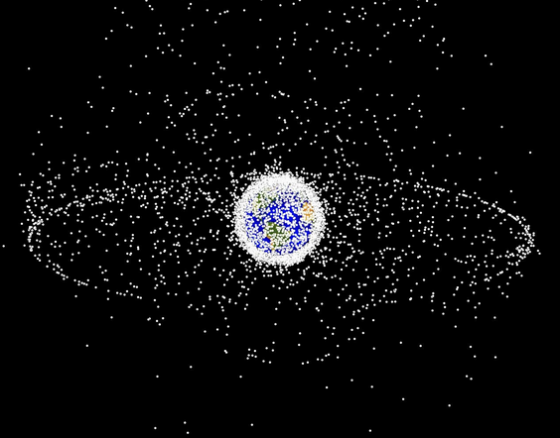
Polluting the Final Frontier With Space Junk

space junk debrisWith space labs, astronaut gloves and even a toothbrush floating in space, is there no limits to where we’ve flung our junk?

Thirty-four years ago the charred remains of a spaceship fell to earth. The spaceship was named Skylab and it was the last orbiting remnant of NASA’s grandiose Apollo era when Saturn V moon rockets with twenty-five times the cargo capacity of the space shuttle lifted humans 240,000 miles to the moon, one thousand times higher than the orbit of the International Space Station (ISS).

Skylab was a recycled spaceship. It was made from an empty Saturn V fuel tank decorated with solar panels and furniture. One solar panel and a heat-shield fell off during launch, forcing astronauts to jury-rig a parasol based on $12.95 fishing poles and a parachute canopy.

Skylab was massive, at launch it was already nearly as big as the fully completed International Space Station. No one wanted this house-sized spaceship to crash. It was supposed to be boosted into a higher orbit by NASA’s newly invented space shuttle. But when the space shuttle was delayed, Skylab’s orbit gradually decayed until it crashed in 1979.

Russia entered the litterbug space race the previous year when its COSMOS 954 nuclear-powered spy satellite fell from the sky and spread highly radioactive uranium across hundreds of thousands of square miles of western Canada.
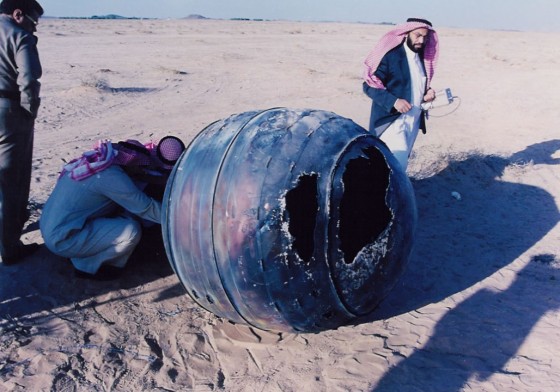
space junk lands in the middle east
Space junk found in the Middle East, in Saudi Arabia

Space Junk Cost and Liability
Under international agreement, space-faring countries are liable for the damage caused by their junk and debris so Canada sent the bill for the $6 billion radioactive clean-up to the Soviets who eventually paid a fraction of that amount. NASA never paid the $500 littering fine imposed by the remote Australian shire where Skylab landed.

China enters the space junk race
China was a latecomer to the space junk race but it made up for lost time when it deliberately crashed a kill satellite into its Fengyun weather satellite in 2007. This collision created an estimated 150,000 fragments of hypersonic shrapnel which expanded to fill thousands of cubic miles. The satellite was in a particularly high orbit where its fragments will threaten space travel for centuries. Shards are already known to have passed near the International Space Station and one piece destroyed a Russian satellite in January 2013. When Canadian astronaut Chris Hadfield photographed what looked like a bullet hole in one of the International Space Station’s solar panels he said it was caused by a small stone from space. But it’s far more likely to have been caused by man-made litter from earth.

Peeing in our water bowl
The pattern of human pollution is all too predictable. Our middens become mountains. Earth’s landscapes, lakes, rivers and oceans become our dumps. Like a mad dog we pee in our own bowl and only notice a problem when civilization’s belly begins to ache from the stench. Humans eventually polluted earth’s seven great continents, its atmosphere and its oceans. So it shouldn’t surprise anyone that we’re beginning to fill space with trash.

Space is big but…
Space is big, but the amount of space in useful earth orbits is relatively small. Astronauts typically orbit at altitudes between 150 and 300 miles above sea level, no more than the distance between Alexandria, Egypt and Paphos, Cyprus. Geosynchronous communications and weather satellites must all orbit the earth at the same altitude, 22236 miles above sea level. So unless we’re very careful, space will eventually be so full that each collision with orbiting debris will create more orbiting debris.

The resulting chain-reaction is known as Kessler’s syndrome and is a plot complication in the newly released film Gravity. The resulting ring of debris may be beautiful but it could make space travel too risky and set back the advances in space technology since 1959. Imagine a world without satellite TV, GPS navigation, satellite weather forecasts and the Internet.

What can be done to remove space junk?
There are strategies for reducing the dangers of space junk but the the first order of business is tracking it. America’s NORAD is one of the agencies tasked with this space traffic control.

People at NORAD keep track of thousands of orbiting objects including everything from rocket fuel tanks to an astronaut’s lost glove and toothbrush. The ESA, NASA and other space agencies have collaborated on strategies for space junk mitigation. Russia’s COSMOS 954 used one of these strategies. It was designed to eject its nuclear reactor core into a higher “graveyard” orbit, but that strategy failed. The Mir space station outlived the Soviet empire that launched it but a controlled de-orbit in the spring of 2001 burned up as much as possible and dropped the remainder into a remote part of the South Pacific.

We don’t yet have a solution for removing smaller items but engineers have suggested everything from sailing space robots to aerogels and lasers. It’s clearly an environmental problem we will have to deal with very soon.

Update 2020: orbital sustainability happening thanks to Astroscale.

Public domain images of Skylab, orbiting objects, and space debris in Saudi Arabia via NASA.

Brian Nitz
Brian Nitzhttp://www.greenprophet.com
Brian remembers when a single tear dredged up a nation's guilt. The tear belonged to an Italian-American actor known as Iron-Eyes Cody, the guilt was displaced from centuries of Native American mistreatment and redirected into a new environmental awareness. A 10-year-old Brian wondered, 'What are they... No, what are we doing to this country?' From a family of engineers, farmers and tinkerers Brian's father was a physics teacher. He remembers the day his father drove up to watch a coal power plant's new scrubbers turn smoke from dirty grey-back to steamy white. Surely technology would solve every problem. But then he noticed that breathing was difficult when the wind blew a certain way. While sailing, he often saw a yellow-brown line on the horizon. The stars were beginning to disappear. Gas mileage peaked when Reagan was still president. Solar panels installed in the 1970s were torn from roofs as they were no longer cost-effective to maintain. Racism, public policy and low oil prices transformed suburban life and cities began to sprawl out and absorb farmland. Brian only began to understand the root causes of "doughnut cities" when he moved to Ireland in 2001 and watched history repeat itself. Brian doesn't think environmentalism is 'rocket science', but understanding how to apply it within a society requires wisdom and education. In his travels through Europe, North America, Asia and the Middle East, Brian has learned that great ideas come from everywhere and that sharing mistakes is just as important as sharing ideas.
1 COMMENT
  1. This is another powerful reason to immediately begin safely recycling 100% of our human-generated waste materials, and to peacefully reduce our human population with family planning programs.

LEAVE A REPLY

Please enter your comment!
Please enter your name here

TRENDING

Jeff Bezos’ climate change satellite goes dark, becomes space junk

MethaneSAT’s development marked a shift in how environmental data is collected and shared. Unlike many state-run satellites whose data is restricted or delayed, MethaneSAT was created to provide rapid, open-access emissions data to encourage faster policy responses and regulatory action.

SpaceX and SETI Partner to Protect Alien-Hunting Telescopes—But What About the Rest of the Sky?

SpaceX has taken steps to address concerns, including darker satellite coatings and directional signal shielding. But critics argue that without enforceable global standards, voluntary measures may not go far enough. Meanwhile, scientists at SETI and other institutions continue developing tools to protect the last wild frontier: the cosmic spectrum.

As Planes Go Green, Is Sustainable Space Fuel Next?

Meanwhile, Singapore’s GenZero, in partnership with the World Economic Forum, has launched the Green Fuel Forward Initiative, aiming to scale SAF across the Asia-Pacific region. This initiative unites airlines, aerospace manufacturers, and financiers to create a self-sustaining SAF market—one that can meet the demand of one of the world’s fastest-growing aviation hubs.

China and Russia to build nuclear powered base for first Moonians

The deployment of a nuclear power plant on the Moon raises questions about the legal frameworks governing space activities. The 1967 Outer Space Treaty, signed by over 100 countries including China, Russia, and the United States, stipulates that celestial bodies are not subject to national appropriation and must be used exclusively for peaceful purposes.

Climate change will reduce the number of satellites that can safely orbit in space

MIT aerospace engineers have discovered that rising greenhouse gas emissions are altering the near-Earth space environment in ways that will gradually reduce the number of satellites that can safely operate in this region.

Qatar’s climate hypocrisy rides the London Underground

Qatar remains a master of doublethink—burning gas by the megaton while selling “sustainability” to a world desperate for clean air. Wake up from your slumber people.

How Quality of Hire Shapes Modern Recruitment

A 2024 survey by Deloitte found that 76% of talent leaders now consider long-term retention and workforce contribution among their most important hiring success metrics—far surpassing time-to-fill or cost-per-hire. As the expectations for new hires deepen, companies must also confront the inherent challenges in redefining and accurately measuring hiring quality.

8 Team-Building Exercises to Start the Week Off 

Team building to change the world! The best renewable energy companies are ones that function.

Thank you, LinkedIn — and what your Jobs on the Rise report means for sustainable careers

While “green jobs” aren’t always labeled as such, many of the fastest-growing roles are directly enabling the energy transition, climate resilience, and lower-carbon systems: Number one on their list is Artificial Intelligence engineers. But what does that mean? Vibe coding Claude? 

Somali pirates steal oil tankers

The pirates often stage their heists out of Somalia, a lawless country, with a weak central government that is grappling with a violent Islamist insurgency. Using speedboats that swarm the targets, the machine-gun-toting pirates take control of merchant ships and then hold the vessels, crew and cargo for ransom.

Leopoldo Alejandro Betancourt López Turned Ocean Plastic Into Profitable Sunglasses

Few fashion accessories carry the environmental burden of sunglasses. Most frames are constructed from petroleum-based plastics and acrylic polymers that linger in landfills for centuries, shedding microplastics into soil and waterways long after they've been discarded. Leopoldo Alejandro Betancourt López, president of the Spanish eyewear brand Hawkers, saw this problem differently than most industry executives.

Why Dr. Tony Jacob Sees Texas Business Egos as Warning Signs

Everything's bigger in Texas. Except business egos.  Dr. Tony Jacob figured...

Israel and America Sign Renewable Energy Cooperation Deal

Other announcements made at the conference include the Timna Renewable Energy Park, which will be a center for R&D, and the AORA Solar Thermal Module at Kibbutz Samar, the world's first commercial hybrid solar gas-turbine power plant that is already nearing completion. Solel Solar Systems announced it was beginning construction of a 50 MW solar field in Lebrija, Spain, and Brightsource Energy made a pre-conference announcement that it had inked the world's largest solar deal to date with Southern California Edison (SCE).

Related Articles

Popular Categories