Mare Nostrum to Save the Mediterranean Sea from Coastline Development

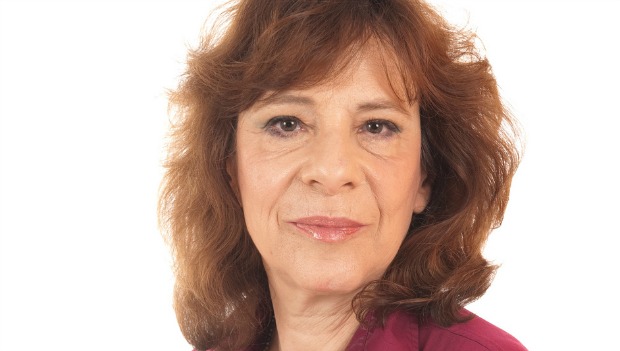
rachelle alterman, Mare Nostrum
Over the millennia, the Mediterranean Sea has become much more than a transport hub for empires that control the region: It links nations, feeds countries, and its shores hold some of the world’s most expensive real estate and natural beauty. Now, Israeli legal eagle Prof. Rachelle Alterman plans to take marine policy and swiftly turn it into on-the-ground results.

Keeping human development in check along the Mediterranean isn’t only a goal for environmentalists, she says. Already back in 2004 the United Nations penned directives and policies on how coastal development in the Med region should look. And most of the countries in the region signed on.

An urban land-use and policy expert at the Technion-Israel Institute of Technology, Alterman initiated Mare Nostrum, a new project that will unite 11 Mediterranean countries and stakeholders in finding ways to better enforce shoreline development regulations.

Back in Roman times, the Mediterranean was nicknamed Mare Nostrum, Latin for “Our Sea.” And indeed the Romans celebrated it as their own by building amphitheatres on its shores to provide entertainment venues for the empire’s port cities, which stretched as far as Israel and Egypt.

The Israeli Mare Nostrum project will link modern partners with modern needs and problems. It will serve as a legal bridge between all the Mediterranean nations, starting first with a handful of partners. Mare Nostrum has been awarded a grant of €4.3 million and will take place over three years.

She ‘sells’ seashore laws

“My idea was unique in the field, and rather than offering to look again at what should be the best laws of how to manage the coastlines,” Alterman tells ISRAEL21c, “the devil is in the details and the problem is getting the [existing] laws implemented.”

The legally binding treaty that most of the Mediterranean countries signed is called the Integrated Coastal Zone Management Protocol of the Barcelona Convention. Among its directives is that development should be set back 100 meters from shore. The EU now wants full enforcement and coordination between ministerial offices and databanks.

However, “the distance between lofty declarations and what’s on the ground gets messy. There are major disparities between countries in the Med,” says Alterman.

“My strategy is to look from the bottom up rather than the top down,” she says. “I am not looking at the best practices, but the baseline practices. We’ll look at the lowest baseline for each country and inch it up a bit, notch by notch from the bottom.”

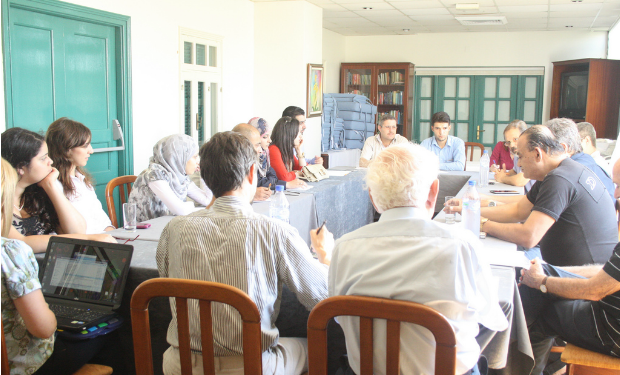
Some 30 partners and advisers from countries including Greece, Malta, Italy, Jordan, Germany, Turkey and Spain met in Haifa recently to determine the biggest issues facing “their sea,” ascertaining that uncontrolled development is the biggest problem for coastline protection.

Haifa is a beautiful port city north of Tel Aviv but it has been polluted from tankers and industry on its shores. This city, as well as several others in the Med region including Kavala, Greece, will be case studies for how Alterman’s modern-day Mare Nostrum will be put into action.

Alterman tells ISRAEL21c that she plans with her partners to build a toolbox to help local enforcement agencies do their job, but also help them find a middle ground with property owners who want to build on the coast, or with those who have done so already. Compensation could be part of the middle ground, she says.
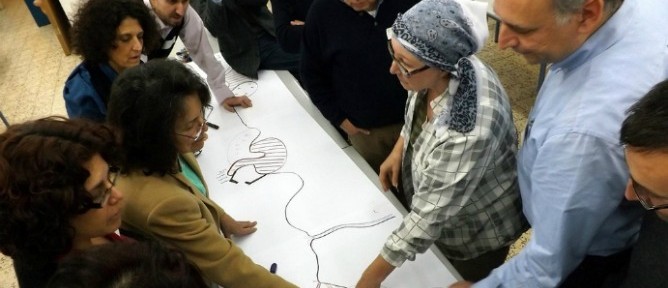
mare nostrum participants
Mare Nostrum meeting participants

She says it’s necessary and meaningful for Mare Nostrum leaders to engage the public and local NGOs by creating an activist spirit. Using mapping technologies like GIS (geographic information system), they can show physical sites of uncontrolled development, and the pristine areas that need to be saved for the future. With maps and coordinates in hand, and knowing what’s at stake, local groups and individuals can better petition to save their coastlines.

Israel has one of the densest countries in the region and offers only 2.5 centimeters of coastline per citizen. This is one reason why the country was a very early adopter and implementer of coastline development laws well before the UN created its regional protocol in 2004. Israel’s laws are pretty well developed, and except for France perhaps, quite possibly the most developed in the Med region, says Alterman, who is considered a world expert in her field.

Over the next three years, Mare Nostrum partners will assess progress in several case-study cities. These results will be brought to the table in another few years to see if Mare Nostrum will indeed be a successful vehicle for saving Our Sea.

This is reprinted from ISRAEL21c – www.israel21c.org

Karin Kloosterman
Karin Kloostermanhttp://www.greenprophet.com
Karin Kloosterman is an award-winning journalist, innovation strategist, and founder of Green Prophet, one of the Middle East’s pioneering sustainability platforms. She has ranked in the Top 10 of Verizon innovation competitions, participated in NASA-linked challenges, and spoken worldwide on climate, food security, and future resilience. With an IoT technology patent, features in Canada’s National Post, and leadership inside teams building next-generation agricultural and planetary systems — including Mars-farming concepts — Karin operates at the intersection of storytelling, science, and systems change. She doesn’t report on the future – she helps design it. Reach out directly to [email protected]
1 COMMENT

LEAVE A REPLY

Please enter your comment!
Please enter your name here

TRENDING

Earth building with Dead Sea salt bricks

Researchers develop a brick made largely from recycled Dead Sea salt—offering a potential alternative to carbon-intensive cement.

Farm To Table Israel Connects People To The Land

Farm To Table Israel is transforming the traditional dining experience into a hands-on journey.

Remilk makes cloned milk so cows don’t need to suffer and it’s hormone-free

This week, Israel’s precision-fermentation milk from Remilk is finally appearing on supermarket shelves. Staff members have been posting photos in Hebrew, smiling, tasting, and clearly enjoying the moment — not because it’s science fiction, but because it tastes like the real thing.

An Army of Healers Wins the 2025 IIE Goldberg Prize for Peace in the Middle East

In a region more accustomed to headlines of loss than of listening, the Institute of International Education (IIE) has chosen to honor something quietly radical: healing. The 2025 Victor J. Goldberg Prize for Peace in the Middle East has been awarded to Nitsan Joy Gordon and Jawdat Lajon Kasab, the co-founders of the Army of Healers, for building spaces where Israelis and Palestinians — Jews, Muslims, Christians, Druze, and Bedouins — can grieve, speak, and rebuild trust together.

Peace hospital opens between Jordan and Israel

The proposed medical centre, described by Emek HaMaayanot Regional Council head Itamar Matiash as “a centre for cancer treatment, so that people from Jordan or further away could come and receive treatment,” would become the flagship of a wider cluster of medical, academic and innovation-based services planned for the Israeli half of the zone.

Qatar’s climate hypocrisy rides the London Underground

Qatar remains a master of doublethink—burning gas by the megaton while selling “sustainability” to a world desperate for clean air. Wake up from your slumber people.

How Quality of Hire Shapes Modern Recruitment

A 2024 survey by Deloitte found that 76% of talent leaders now consider long-term retention and workforce contribution among their most important hiring success metrics—far surpassing time-to-fill or cost-per-hire. As the expectations for new hires deepen, companies must also confront the inherent challenges in redefining and accurately measuring hiring quality.

8 Team-Building Exercises to Start the Week Off 

Team building to change the world! The best renewable energy companies are ones that function.

Thank you, LinkedIn — and what your Jobs on the Rise report means for sustainable careers

While “green jobs” aren’t always labeled as such, many of the fastest-growing roles are directly enabling the energy transition, climate resilience, and lower-carbon systems: Number one on their list is Artificial Intelligence engineers. But what does that mean? Vibe coding Claude? 

Somali pirates steal oil tankers

The pirates often stage their heists out of Somalia, a lawless country, with a weak central government that is grappling with a violent Islamist insurgency. Using speedboats that swarm the targets, the machine-gun-toting pirates take control of merchant ships and then hold the vessels, crew and cargo for ransom.

Leopoldo Alejandro Betancourt López Turned Ocean Plastic Into Profitable Sunglasses

Few fashion accessories carry the environmental burden of sunglasses. Most frames are constructed from petroleum-based plastics and acrylic polymers that linger in landfills for centuries, shedding microplastics into soil and waterways long after they've been discarded. Leopoldo Alejandro Betancourt López, president of the Spanish eyewear brand Hawkers, saw this problem differently than most industry executives.

Why Dr. Tony Jacob Sees Texas Business Egos as Warning Signs

Everything's bigger in Texas. Except business egos.  Dr. Tony Jacob figured...

Israel and America Sign Renewable Energy Cooperation Deal

Other announcements made at the conference include the Timna Renewable Energy Park, which will be a center for R&D, and the AORA Solar Thermal Module at Kibbutz Samar, the world's first commercial hybrid solar gas-turbine power plant that is already nearing completion. Solel Solar Systems announced it was beginning construction of a 50 MW solar field in Lebrija, Spain, and Brightsource Energy made a pre-conference announcement that it had inked the world's largest solar deal to date with Southern California Edison (SCE).

Related Articles

Popular Categories