
 Who’s got the wind in the Middle East? Morocco and Egypt have the biggest wind power plants, but don’t discount Iraq, Qatar, Saudi Arabia and the United Arab Emirates.
Wind power has taken a backseat to solar power across the Middle East and North Africa, but there are still some ambitious projects in wind power being undertaken across the region. Leading that charge is Egypt and Morocco, who have continued to push forward on alternative energy despite facing political turmoil in their respective countries. But don’t count out Iraq, Qatar, Saudi Arabia and the United Arab Emirates, who are all currently looking to develop wind energy.
Adapting a sophisticated climate model, researchers show that there is plenty of wind available to supply half to several times the world’s total energy needs within the next two decades. If the world is to shift to clean energy, electricity generated by the wind will play a major role, and there is more than enough wind for that, according to research from Stanford and the University of Delaware.
The Middle East North Africa region has been instrumental in the push for solar power, but wind projects are finally beginning to take form, or in development across what we call the MENA region. Two of the largest wind farms in the world are in the region, in Morocco and Egypt.
Morocco’s Tarfaya Wind Farm
Morocco’s state utility Office National d’Electricite (ONE) awarded a $350 million, 20-year PPA contract for the 300 MW Tarfaya wind power plant to a consortium consisting of the local firm Nareva and the UAE-based Karabel Fez/International Power (a subsidiary of GDF Suez Energy International) and International Power from the UK after months of haggling over the details.
The plant, which will be financed by Attijariwafa Bank, Banque Marocaine du Commerce Extérieur (BMCE) and France’s Banque Populaire, will be built astride the Atlantic ocean in southern Morocco.
It is said to be the largest such plant on the African continent.
Egypt’s Zaafarana and Elsewedy Towers
Touted as the largest wind turbine towers site in the MENA region, Egypt hopes that this project will help generate a massive amount of electricity to the country. According to reports, it is strategically located near Ain Sokhna on the Red Sea, which will allow it easy transportation to the Zaafarana farm a few kilometers to the south, and to the Suez Canal for global exportation to the MENA region, Europe and the United States.
At its location are 700 wind turbines that produce a total capacity of 550 megawatts (MW). It is still yet to be fully operational, but the government hopes to boost capacity in the near future.
Wind at the Red Sea
The Red Sea has the ability to be transformed by Egypt, Israel, Jordan and Saudi Arabia and over the past two years, this is finally becoming reality. Egypt is leading that charge, as seen with the Zaafarana and Elsewedy projects. But in the past few months, Saudi officials have said they are looking to take advantage of the Red Sea coastal areas in establishing potential wind farms to help boost renewable energy output.
Of note:
Iraq has announced that it is to put forward $1.6 billion in the next three years aimed at establishing an alternative energy sector, of which a large portion will be in the wind turbine sector.
Also aiming to enter the wind industry is Saudi Arabia, which has in recent months named five areas as targets for future wind turbine farms, which the government hopes to unveil and begin work on the projects next year.
While wind is still in the works as countries look to solar power as the number one renewable source of energy and electricity, as we have seen in the UAE, Saudi Arabia, Qatar and Iraq, wind power is finally becoming a focal point of energy strategies. This may take some time, but all countries in the region seem keen on developing this sector.
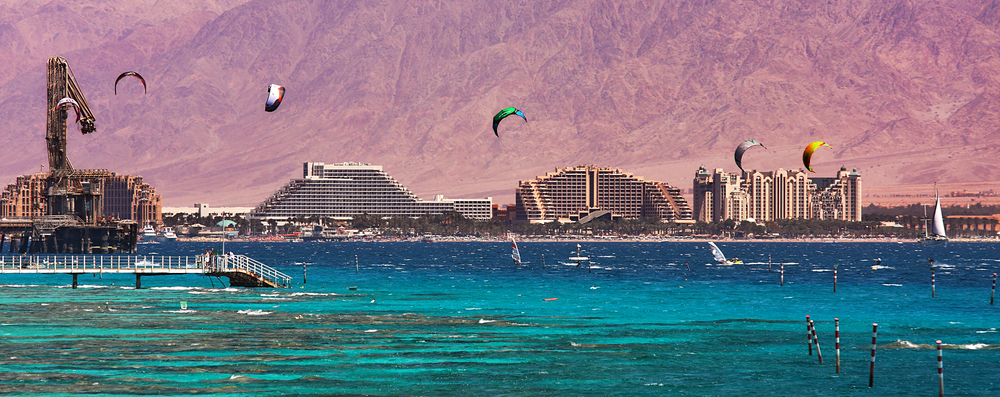
Image of kite surfing on the Red Sea from Shutterstock