Israel’s Separation Barrier Could Disrupt Ancient Way of Farming Since Roman Times

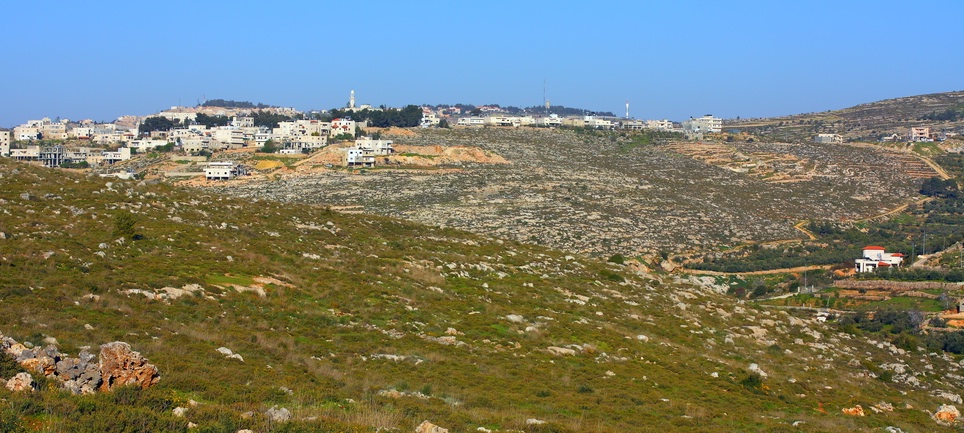
Battir on hill above Wadi el-Jundi

Water from natural springs burbles in the ancient Roman stone aqueduct as it carries water downward to this village’s ancient terraces. Palestinian families grow olives, cabbage and eggplant today the same way they did more than 2,000 years ago.

“Each family here gets water one day a week, but the week lasts eight days since there are eight families,” Kayan Manasra, the Palestinian Coordinator of Friends of the Earth Middle East (FOEME), a joint Israeli-Palestinian-Jordanian NGO, told The Media Line. “There are 13 springs and seven are still in use. We farm here the same way we are doing for thousands of years.”

Battir, with its 6,000 residents is in Area B of the West Bank, meaning that Palestinians provide municipal services such as garbage pickup but Israel is responsible for security.

Most crops are grown on terraces — small plots surrounded by stone walls on the slopes of the hill. Conservationists say the farming methods are the same as those used in ancient times. Residents here are hoping that the World Heritage Committee of the United Nations Educational, Scientific and Cultural Organization (UNESCO) will designate the village a World Heritage Site. Earlier this year, UNESCO gave Battir the Melina Mercouri International Prize for the Safeguarding and Management of Cultural Landscapes.

Battir also has a Jewish connection. Once a Jewish village, it was the site of the defeat of a Jewish revolt against the Romans led by Bar Kokhba in the Second Century. Archaeological artifacts show the site was inhabited since the Iron Age. Today, some 4,000 residents live mostly by farming.

Now, they fear that Israel is about to construct the barrier it is building in and around the West Bank right through the village lands, which some fear could end this way of farming.

“The barrier will disconnect part of the farming lands from their owners and disturb the landscape,” Gilat Bartana of FOEME, told The Media Line. “An appeal against the barrier was rejected so building could start anytime soon.”

Building the barrier has already begun in the neighboring village of Wallaje. The Israeli Supreme Court rejected several appeals and the planned route of the barrier will completely surround the village. Omar Hajableh, 47, told The Media Line that the barrier will run very close to his house on the outskirts of the village. He says he will not be able to reach his 450 olive trees.

“It will be a prison here,” he says angrily. “The Israelis want me to leave my land but I refuse to. They say it’s for security – what security do they need here?”

He said that in the past ten years there has been one terror attack in the area. Hajableh also said that Israeli officials told him would build a special agricultural gate in the barrier to enable him to reach his farmland. Hajableh says this is not a solution.

“They said I can cross in twice a year to farm my land,” he said. “I work alone. I can’t take care of even one tree, let alone 450. They are simply trying to find a way to take the land.”

Israeli officials defend the route of the separation barrier, which Israel calls a “security fence” and Palestinians an “apartheid wall.” In a statement, the Defense Ministry said the route of the barrier is based only on security considerations and Israel tries to minimize the damage to the Palestinians. They say the numbers speak for itself, that the construction of the barrier has made a major contribution to Israel’s security, and that Palestinian attackers have not been able to enter Israel since it was erected. The barrier costs an estimated $1.4 million dollars per mile to build. Some 90 percent of it is a fence with trenches on both sides, while ten percent, in heavily populated areas, is a 26-foot high concrete barricade.

Part of the barrier runs along the so-called “Green Line”, the demarcation line between Israel and the West Bank that was agreed to in the 1949 armistice agreements, but part also dips into the West Bank. The Israeli human rights group B’tselem says the barrier effectively annexes 8.5 percent of the West Bank to Israel, by keeping that land on the Israeli side of the barrier.

Back in Battir, the view from the top of the hill is breathtaking. A donkey ambles by, led by a famer on the way to his plot. Palestinians here say they fear that the Israeli bulldozers will come, and permanently change their way of life.

Image of Battir on a hill from Shutterstock

LEAVE A REPLY

Please enter your comment!
Please enter your name here

TRENDING

Earth building with Dead Sea salt bricks

Researchers develop a brick made largely from recycled Dead Sea salt—offering a potential alternative to carbon-intensive cement.

Farm To Table Israel Connects People To The Land

Farm To Table Israel is transforming the traditional dining experience into a hands-on journey.

Remilk makes cloned milk so cows don’t need to suffer and it’s hormone-free

This week, Israel’s precision-fermentation milk from Remilk is finally appearing on supermarket shelves. Staff members have been posting photos in Hebrew, smiling, tasting, and clearly enjoying the moment — not because it’s science fiction, but because it tastes like the real thing.

An Army of Healers Wins the 2025 IIE Goldberg Prize for Peace in the Middle East

In a region more accustomed to headlines of loss than of listening, the Institute of International Education (IIE) has chosen to honor something quietly radical: healing. The 2025 Victor J. Goldberg Prize for Peace in the Middle East has been awarded to Nitsan Joy Gordon and Jawdat Lajon Kasab, the co-founders of the Army of Healers, for building spaces where Israelis and Palestinians — Jews, Muslims, Christians, Druze, and Bedouins — can grieve, speak, and rebuild trust together.

Peace hospital opens between Jordan and Israel

The proposed medical centre, described by Emek HaMaayanot Regional Council head Itamar Matiash as “a centre for cancer treatment, so that people from Jordan or further away could come and receive treatment,” would become the flagship of a wider cluster of medical, academic and innovation-based services planned for the Israeli half of the zone.

Qatar’s climate hypocrisy rides the London Underground

Qatar remains a master of doublethink—burning gas by the megaton while selling “sustainability” to a world desperate for clean air. Wake up from your slumber people.

How Quality of Hire Shapes Modern Recruitment

A 2024 survey by Deloitte found that 76% of talent leaders now consider long-term retention and workforce contribution among their most important hiring success metrics—far surpassing time-to-fill or cost-per-hire. As the expectations for new hires deepen, companies must also confront the inherent challenges in redefining and accurately measuring hiring quality.

8 Team-Building Exercises to Start the Week Off 

Team building to change the world! The best renewable energy companies are ones that function.

Thank you, LinkedIn — and what your Jobs on the Rise report means for sustainable careers

While “green jobs” aren’t always labeled as such, many of the fastest-growing roles are directly enabling the energy transition, climate resilience, and lower-carbon systems: Number one on their list is Artificial Intelligence engineers. But what does that mean? Vibe coding Claude? 

Somali pirates steal oil tankers

The pirates often stage their heists out of Somalia, a lawless country, with a weak central government that is grappling with a violent Islamist insurgency. Using speedboats that swarm the targets, the machine-gun-toting pirates take control of merchant ships and then hold the vessels, crew and cargo for ransom.

Leopoldo Alejandro Betancourt López Turned Ocean Plastic Into Profitable Sunglasses

Few fashion accessories carry the environmental burden of sunglasses. Most frames are constructed from petroleum-based plastics and acrylic polymers that linger in landfills for centuries, shedding microplastics into soil and waterways long after they've been discarded. Leopoldo Alejandro Betancourt López, president of the Spanish eyewear brand Hawkers, saw this problem differently than most industry executives.

Why Dr. Tony Jacob Sees Texas Business Egos as Warning Signs

Everything's bigger in Texas. Except business egos.  Dr. Tony Jacob figured...

Israel and America Sign Renewable Energy Cooperation Deal

Other announcements made at the conference include the Timna Renewable Energy Park, which will be a center for R&D, and the AORA Solar Thermal Module at Kibbutz Samar, the world's first commercial hybrid solar gas-turbine power plant that is already nearing completion. Solel Solar Systems announced it was beginning construction of a 50 MW solar field in Lebrija, Spain, and Brightsource Energy made a pre-conference announcement that it had inked the world's largest solar deal to date with Southern California Edison (SCE).

Related Articles

Popular Categories