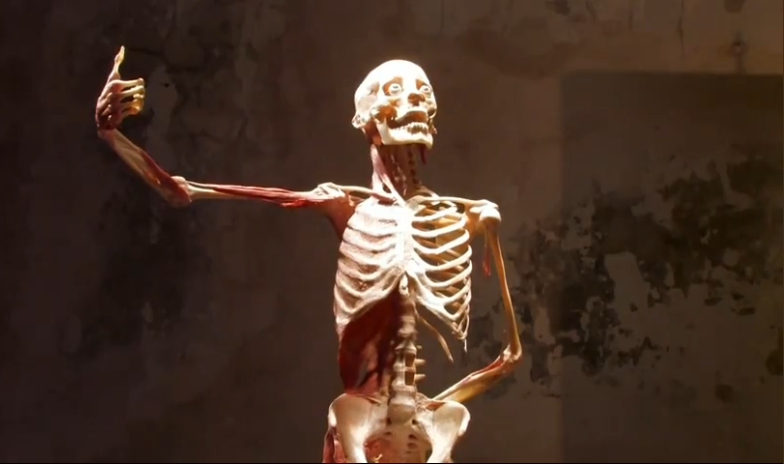

Israel Closes Down Bodies Exhibition Early


Legal, or a human rights violation? The “Bodies” exhibit raised a storm of controversy in Israel.

Israelis are no strangers to making art from live naked humans. Green Prophet’s coverage of Spencer Tunick’s  photo events showing hundreds of social and ecological activists standing nude in the Dead Sea proves that “prudish” doesn’t describe the Israeli public.

But now Israelis are looking at dead Chinese people stripped of most of their flesh and preserved in liquid silicon in the “Bodies” exhibition, now open in Tel Aviv.

Some consider it art. Some consider it educational. And indeed, the exhibit has been presented at major cities worldwide. But because there’s no proof that the people whose bodies are displayed knew or consented to it before death, some consider that the exhibit violates human rights According to Jewish thought, where human remains are treated with careful respect, it is a desecration.

Protests from elements as dissimilar as politicians, the Israel Teacher’s Association, religious groups, private citizens, and the emergency-response organization Zaka began immediately after the exhibit opened its doors in May. Yitzhak Lampert a yeshiva student from Jerusalem and Yehuda Pua, a teacher, led a Facebook campaign to close the exhibit and get the bodies buried.

Lawyer David Schonberg presented a petition demanding closure of “Bodies” to Attorney General Yehuda Weinstein, who responded by recommending closure of “Bodies” to the Supreme Court.

“Taking the body, preserving it, selling and exhibiting it without the consent of the dead, as if it were an object open to anyone’s use was disrespectful to the deceased and to the autonomy of the living,” wrote Weinstein in a letter to the Supreme Court.

Many suspect that the human remains came from tortured and executed prisoners, and in particular, from members of the persecuted Falun Gong sect. Those prisoners of conscience don’t reveal their identities in order to protect their families. When they die, their bodies remain unclaimed. Chinese law allows sale of unclaimed dead for medical or other purposes.

The Bodies Exhibition was produced by Premier Exhibitions, an American company. Its New York show posted a sign saying the human remains were obtained via the Chinese police, and may originally be from Chinese prisons.

Israeli producer Shuki Gur said,

“The statement at the entrance to the exhibition states that we don’t know exactly what the source of the bodies is. I can’t say if they were donated.” He adds, “There is no need to know who they are.”

Israel’s Supreme Court  mandated that the exhibition may run no later than October 9th. The original closing date was October 21st, which makes the decision seem more like a gesture than a step to end the exhibit that fascinates and offends so many.

Knesset (Israeli Parliament) member Dr. Michael Ben Ari said,

“Unfortunately, the high court in the State of the Jewish people, disappointed us badly by making a decision that would be acceptable to everyone. Their closing date is just a few days before the exhibit’s original closing date. [The decision] should say clearly: ‘This Exhibition is an abomination. These bodies must be buried respectfully and these terrible actions of trading people, trading bodies must stop.’”

More on the Middle Eastern way of death and dying:
Can Muslims Be Buried At Sea?
Iran’s Green Zoroastrian Burials


Miriam Kresh
Miriam Kreshhttps://www.greenprophet.com/
Miriam Kresh is an American ex-pat living in Israel. Her love of Middle Eastern food evolved from close friendships with enthusiastic Moroccan, Tunisian and Turkish home cooks. She owns too many cookbooks and is always planning the next meal. Miriam can be reached at miriam (at) greenprophet (dot) com.

TRENDING

Jewish Vegans invite global community to “Compassionate Passover” event

As Passover approaches, a global online gathering is inviting...

Eco organization offices destroyed by Iran missile

Tel Aviv's eco organization, the Heschel Center, was impacted by an Iranian missile.

What are AWG air-water generators, and why they aren’t a golden-bullet solution (yet)

Atmospheric water generators (AWGs) sound like magic: machines that can pull drinking water out of air. The idea is mentioned in the Bible, where the elders would pray for water collected as dew on plants and the catch on turning this into a machine is in the physics. To turn invisible vapor into liquid, you must remove heat, especially the latent heat of condensation.

Jordan’s $6 Billion Aqaba–Amman Desalination Project from the Red Sea Moves Forward

In 2025, the Jordanian government signed agreements with a consortium led by Meridiam and SUEZ, alongside VINCI Construction and Orascom Construction. Under a 30-year concession agreement, the consortium will design, build, finance, operate, and maintain the system before transferring it back to the Jordanian government. The total investment is estimated at approximately $6 billion USD.

The Saudi Startup Turning Desalination’s Toxic Waste Into Its Own Disinfectant

For millennia, the Middle East's water crisis seemed an immutable fact of geography — a region defined as much by what it lacked as by what lay beneath its sands. Today, a convergence of plummeting solar costs, advancing membrane technology, and hard-won engineering expertise is rewriting that story.

Should You Invest in the Private Market?

startustartup Unlike public stock exchanges, which offer daily trading, strict...

How to build a 100-year-company

Kongō Gumi is a Japanese construction company, purportedly founded in 578 A.D., making it the world's oldest documented company. What can we learn about building sustainable businesses from them?

From Pilot Plant to Global Stage: How Aduro Clean Technologies’ 2026 Expansion Signals a Turning Point for Chemical Recycling Investors Like Yazan Al Homsi

The company's Next Generation Process (NGP) Pilot Plant in London, Ontario, has officially moved into initial operating campaigns, generating the kind of structured, repeatable data that separates laboratory promise from commercial viability.

How AI Helps SaaS Companies Reduce Repetitive Customer Support Work

SaaS products are designed for large numbers of users with different levels of experience, and also in renewable energy.

Pulling Water from the Air

Faced with water shortage in Amman, Laurie digs up...

Turning Your Energy Consultancy into an LLC: 4 Legal Steps for Founders in Texas

If you are starting a renewable energy business in Texas, learn how to start an LLC by the books.

Tracking the Impacts of a Hydroelectric Dam Along the Tigris River

For the next two months, I'll be taking a break from my usual Green Prophet posts to report on a transnational environmental issue: the Ilısu Dam currently under construction in Turkey, and the ways it will transform life along the Tigris River.

6 Payment Processors With the Fastest Onboarding for SMBs

Get your SMB up and running fast with these 6 payment processors. Compare the quickest onboarding options to start accepting customer payments without delay.

Related Articles

Popular Categories