
Tel Aviv Bids for Artificial Island International Airport At Sea

tel aviv artificial island airport
Fly into Israel? Land at sea first on this 250 acre platform runway proposed for international flights.

There has been talk for a couple of years already that Tel Aviv’s international airport will move to the sea, literally. A proposal has been submitted to create an artificial island off the city’s coast to replace the Ben Gurion Airport, one that services local, domestic and international flights. A couple months ago I interviewed a geologist helping to develop feasibility studies for such a structure. And according to media reports it looks like the crazy plan is going ahead despite environmental risks to the fragile Mediterranean Sea, and security risks of sabotage.

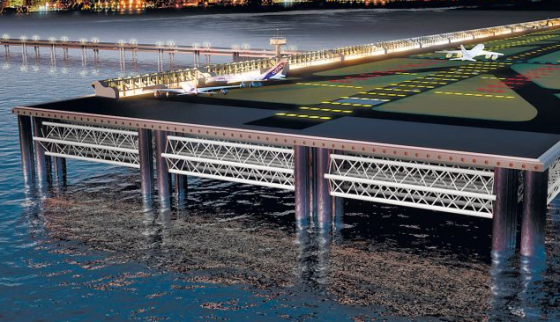
A new committee from the Ministry of Science and Technology in Israel developed a feasibility report for this artificial airport island to be built off the coast of the Tel Aviv suburb Rishon LeZion. Goodovitch Architects have drafted some sketches (above) of how the airport could look.

Among the parties involved in the far-flung idea is Elie Schalit, 92, a chairman and founder of the Colbert Group, which builds giant cruise ships. He was the man who built the first ships for Ted Arison and his Carnival Cruise Lines.

According to Haaretz the plan for the airport would include a large artificial island on top of poles, 15 meters above sea level. Located two kilometers out in the Mediterranean Sea, the 250 acre landing surface would connect to terminals and cargo docks onshore. Passengers would be shuttled to and from the runways by a fast train or by buses traveling along a long pier. The project cost is an estimated NIS 50 billion, about $12 billion USD, and would take more than a decade to build.

Land grab for the rich, at the Sea’s expense?

“Former Tel Aviv municipal engineer Israel Goodovitch, the driving force behind the idea, is not concerned by the inevitable doubts. He makes use of his connections and acquaintances, and rushes through every door, loaded down with data and models of the plan that will he claims, make it possible to shut down Ben-Gurion International Airport altogether and transform its site into lands worth their weight in gold for residential construction in the center of the country.”

Doesn’t anyone see a conflict of interest in that the city engineer is also drafting plans for the airport under his private name?

With the growth of Israel outpacing its space, real estate developers no doubt have their eye on the land surrounding the Ben Gurion Airport in central Israel about 20 minutes from Tel Aviv. The conveniently located airport has become a drag for nearby residents who suffer from airplane emissions and exhaust. Goes to show why you shouldn’t buy your home near an airport and then complain later.

At any rate, this massive artificial island will far exceed the size and scope of the artificial islands in the Persian Gulf – ones that have have severe ramifications for coastal erosion and sea life. Since it will be built on poles, perhaps the environmental effects will be less pronounced than they are in the gulf?

I have to say that after flying in the air for 10 or 12 hours getting to Israel, or any location for that matter, I am happy to land on, well, land. I am not so sure about how I feel landing on an artificial island, especially in a land that has seen its fair share of earthquakes and tsunamis. And terror attacks.

My overall feeling is that this new airport scheme is a bad idea. Want to usurp the valuable land on the not-long ago revamped Tel Aviv airport? Then move it to a periphery and have travellers move about on high speed trains. Or move the people to the periphery. Where to live is all about perceptions. Create a great city and the people will move there. No need to engineer new land at sea.

Karin Kloosterman
Karin Kloostermanhttp://www.greenprophet.com
Karin Kloosterman is an award-winning journalist, innovation strategist, and founder of Green Prophet, one of the Middle East’s pioneering sustainability platforms. She has ranked in the Top 10 of Verizon innovation competitions, participated in NASA-linked challenges, and spoken worldwide on climate, food security, and future resilience. With an IoT technology patent, features in Canada’s National Post, and leadership inside teams building next-generation agricultural and planetary systems — including Mars-farming concepts — Karin operates at the intersection of storytelling, science, and systems change. She doesn’t report on the future – she helps design it. Reach out directly to [email protected]
2 COMMENTS
  1. Re: Tsuamis, sort of. From Wikipedia: ‘Studies of seabed deposits at Caesarea have shown that a tsunami struck the area sometime between the 1st and 2nd centuries CE.[28] Although it is unknown if this tsunami simply damaged or completely destroyed the harbor, it is known that by the 6th century the harbor was unusable.” So maybe there was a mild tsunami, although 1900 years ago… Point taken. Thanks for letting me know about that.

LEAVE A REPLY

Please enter your comment!
Please enter your name here

TRENDING

Earth building with Dead Sea salt bricks

Researchers develop a brick made largely from recycled Dead Sea salt—offering a potential alternative to carbon-intensive cement.

Farm To Table Israel Connects People To The Land

Farm To Table Israel is transforming the traditional dining experience into a hands-on journey.

Remilk makes cloned milk so cows don’t need to suffer and it’s hormone-free

This week, Israel’s precision-fermentation milk from Remilk is finally appearing on supermarket shelves. Staff members have been posting photos in Hebrew, smiling, tasting, and clearly enjoying the moment — not because it’s science fiction, but because it tastes like the real thing.

Quintin Tarantino walks on a bike lane in Tel Aviv

Quentin Tarantino lives in Israel now, quietly blending into Tel Aviv life (which is pretty loud and late night!) — until Tel Aviv, of course, notices him.

An Army of Healers Wins the 2025 IIE Goldberg Prize for Peace in the Middle East

In a region more accustomed to headlines of loss than of listening, the Institute of International Education (IIE) has chosen to honor something quietly radical: healing. The 2025 Victor J. Goldberg Prize for Peace in the Middle East has been awarded to Nitsan Joy Gordon and Jawdat Lajon Kasab, the co-founders of the Army of Healers, for building spaces where Israelis and Palestinians — Jews, Muslims, Christians, Druze, and Bedouins — can grieve, speak, and rebuild trust together.

Qatar’s climate hypocrisy rides the London Underground

Qatar remains a master of doublethink—burning gas by the megaton while selling “sustainability” to a world desperate for clean air. Wake up from your slumber people.

How Quality of Hire Shapes Modern Recruitment

A 2024 survey by Deloitte found that 76% of talent leaders now consider long-term retention and workforce contribution among their most important hiring success metrics—far surpassing time-to-fill or cost-per-hire. As the expectations for new hires deepen, companies must also confront the inherent challenges in redefining and accurately measuring hiring quality.

8 Team-Building Exercises to Start the Week Off 

Team building to change the world! The best renewable energy companies are ones that function.

Thank you, LinkedIn — and what your Jobs on the Rise report means for sustainable careers

While “green jobs” aren’t always labeled as such, many of the fastest-growing roles are directly enabling the energy transition, climate resilience, and lower-carbon systems: Number one on their list is Artificial Intelligence engineers. But what does that mean? Vibe coding Claude? 

Somali pirates steal oil tankers

The pirates often stage their heists out of Somalia, a lawless country, with a weak central government that is grappling with a violent Islamist insurgency. Using speedboats that swarm the targets, the machine-gun-toting pirates take control of merchant ships and then hold the vessels, crew and cargo for ransom.

Leopoldo Alejandro Betancourt López Turned Ocean Plastic Into Profitable Sunglasses

Few fashion accessories carry the environmental burden of sunglasses. Most frames are constructed from petroleum-based plastics and acrylic polymers that linger in landfills for centuries, shedding microplastics into soil and waterways long after they've been discarded. Leopoldo Alejandro Betancourt López, president of the Spanish eyewear brand Hawkers, saw this problem differently than most industry executives.

Why Dr. Tony Jacob Sees Texas Business Egos as Warning Signs

Everything's bigger in Texas. Except business egos.  Dr. Tony Jacob figured...

Israel and America Sign Renewable Energy Cooperation Deal

Other announcements made at the conference include the Timna Renewable Energy Park, which will be a center for R&D, and the AORA Solar Thermal Module at Kibbutz Samar, the world's first commercial hybrid solar gas-turbine power plant that is already nearing completion. Solel Solar Systems announced it was beginning construction of a 50 MW solar field in Lebrija, Spain, and Brightsource Energy made a pre-conference announcement that it had inked the world's largest solar deal to date with Southern California Edison (SCE).

Related Articles

Popular Categories