
Only eight percent of our oceans are “shallow seas” (shallower than 100 feet), but these wildly diverse ecosystems harbor most of the world’s marine life. Egypt, Israel, and Jordan (all connected to the Red Sea) and the Gulf states stand to lose enormous tourism revenue if their natural reefs continue to be destroyed by coastal development. Last year, the Bahraini government commissioned ten artificial reefs to be built in their coastal waters using perforated reef balls and tall structures designed to look like Arab wind towers. Slap on your virtual scuba gear and see what’s happening four months after the first reef was placed.
[youtube]http://youtu.be/3p-NsKNZ8QA[/youtube]
Rapid coastal development left its mark on the integrity of Bahrain‘s marine ecosystems. Intense dredging and land reclamation have decimated complex benthic habitats. Unsustainable and illegal fishing practices aggravate an already stressed subtidal environment; natural storm events and rising sea temperature also play a villain’s role.
To mitigate some of the damage, Bahrain’s experimenting with artificial reefs to enhance those areas with potential for increased productivity. The Public Commission for the Protection of Marine Resources, Environment and Wildlife hired PH Environment Gulf to design, construct, deploy and monitor 2620 reef units in ten strategically located reef sites.
Site selection kicked off last October with a GIS-based mapping exercise, and ten areas underwent intensive field investigations (such as drop-down video, SCUBA diver and fisheries surveys). Three of those ten sites were selected for phase one roll-out, and a desk-based hydrodynamic assessment of reef unit stability was undertaken to confirm their suitability.
The ocean’s benthic region starts at the shoreline and extends along the continental shelf, away from land. Organisms that live in this part of the sea are different from species that thrive elsewhere in the water column, and include crustaceans, bottom feeders, bottom hiders, flatfish, corals and anenomes, and several species of shark. Different than coral reef reconstruction, this project aims to recreate habitat to enhance local fish stocks. It’s about increasing populations of fish, not tourists.
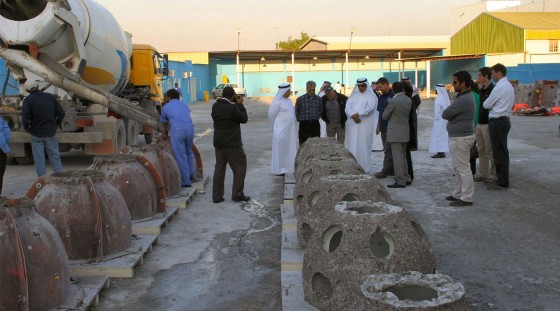
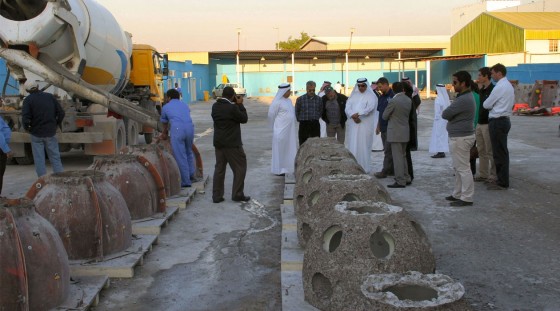
The patented “reef ball” system was selected as the basis of design, supplemented by structures reflecting Arabian architecture and the seabed’s natural topography. Reef balls are punctured orbs that settle into the sea floor, inviting rapid encrustacean by bivalves (clams, mussels), hydrozoa (jellyfish), and ascidians (sea squirts, inverterbrate filter feeders).
The fish won’t care about the artfulness of the structures, so long as they shelter tasty organisms for them to feed on. The larger “Arab windtowers” function as habitat for pelagic fish: species that live in higher levels of the water column, closer to the ocean surface. Some of the towers feature a reef ball for increased complexity: cardinalfishes are taking up residence in smaller nooks and crannies. Tower bases provide fish relief from midday sun and strong water currents. Special seabed units call “ridge modules” mimic natural seabed cracks: there’s a significant increase in harmour sitings.
The first reef complex (made up of 262 units) was deployed in March, and the target for placement of all ten reefs is October 2012.
There was a charitable angle to the project: people could “sponsor” individual reef balls, which were dressed with a plaque honoring the donors. Most of the structures were constructed in Bahrain by Reef Arabia using high strength marine-grade concrete.
Reef Arabia is the first authorized supplier of artificial reefs in the Gulf region. Developing a local industry to support reef protection bodes well for neighboring MENA and GCC nations: at a minimum, costs for structural components will be lower and more easily acquired. Environmental monitoring will continue for another year on a quarterly basis, but initial surveys show the project to be a success.