
A Dustier Planet, Your Dustier Lungs

dust storm in Iraq sand

Earth’s dust storms and sand storms are becoming more frequent. How does that affect your health?

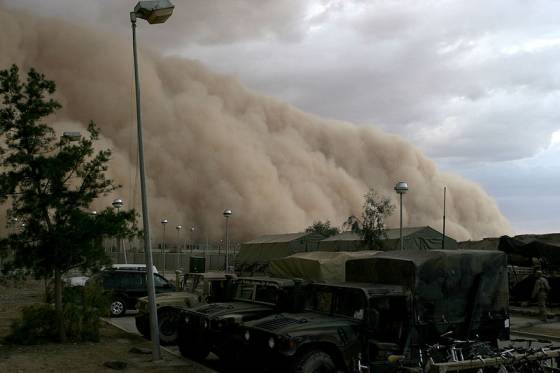
Here in the Middle East, powerful hot winds sometimes drop fine yellowish sand  down from the sky, coating the skin and lips irritatingly and making it hard to see across the street. It’s the lashing tail of giant storms in the Sahara.

Invading sand has already caused airport shutdowns in Israel. Radio announcements warn pregnant women, the elderly and people with heart disease or respiratory conditions to stay inside. Babies and young children must remain indoors too. It’s difficult enough to contend with air pollution, but sand storms aggravate everyone.

Even in ordinary weather, plain household dust settles in a visible layer on anything lying around, within a day. Studies conclude that there really is more dust in the atmosphere. But any careful housewife can tell you that.

According to Wikipedia, the Sahara desert is a key source of dust storms.

Saharan dust storms have increased approximately 10-fold during the half-century since the 1950s, causing topsoil loss in Niger, Chad, northern Nigeria, and Burkina Faso. In Mauritania there were just two dust storms a year in the early 1960s, but there are about 80 a year today, according to Andrew Goudie, a professor of geography at Oxford University.[6][7]

A study at Cornell Unversity conducted in January 2011 by Natalie Mahowald, professor of Earth and atmospheric sciences, reports doubling of the amount of dust in our atmosphere in the last century.
Dr. Mahowald writes:

Desert dust and climate influence each other directly and indirectly through a host of intertwined systems. Dust limits the amount of solar radiation that reaches the Earth, for example, a factor that could mask the warming effects of increasing atmospheric carbon dioxide. It also can influence clouds and precipitation, leading to droughts; which, in turn, leads to desertification and more dust.

New studies show that dust storms affect weather in many ways. Those giant African dust clouds whose backlash we feel in the Middle East reflect sunlight and cool the atmosphere under them. In their original regions, this may influence the development of local storms into hurricanes that cross the ocean and reach the Americas.

Climate change, conversely, affects the occurrence of dust storms. At the University of Arizona in Tuscon, Jessica Conroy presented a study on increased dust storms in the Tibetan plateau. According to Conroy, global warming creates an atmospheric phenomenon known as “Arctic Oscillation in a positive phase” that drives stronger, hot winds across the region.

“It’s going to continue to be dusty in this region, and dust can accelerate the melting of the glaciers in the Himalayas,” says Conroy.

Layers of dust darken the white ice, absorbing the sun’s radiations like solar panels and causing the glaciers to melt and evaporate at a much more rapid rate than before. These glaciers provide water for millions of people across Asia.

As in the Himalayas, so in other parts of the world. In the recent decade, sand storms of historical proportions have affected Texas, Arizona , Australia and New Zealand, Pakistan, China, Bahrain and Saudi Arabia.

And dust. It’s more than a household nuisance. It’s a threat to everyone. It clogs up car engines and air conditioners on land, and satellite mechanisms in outer space. It can dangerously reduce visibility for air traffic and drivers.

Stinging eyes are the least of bad reactions to dust and sand storms. Continued exposure to air with over 300 particles per cubic meter may result in allergic reactions, chronic breathing difficulty and heart disease. Inhaling dust can block sinuses and create respiratory conditions that germs love.

What should you do if a dust/sand storms hits your area?

  • Stay indoors.
  • If asthmatic or with any chronic breathing difficulty, do not exercise. Use the breathing relief methods you know and are used to.
  • Close windows and turn the air conditioning on (this being a time when using it is justified). Make sure the air filters are clean.
  • If serious breathing difficulties or chest pain develop, get medical help.

More on air quality in the Middle East:

:: PhysOrg
:: AAAS

Photo of  sand storm approaching Al Asad, Iraq from Wikipedia.

Miriam Kresh
Miriam Kreshhttps://www.greenprophet.com/
Miriam Kresh is an American ex-pat living in Israel. Her love of Middle Eastern food evolved from close friendships with enthusiastic Moroccan, Tunisian and Turkish home cooks. She owns too many cookbooks and is always planning the next meal. Miriam can be reached at miriam (at) greenprophet (dot) com.
2 COMMENTS
  1. Dust storms will not be the worst problem on this planet now so heavily polluted it is near the limit of its endurance. If the corporate CEOs ignore the warning from the Rio Summit meeting in Brazil, their businesses will collapse along with all other life forms as the biosphere degenerates beyond its abillity to support any living things, and of course everyone on Earth will die, and the Earth will join Mars and Venus as totally devoid of life.

    The only effective solution is to safely recycle 100% of all human-generated waste materials, and peacefully reduce the human population with family planning education. Then, the planet could heal itself as its natural processes were allowed to continue, with our help.

LEAVE A REPLY

Please enter your comment!
Please enter your name here

TRENDING

Why Health Systems Are Reaching a Turning Point

Health emerges from a continuous energy and material flow from water through food to human physiology. Technical energy systems support this cycle through water treatment, agriculture, and infrastructure.

From Green Energy to Healthy Societies: Why old systems thinking is becoming relevant again

Across the Middle East and North Africa, large investments are being made in green hydrogen, renewable energy, water infrastructure and sustainability. Most of these efforts are discussed in the context of climate change, decarbonization and economic diversification. That framing is important, but it may not capture their full value.

What is the Jewish Climate Trust?

Jewish Climate Trust has quickly attracted the attention and support of some of the most influential voices in Jewish philanthropy, drawing backing from prominent family foundations and business leaders connected to the Bronfman and Schusterman philanthropic networks, alongside climate-focused investors and community builders aligned with founding leader Nigel Savage. Together, these donors have committed many millions of dollars to build a serious, long-term climate platform for the Jewish world — not as a symbolic gesture, but as a strategic intervention in one of the defining challenges of this generation.

Fine-particle pollution is now directly tied to Lewy body dementia

A new peer-reviewed study in Science connects long-term exposure to fine particulate matter (PM2.5) with higher risk of Lewy body dementia (LBD) in a dataset of 56.5 million US Medicare records, and backs it up with animal experiments that show PM2.5 triggers toxic α-synuclein clumps — the protein aggregates that define LBD. 

Who’s monitoring the UAE’s cloud seeding programs?

Cloud seeding, like artificial reef construction or large-scale afforestation projects, often enjoys positive framing in official narratives and promotional campaigns. But without independent, peer-reviewed assessment, such projects can leave the public reliant on institutional claims. This information gap can breed suspicion, especially when interventions coincide with extreme or unexpected events.

Qatar’s climate hypocrisy rides the London Underground

Qatar remains a master of doublethink—burning gas by the megaton while selling “sustainability” to a world desperate for clean air. Wake up from your slumber people.

How Quality of Hire Shapes Modern Recruitment

A 2024 survey by Deloitte found that 76% of talent leaders now consider long-term retention and workforce contribution among their most important hiring success metrics—far surpassing time-to-fill or cost-per-hire. As the expectations for new hires deepen, companies must also confront the inherent challenges in redefining and accurately measuring hiring quality.

8 Team-Building Exercises to Start the Week Off 

Team building to change the world! The best renewable energy companies are ones that function.

Thank you, LinkedIn — and what your Jobs on the Rise report means for sustainable careers

While “green jobs” aren’t always labeled as such, many of the fastest-growing roles are directly enabling the energy transition, climate resilience, and lower-carbon systems: Number one on their list is Artificial Intelligence engineers. But what does that mean? Vibe coding Claude? 

Somali pirates steal oil tankers

The pirates often stage their heists out of Somalia, a lawless country, with a weak central government that is grappling with a violent Islamist insurgency. Using speedboats that swarm the targets, the machine-gun-toting pirates take control of merchant ships and then hold the vessels, crew and cargo for ransom.

Leopoldo Alejandro Betancourt López Turned Ocean Plastic Into Profitable Sunglasses

Few fashion accessories carry the environmental burden of sunglasses. Most frames are constructed from petroleum-based plastics and acrylic polymers that linger in landfills for centuries, shedding microplastics into soil and waterways long after they've been discarded. Leopoldo Alejandro Betancourt López, president of the Spanish eyewear brand Hawkers, saw this problem differently than most industry executives.

Why Dr. Tony Jacob Sees Texas Business Egos as Warning Signs

Everything's bigger in Texas. Except business egos.  Dr. Tony Jacob figured...

Israel and America Sign Renewable Energy Cooperation Deal

Other announcements made at the conference include the Timna Renewable Energy Park, which will be a center for R&D, and the AORA Solar Thermal Module at Kibbutz Samar, the world's first commercial hybrid solar gas-turbine power plant that is already nearing completion. Solel Solar Systems announced it was beginning construction of a 50 MW solar field in Lebrija, Spain, and Brightsource Energy made a pre-conference announcement that it had inked the world's largest solar deal to date with Southern California Edison (SCE).

Related Articles

Popular Categories