
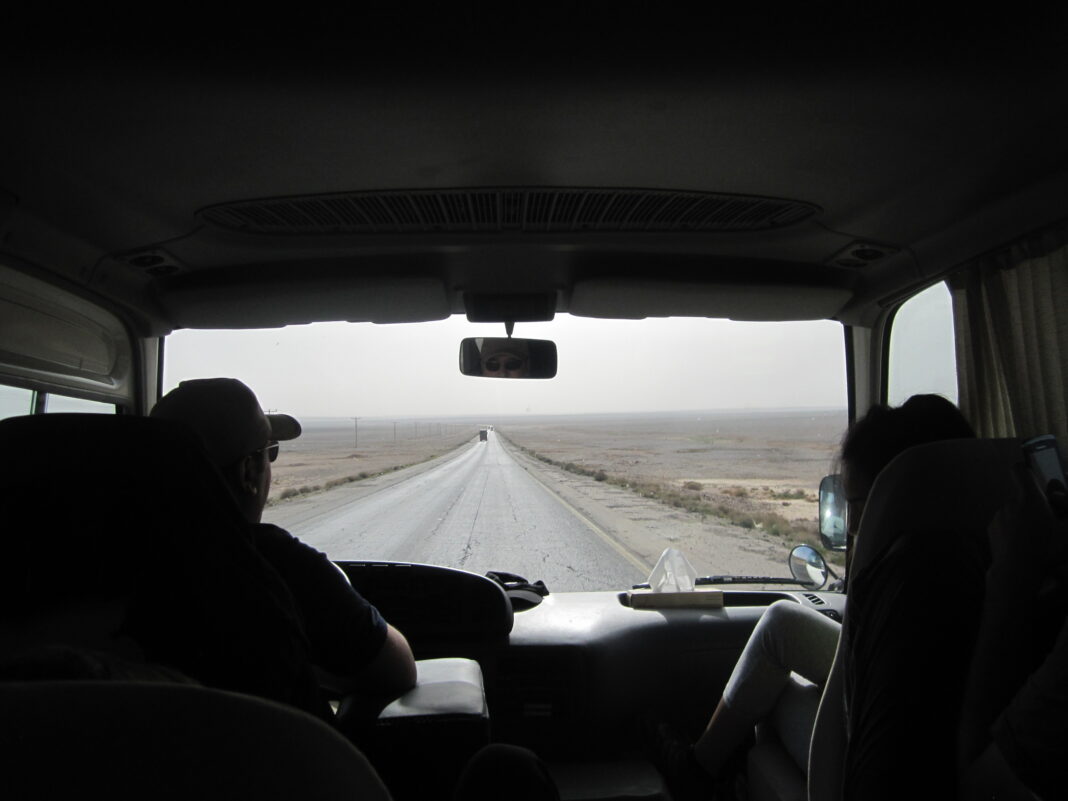

 Guests descend like locusts since I moved to Jordan. This time we decided to try something new.
Mass transit is not an option outside Amman city limits. Navigating a rental car through craggy mountains and city roads would test Evel Knievel. My visitors speak no Arabic, further limiting free travel. And most are past their hitchhiking and hostel “sell-by” date. So we devise a speed-date for traveling friends, with us at the wheel, through the Dead Sea, Wadi Rum, and Petra: a Jordanian trifecta. We know the hotel deals, the routes with the vistas, and cool places to grab a coffee or a local meal. Satisfaction delivered every time. Too many times.
Easter break loomed and Hotel Balbo was empty; what to do that’s new? I itch for something different. Wild Jordan tops the list of travel alternatives. We head over to see what appeals.
Wild Jordan (WJ) is the business arm of the Royal Society for the Conservation of Nature (RSCN), tasked with developing socioeconomic programs in Jordan’s varied nature reserves. They’ve got eco-tourism facilities in four protected areas: Dana Biosphere, Azraq Wetland, Mujib Nature Reserve, and Ajloun Forest. Each reserve offers widely different landscapes, from mountains to forests to desert wetlands. Tourism is controlled; visitors access only a fraction of total reserve areas. While the restrictions aren’t really noticeable, this practice keeps protected areas undisturbed. Wildlife and ecosystems can flourish.
Their headquarters is an attractive outpost perched clifftop overlooking downtown Amman. The “green” building holds an eco-shop and café and with excellent Citadel views. Eco-tours are presented in a low-key way. Homemade photo albums showing each site rest on a funky reception counter; poured concrete on a bed of crushed aluminum cans.
A friendly woman in a hot pink hijab answers our questions, and we make our selection, hand over some dinar. She prints out directions to the meeting point, an itinerary, and a tip sheet of what to bring.
We pick Azraq, a bike tour through a wetland oasis in the Eastern Desert famous for migrating birds. The bike ride pulls us in (hey, I bowled once just so I could wear the colorful rental shoes).
The day of the trip arrives.
We drive to RSCN headquarters in Jubeiha. It’s 8 am. People arrive and mill about the courtyard: a pair of American teachers from an Amman international school; three giggly Jordanian women; four serious Spaniards and a Columbian engineer on a break from his studies in Saudi Arabia. Five more arrive as the minibus revs its engine.
At 9 am we’re off. A few of the late arrivals turn out to be Wild Jordan staff; a high energy young woman is our guide. They walk us through the itinerary, tell jokes, and as the desert unfolds on the drive south east, we fall into dreamy quietude. We arrive at 11 am at Azraq eco-lodge, a converted 1940’s British field hospital, an unusual base for exploration.
A low complex of concrete buildings frames a central patio. A few dozen mountain bikes lean against the walls. We test drive them, adjust our helmets, and tuck water in our back packs. Here we go.
Fifteen minutes later we wheel up to a small nature center. The Azraq Wetlands Reserve. It’s super sunny and hot. I’ve already knocked off my water.
We meet Ahmed, our local guide and Azraq native. He leads us through an exhibit of the wetlands’ ecological history. Azraq mean “blue” in Arabic, a cruel reminder of the watershed that used cover this terrain. We read about long-vanished species of animals and plants. Learn how the once vibrant wetlands were tapped dry by thirsty Amman politicos. It’s “Chinatown”, Middle East style. Stroll outside along a lovely wooden path. Sidestep girl scouts and lone photographers.
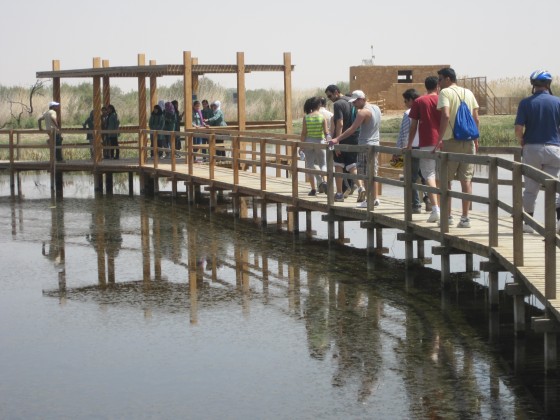
Ahmed points to a dusty patch of grass, tells how he learned to swim in this spot that once held 10 meter deep pools. Says his kids have to learn to swim at an indoor pool 100km away.
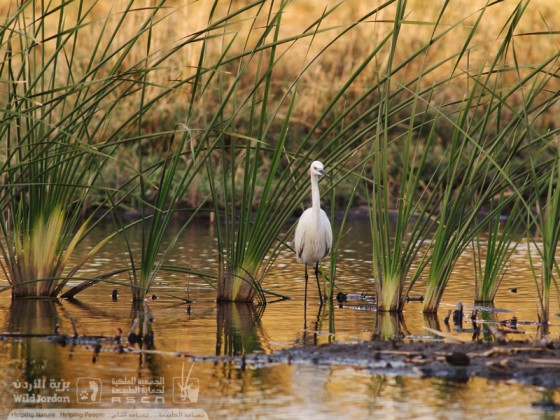
We sit in wonderfully cool shade, peer at waterfowl from a viewing hut. Ahmed jumps in his van and we’re back on our bikes; it’s noon. He’ll follow us all day – bringing up the rear, dispensing cold water and giving short informational speeches at every stop along the route.

That first leg was brutal. I had an epic head cold, and pedaling through soft sands (formerly wetland) wasn’t easy. We cross the sandpits of Al Qa’a, formerly mudflats, and climb a rock outcropping where the guide tells how ancient peoples used to trap wolves, using the then-lush swamp to keep the predators from killing their livestock. An old Brit in the group asks why they didn’t just steal the wolves’ bikes. A big laugh as the bad joke gets translated around. I chew sinus meds and marvel at everyone smoking.
Our guide stops us about every half hour at another point of interest. There’s an old Druze village, and the ruins of Qasr-al-Shaér. We bike in a wide arc around the former wetlands. Cross a motorway where overhead signs offer routes to Iraq or Syria. Thought bubble over my head reads, “You’re not in Kansas anymore.”
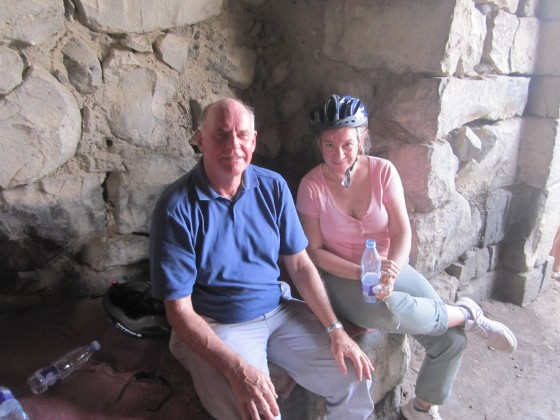
After 2 PM we arrive at Azraq Castle where we de-bike again for water refills and a self-guided tour. Within an hour we’re in a local house for lunch. Did food ever taste so good? Mountains of savory rice with tender grilled chicken, tomato and cucumber salads topped with chilled yogurt and coriander. Vats of chilled water, Frisbee sized flatbread.
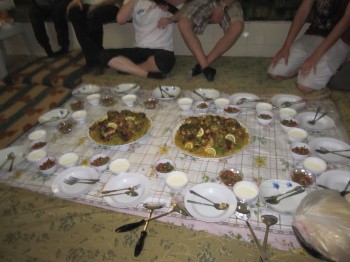
Sated, we roll outdoors; slap on our sandy sneakers, and sit beneath a grapevine drinking sugary minted tea. More cigarettes: how do they do it?
We re-introduce sore butts to bike saddles, and tackle the last leg back to the lodge. By 5 PM we’re on the air-conditioned minibus, where the staff grab the microphone and sing us back to Amman.
Just like the flyer said, the trip took about 5 hours and we covered over 22 km.
Wild Jordan’s eco-tourism operations are making significant contributions to the development of Jordan’s tourism industry. Each year 50,000 tourists visit RSCN sites. Revenues contribute over 45% of annual conservation costs and supported hundreds of local community jobs.
Craving adventure but dreading the planning? Want to experience nature and history, touch a local community, see its traditions, and share its food?
Give your wallet a vacation too. The Azraq experience cost less than $40, all inclusive. About what I’d drop on lunch at one of the five-star joints along the Dead Sea.
If you’re headed this way, do check out Wild Jordan. They do all the work, and you’ll have a priceless experience that keeps on giving.
Image of Waterfowl by Wild Jordan, all others by Laurie Balbo


When are you next in Jordan? Would be great to meet up –
Sounds wonderful Laurie. Thanks for this lovely post and kudos for ploughing through the day with that epic head cold.