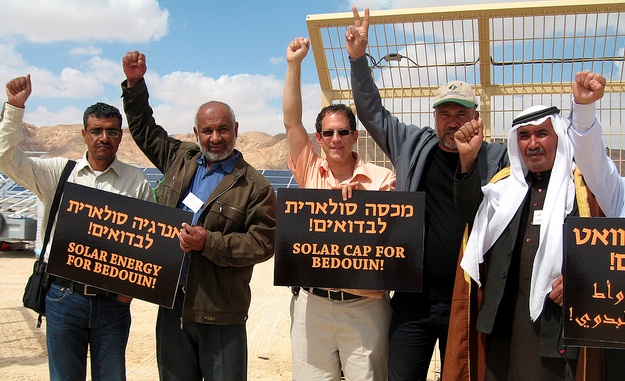
Bedouin Solar Power Activate!

bedouin solar powerArava Power in Israel is fighting so Bedouin get a fair share of feed-in tariffs in Israel. Backed by Siemens Arava stands to benefit too.

“Sixty percent of the country happens to be desert, and 30 percent of the [desert] inhabitants happen to be Bedouin,” says Yosef Abramowitz, president of Arava Power Company in Israel. Abramowitz sees his solar energy company’s success of installing solar units in the desert as intertwined with the people who know Israel’s deserts best: the Israeli Bedouin.

He is fighting regulatory bodies on behalf of the Bedouin, to make sure they get their share of the sun. Attractive feed-in tariffs in Israel, with state guarantees on solar energy investments for new solar power plants, have created a small windfall of opportunities for local installers, as well as local and foreign investors. Arava seeks to lease Bedouin land to install solar power plants, with financial backing from companies like Siemens.

Step-by-step progress is being made: In the summer, the Southern Regional Planning and Building Committee of the Israeli Ministry of the Interior approved plans for a photovoltaic (PV) solar installation next to the Israeli Bedouin community of Tarabin. This $30 million joint project between the Tarabin tribe and Arava would be the first to be approved on Bedouin land.

Pushing through red tape

Arava Power recently installed a solar power plant of almost five megawatts at Kibbutz Ketura. A series of additional solar installations in the same area are planned as the company joins other industrious solar power plant entrepreneurs.

But getting the rubber stamp from the last regulatory body to go ahead with building the solar field at Tarabin is not proving easy. And in the meantime, feed-in tariffs, which cap at 300 megawatts, are getting used up.

Arava Power is appealing to the government to provide special caps to the Bedouin, a once entirely nomadic people now in transition. Abramowitz says Arava is ready to invest $3 billion in developing solar fields if this happens.

“Billions and billions of dollars will be invested in solar installations in the south of the country, and we have a moral obligation to ensure that the solar benefits of the state of Israel will be shared by all the citizens of the desert,” says Abramowitz, pointing out that allowing the Bedouin to derive a guaranteed income from an Arava-built plant would ease conditions caused by high unemployment.

The idea started with Lucy Michaels, a PhD student at the Arava Institute for Environmental Studies. She suggested that the solar energy business in Israel also benefit the Bedouin people, who tend to be socially, culturally, politically and economically marginalized from the Israeli majority.

“We didn’t start with a business model,” Abramowitz tells ISRAEL21c. “We started with a mission. We strove to maintain our mission focus. In the early years we expanded that mission to include economic justice.”

Tea, kisses and darned socks

However, complicated issues have emerged about the status of Bedouin on land that they claim without paperwork or formal deeds. According to Abramowitz, involving Bedouins in the solar industry can be a catalyst for resolving these land ownership claims, which is a government priority.

A Bedouin staff currently manages the planning stages for solar energy leasing agreements with Arava, signed at first over tea, handshakes and kisses — the Bedouin way. Every week when Abramowitz goes to visit the Bedouins he has to make sure his socks are clean with no holes, as it’s customary to remove your shoes while entering the host’s tent. “We choose families and tribes very carefully, and we are dealing with honorable people, people with influence,” he says. “A Bedouin word is their word.”

The first of five anticipated deals, the Tarabin project would be an eight-megawatt, 37-acre installation. The eventual full 30 megawatts from additional projects would go to the national grid, and in theory would be quickly used by the Bedouin people of Tarabin. Once a license is granted by the Public Utilities Authority, the first plant could be up and running in six months.

Community leader Haj Mousa Tarabin said: “I am glad there are people who are concerned and are helping the Bedouin improve their lifestyle on the economic level as well as with creating various sources of income.”

I wrote this story for ISRAEL21c – www.israel21c.org and it is reprinted here with permission.

Karin Kloosterman
Karin Kloostermanhttp://www.greenprophet.com
Karin Kloosterman is an award-winning journalist, innovation strategist, and founder of Green Prophet, one of the Middle East’s pioneering sustainability platforms. She has ranked in the Top 10 of Verizon innovation competitions, participated in NASA-linked challenges, and spoken worldwide on climate, food security, and future resilience. With an IoT technology patent, features in Canada’s National Post, and leadership inside teams building next-generation agricultural and planetary systems — including Mars-farming concepts — Karin operates at the intersection of storytelling, science, and systems change. She doesn’t report on the future – she helps design it. Reach out directly to [email protected]

LEAVE A REPLY

Please enter your comment!
Please enter your name here

TRENDING

Earth building with Dead Sea salt bricks

Researchers develop a brick made largely from recycled Dead Sea salt—offering a potential alternative to carbon-intensive cement.

Farm To Table Israel Connects People To The Land

Farm To Table Israel is transforming the traditional dining experience into a hands-on journey.

Remilk makes cloned milk so cows don’t need to suffer and it’s hormone-free

This week, Israel’s precision-fermentation milk from Remilk is finally appearing on supermarket shelves. Staff members have been posting photos in Hebrew, smiling, tasting, and clearly enjoying the moment — not because it’s science fiction, but because it tastes like the real thing.

An Army of Healers Wins the 2025 IIE Goldberg Prize for Peace in the Middle East

In a region more accustomed to headlines of loss than of listening, the Institute of International Education (IIE) has chosen to honor something quietly radical: healing. The 2025 Victor J. Goldberg Prize for Peace in the Middle East has been awarded to Nitsan Joy Gordon and Jawdat Lajon Kasab, the co-founders of the Army of Healers, for building spaces where Israelis and Palestinians — Jews, Muslims, Christians, Druze, and Bedouins — can grieve, speak, and rebuild trust together.

Peace hospital opens between Jordan and Israel

The proposed medical centre, described by Emek HaMaayanot Regional Council head Itamar Matiash as “a centre for cancer treatment, so that people from Jordan or further away could come and receive treatment,” would become the flagship of a wider cluster of medical, academic and innovation-based services planned for the Israeli half of the zone.

6 Payment Processors With the Fastest Onboarding for SMBs

Get your SMB up and running fast with these 6 payment processors. Compare the quickest onboarding options to start accepting customer payments without delay.

Qatar’s climate hypocrisy rides the London Underground

Qatar remains a master of doublethink—burning gas by the megaton while selling “sustainability” to a world desperate for clean air. Wake up from your slumber people.

How Quality of Hire Shapes Modern Recruitment

A 2024 survey by Deloitte found that 76% of talent leaders now consider long-term retention and workforce contribution among their most important hiring success metrics—far surpassing time-to-fill or cost-per-hire. As the expectations for new hires deepen, companies must also confront the inherent challenges in redefining and accurately measuring hiring quality.

8 Team-Building Exercises to Start the Week Off 

Team building to change the world! The best renewable energy companies are ones that function.

Thank you, LinkedIn — and what your Jobs on the Rise report means for sustainable careers

While “green jobs” aren’t always labeled as such, many of the fastest-growing roles are directly enabling the energy transition, climate resilience, and lower-carbon systems: Number one on their list is Artificial Intelligence engineers. But what does that mean? Vibe coding Claude? 

Somali pirates steal oil tankers

The pirates often stage their heists out of Somalia, a lawless country, with a weak central government that is grappling with a violent Islamist insurgency. Using speedboats that swarm the targets, the machine-gun-toting pirates take control of merchant ships and then hold the vessels, crew and cargo for ransom.

Leopoldo Alejandro Betancourt López Turned Ocean Plastic Into Profitable Sunglasses

Few fashion accessories carry the environmental burden of sunglasses. Most frames are constructed from petroleum-based plastics and acrylic polymers that linger in landfills for centuries, shedding microplastics into soil and waterways long after they've been discarded. Leopoldo Alejandro Betancourt López, president of the Spanish eyewear brand Hawkers, saw this problem differently than most industry executives.

Why Dr. Tony Jacob Sees Texas Business Egos as Warning Signs

Everything's bigger in Texas. Except business egos.  Dr. Tony Jacob figured...

Related Articles

Popular Categories