Turkish Village Goes Off The Grid With A Wind Turbine

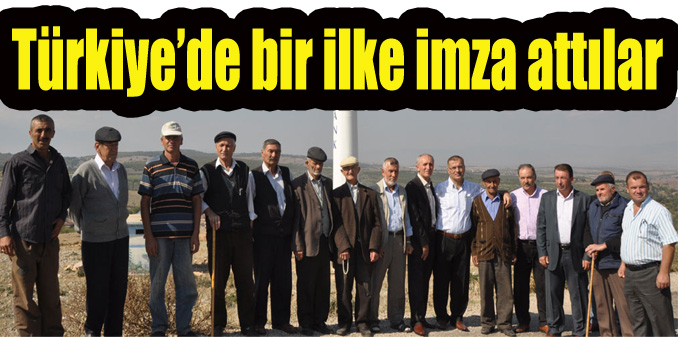
turkey wind energy“They’re blazing a new path in Turkey” reads the headline over this photo of Akbıyık villagers standing in front of their new wind turbine.

The lights in Akbıyık went out one and a half years ago, when the Turkish Electricity Distribution Company cut off the village’s electricity because of outstanding utility bills that amounted to TRY 33,000 ($18,000). At that point, the villagers faced a choice: pay off the debt and get back on the national power grid, or find a new energy source that they could harness and control on their own.

They chose to stay off the grid and switch to wind power, securing their energy future and making them one of the greenest villages in Turkey.

A carefully researched decision

Akbıyık’s residents and village headman researched various forms of renewable energy before settling on wind power. They proposed a TRY 160,000 wind turbine project to the government of their province, Bursa. The villagers contributed TRY 20,000, but the majority of the initial costs were paid by the Bursa Provincial Administration.

With a 50 KW capacity, the turbine won’t break any power generation records for wind energy. But it has already enabled Akbıyık to pay off its electric debts, and it is being used to power a water pump that will allow the village to remain completely independent from state utility providers.

Setting the pace for the government

The turbine began to spin several days before Turkey’s government announced an ambitious new National Wind Energy System, in which Turkey will begin producing and designing wind turbines itself rather than relying on foreign parts and engineering expertise.

Although the turbine in Akbıyık is not 100% local to Turkey, the village’s decision to commission it indicates that regular Turks are far ahead of their government when it comes to implementing sustainable energy solutions.

Part of Turkey’s eco-friendly grassroots tradition

Unlike other wind turbines in Turkey, which are owned by private companies, Akbıyık’s turbine belongs completely to the villagers, according to Kemal Demirel, secretary general of Bursa’s provincial government. Demirel expects similar projects to be implemented in other Bursa villages in the future.

Grassroots efforts to produce energy sustainably have a proud history in Turkey. Last year, a mosque in the village of Büyükeceli installed photovoltaic panels on its roof to protest a nuclear power plant that government officials were trying to build in the area. The country’s first Alternative Energy Races were held in Izmir this year, showcasing a range of solar- and hydrogen-powered vehicles built by teams of Turkish university students and professors.

:: Hürriyet Daily News

Read more about renewable energy in Turkey:

Local Wind Energy Industry Emerges In Turkey

Renewable-Energy Cars Heat Up In Turkey

Mosque in Turkey Goes Solar

Image via DaDDiRi

With a 50 KW capacity, the turbine won’t break any power generation records for wind energy.
Julia Harte
Julia Hartehttp://www.greenprophet.com
Julia spent her childhood summers in a remote research station in the Rocky Mountains of Colorado, helping her father with a 25-year-old experiment in which he simulated global warming over a patch of alpine meadow. When not measuring plant species diversity or carbon flux in the soil, she could be found scampering around the forests and finding snowbanks to slide down. Now she is a freelance journalist living in Istanbul, where her passion for the environment intersects with her interest in Turkish politics and grassroots culture. She also writes about Turkish climate and energy policy for Solve Climate News.
1 COMMENT
  1. What an excellent initiative. This is about taking personal and communal responsibility. I love that they decided they couldn’t trust their government to provide reasonably priced (or responsible) power, so they RESEARCHED how to find their own and came up with the best solution for THEM. Pardon my caps, but this is very exciting news. Thank you Julia.

Comments are closed.

Hot this week

How Renewable Energy is Revolutionizing the Way We Power Our World

Solar has become the star of the transition thanks to modular hardware and straightforward installation. It fits dense cities and remote towns alike. Many companies are turning to rooftop arrays and carport systems - and exploring commercial solar installation as a practical way to lock in future savings.

How does one start prepping?

Faced with an extreme winter storm this year, Americans wonder how to be prepared for catastrophe. Miriam has lived through wars in the Middle East - so she's prepared on giving you a guide to prepping.

Fishermen sue tire manufacturers on behalf of the salmon

A federal trial in San Francisco has brought US tire manufacturers, fishing groups, and environmental scientists into court over a chemical most drivers have never heard of — but which scientists say may be silently reshaping aquatic ecosystems.

Listening to Water: Tarek Atoui’s Next Work for Tate Modern

Born in Beirut, Lebanon in 1980 and now living in Paris, Atoui has spent years building instruments that don’t sit comfortably in concert halls. Many of them involve water, glass, and ceramics — materials that react to sound instead of simply producing it.

Leading Through a Dual-Energy Transition: Balancing Decarbonisation with Energy Security

Experience in one area of the energy industry isn't enough to guarantee readiness across all the others. That's where a structured program like an MBA in energy can come in. Today's advanced curricula explore energy economics, finance, policy, and strategic management alongside the technical subjects. And when pursuing an energy MBA online, professionals can skill up and retrain without having to step out of the labor market -- an important perk at a time when skilled professionals are already in short supply.

Topics

How Renewable Energy is Revolutionizing the Way We Power Our World

Solar has become the star of the transition thanks to modular hardware and straightforward installation. It fits dense cities and remote towns alike. Many companies are turning to rooftop arrays and carport systems - and exploring commercial solar installation as a practical way to lock in future savings.

How does one start prepping?

Faced with an extreme winter storm this year, Americans wonder how to be prepared for catastrophe. Miriam has lived through wars in the Middle East - so she's prepared on giving you a guide to prepping.

Fishermen sue tire manufacturers on behalf of the salmon

A federal trial in San Francisco has brought US tire manufacturers, fishing groups, and environmental scientists into court over a chemical most drivers have never heard of — but which scientists say may be silently reshaping aquatic ecosystems.

Listening to Water: Tarek Atoui’s Next Work for Tate Modern

Born in Beirut, Lebanon in 1980 and now living in Paris, Atoui has spent years building instruments that don’t sit comfortably in concert halls. Many of them involve water, glass, and ceramics — materials that react to sound instead of simply producing it.

Leading Through a Dual-Energy Transition: Balancing Decarbonisation with Energy Security

Experience in one area of the energy industry isn't enough to guarantee readiness across all the others. That's where a structured program like an MBA in energy can come in. Today's advanced curricula explore energy economics, finance, policy, and strategic management alongside the technical subjects. And when pursuing an energy MBA online, professionals can skill up and retrain without having to step out of the labor market -- an important perk at a time when skilled professionals are already in short supply.

From Green Energy to Healthy Societies: Why old systems thinking is becoming relevant again

Across the Middle East and North Africa, large investments are being made in green hydrogen, renewable energy, water infrastructure and sustainability. Most of these efforts are discussed in the context of climate change, decarbonization and economic diversification. That framing is important, but it may not capture their full value.

We saw peace – an interreligious encounter deep in our eyes

They came from Israel, Palestine, Jordan, Iraq, Yemen, Morocco, Tunisia, Lebanon, Egypt… There are Sunni Muslims, Shiite Muslims, Jews (Orthodox and Reform), Orthodox Christians, Coptic Christians, Protestant Christians, Druze, Baha'is, a Scientologist.

Can biochar reduce ‘Forever Chemicals’ in food if it’s used in farms?

Biochar is produced by heating organic material in a low-oxygen environment so it does not burn. This process, known as pyrolysis, transforms plant matter into a stable, carbon-rich material.

Related Articles

Popular Categories